
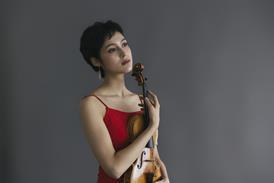
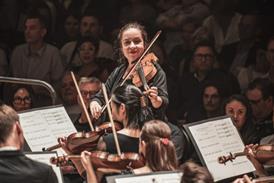




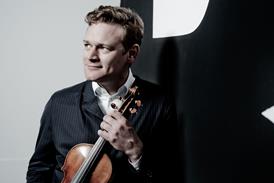






Featuring Njioma Grevious and Tai Murray, Curtis Stewart’s new violin duo explores identity, genre and collaboration as part of Sphinx Virtuosi’s American Mirror.
Discover more Featured Stories like this in The Strad Playing Hub
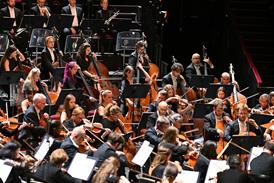
The Sphinx Virtuosi, the flagship ensemble of the Detroit-based Sphinx Organization, has long been a driving force in reshaping American classical music. Comprising some of the nation’s finest Black and Latinx musicians, the chamber orchestra champions artistic excellence alongside a mission of inclusion. Their latest release, American Mirror, issued digitally on Deutsche Grammophon, showcases this vision through a wide-ranging programme of works by composers including Curtis Stewart, Quenton Blache, Derrick Skye, Juantio Becenti, Andrea Casarrubios and Coleridge-Taylor Perkinson – each reflecting diverse cultural identities and musical traditions.
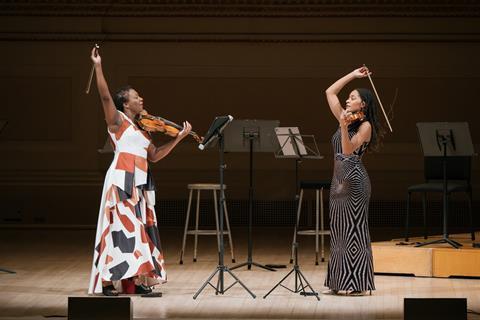
Among the album’s standout commissions is Invention #1: Double Down, which Curtis Stewart composed in 2024 for violinists Tai Murray and Njioma Grevious, who have performed the piece on tour at Carnegie Hall. The title of this brilliant scherzo nods to Bach’s two-part inventions while also referencing the ‘double-down’ bow stroke – a technique that adds rhythmic punch – as well as the heightened virtuosity found in violin duos by Wieniawski and Prokofiev. It was written to reflect not only the individual artistry of its performers but also the mission of diversity and artistic empowerment at the heart of the Sphinx ethos.
Njioma Grevious and Tai Murray joined Curtis Stewart – the Sphinx Composer in Residence for the 2024–25 season – to reflect on the piece and on what it means to make space for new stories within the classical tradition.
You composed Invention #1: Double Down specifically for Tai Murray and Njioma Grevious. What was it about their playing or artistic personalities that shaped how you wrote the piece?
Curtis Stewart: I got on the phone with Njioma at the start of the conception process for the work and asked what she connected with musically growing up. She reflected on her classical training, listening to Gospel music, as well as iconic jazz artists like Sarah Vaughan and Cleo Laine.
I asked Tai and she said: ‘Just be your full self!’ I used to play violin duos with my mother, Elektra Kurtis Stewart, so I also had to honour our connection. What came out is somewhere between an R&B shout, Wieniawski, Prokofiev, Bartók, some contrapuntal funk and an American classical celebration.
What’s behind the word play in the title?
Curtis Stewart: The concept popped into my mind during a taxi ride after a long flight from New York to Tucson, Arizona. I was imagining the energy of the double down-bow stroke I didn’t know of a violin duo that really explored that technical element. It became the hammerstroke of the work, marking sections and generating material for interplay. Many composers hesitate to write something too difficult, but this piece doubles down on the virtuosity. It also taps into the deep roots of my musical heritage, committing to where I come from – even in the challenging cultural times we face.
The piece also plays with the language of virtuosity – referencing everything from Bach to gospel riffs to funk. How did you envision Tai Murray and Njioma Grevious bringing this hybrid voice to life?
Curtis Stewart: I envisioned them tearing the piece up! I couldn’t have imagined how amazingly they did it.
Invention #1: Double Down was written with your specific voices in mind. You’ve both performed the piece on tour, including at Carnegie Hall. What are some of the challenges or surprises in playing this music together – or in finding your shared voice through Curtis Stewart’s writing?
Njioma Grevious: I love the interplay between the violins that Curtis created! It’s edgy and keeps us on our toes. The process wasn’t so much a challenge as it was about being open to experimentation. Tai and I are used to that kind of work. We shared our interpretations of certain passages, eventually coming eye-to-eye on various elements and ideas.
One thing is for sure: we have never practised or performed the piece exactly the same way – no way. We’re both comfortable letting go in the moment and reacting to what’s happening. So many times, after the last note – whether in rehearsal or on stage – it felt like we had just played it for the first time. I remember a lot of smiles, and us just not being able to contain our joy.
Tai Murray: The surprise for me is that this music never felt foreign to me at all. The two violin parts fit together seamlessly. Curtis has constructed the duo in a way that feels completely natural – and yet wildly unpredictable.
The two violin parts fit together seamlessly. Curtis has constructed the duo in a way that feels completely natural – and yet wildly unpredictable.
Curtis describes the piece as moving between ‘wild bariolage and songful passage work, funk grooves and thrown bow strokes’. How do you approach the balance between precision and abandon in a work like this?
Njioma Grevious: This piece is full of pyrotechnics, quick mood changes and a range of violin techniques required to bring it to life. The basis was our skills and experience as violinists, plus the time we put in learning the piece that allowed us to focus on finding the groove.
Tai Murray: I am a fan of total musical uninhibitedness. The precision is found in the one hundred percent commitment to musical intent.
This album reimagines American classical music through a wide lens – heritage, genre, storytelling, identity. As artists, how does that kind of musical openness shape your own sense of what’s possible on your instrument?
Njioma Grevious: As a classical violinist, I perform works mostly from the standard repertoire. So it’s great to expand the scope of what I play to include stories, moods and themes like the ones Curtis presented to us – things that resonate deeply with me as an African-American musician. The violin has a great and long expressive history across many genres, including the blending of genres found in Invention #1. I love the expressive possibilities of the violin!
Tai Murray: Genre acceptance – whatever the genre – makes it easier to build interpretations. Rules are in place to offer comfort, but breaking musical structures achieves that ecstatic place.
What do you hope other violinists take away from Invention #1: Double Down and this kind of cross-genre, commission-based collaboration?
Njioma Grevious: I hope that other violinists, musicians and young composers take away a commitment to fearlessness and creativity.
Sphinx Virtuosi champions bold and diverse musical voices. What does it mean for you – artistically or personally – to be part of an album like American Mirror, which explores so many facets of American identity through sound?
Njioma Grevious: Being part of Sphinx, the Sphinx Virtuosi and the American Mirror album is absolutely invaluable. It’s like a lifeline – hard to put into words. I feel pride, inspiration and the thrill of togetherness from my fellow virtuosi and the Sphinx Organization, which is such an essential platform for developing and showcasing Black and Latin artists and achievements through sound.
Tai Murray: Bringing music to the world is a calling, and this album supports that reality. Everyone involved in American Mirror is speaking a language that is uniquely cultural and already universally translated.
American Mirror is available online from Deutsche Grammophon from 29 August.
Read: Violinist Curtis Stewart on making music: by serving others, I am serving myself
Listen: The Strad Podcast #77: 2023 Sphinx Competition winner Njioma Grevious
Read: Masterclass: Tai Murray on Beethoven’s ‘Triple’ Concerto Part 1
Read: 2025 Sphinx Medal of Excellence recipients honoured
Discover more Featured Stories like this in The Strad Playing Hub












No comments yet