

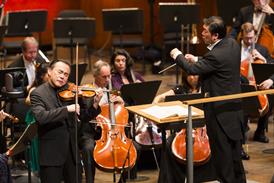
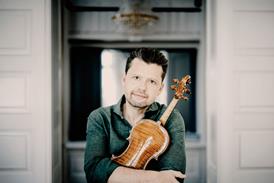
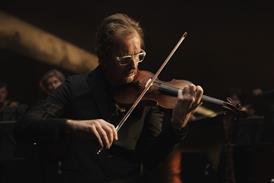


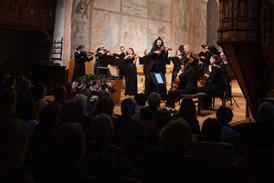





Itzhak Perlman and Peter Oundjian talk about their friendship and shared musical values ahead of their reunion on stage with the Colorado Symphony at Carnegie Hall.
Read more Featured Stories like this in The Strad Playing Hub
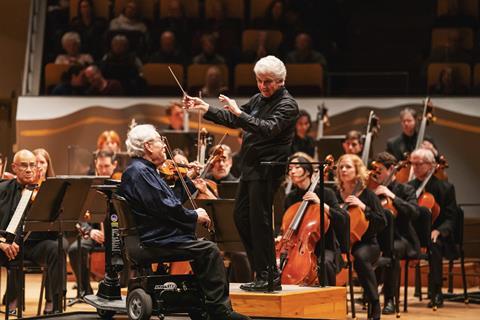
A few weeks before their reunion on stage at Carnegie Hall with the Colorado Symphony, Itzhak Perlman and Peter Oundjian reflected on a relationship shaped over many decades. They spoke from different locations – Perlman from Florida, where he was leading this year’s edition of the Perlman Music Program, and Oundjian from his home in Connecticut – ahead of their joint appearance on 1 February, which marks both the orchestra’s first performance at Carnegie Hall in nearly half a century and a return to shared music-making for two artists whose connection began in mentorship and has evolved into enduring friendship.
Oundjian, who built an international reputation as a violinist with the Tokyo String Quartet before turning to conducting, became the Colorado Symphony’s principal conductor in 2022 and has since assumed the role of music director.
The connection between the two musicians began when Oundjian was growing up in south London and heard Perlman play live for the first time as a boy – an experience he has often described as transformative. Formal study followed several years later, and what began as a mentor–student relationship gradually evolved into a friendship grounded in shared musical values. Over time, their paths have intersected at key moments through teaching, collaboration and parallel careers.
The Carnegie Hall programme surveys the breadth of Perlman’s artistry while also reflecting the Colorado Symphony’s artistic profile under Oundjian’s leadership. Their conversation with US correspondent Thomas May unfolded with easy humour and an unforced warmth as they reflected on music, teaching and trust.
Peter, this story begins with you as a youngster in London. You’ve described the first time you heard Itzhak play – in the Franck Sonata – as a revelation. When you look back on that experience now, what stays with you?
Peter Oundjian: There are moments for all of us that feel like a reawakening – a sudden understanding of the power of music. I felt that when Itzhak came on stage and began to play that evening. We were all entranced, but it was that first phrase of the Franck that felt especially magical and otherworldly. It’s hard to imagine a world in which that music didn’t exist.
Listening to those opening phrases, it was as if Itzhak was playing his violin and everyone in the hall was singing with it. I remember thinking: if I could ever do anything half as good as that, I would be happy. I went backstage to meet him – he was probably 22 by then; I was 12.
Itzhak Perlman: Now that I’m 80, my next recital in Sarasota will include the Franck Sonata. So clearly, everything has changed. [laughter]
After that initial epiphany, did you become obsessed with every recording Itzhak released?
Peter Oundjian: Absolutely. These were the days of the great LPs – beautiful objects in themselves. More importantly, Itzhak impressed upon me the importance of practising. He says it to everyone, seeming to be joking – ‘Remember to practise’ – but it’s not just a line. It’s the most important advice there is. None of us gets anywhere without it. We have some colleagues who used to pretend they never practised, but that’s rubbish.
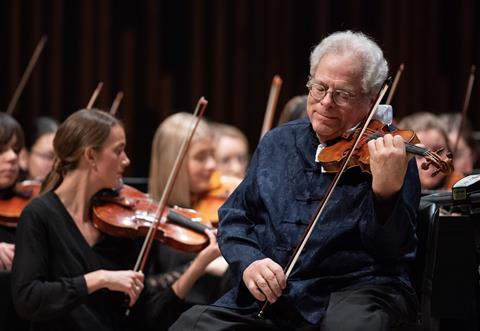
Itzhak Perlman: The older I get, the more I realise how much practising helps. It really does. You’ve got to keep the old fingers going – it sounds funny, but it’s true.
Itzhak, looking back on your role as a mentor, what strikes you as having changed over the years – and what has remained constant?
Itzhak Perlman: With my wife Toby, I started the Perlman Music Program more than 30 years ago, working with exceptionally gifted young string players. What hasn’t changed is how valuable teaching is to an artist.
I love seeing students grow over time – say they start at 13, then look back at 18 and recognise the progress they’ve made. What matters most to me is when they say the experience changed their life. That means more than being able to say ‘now I’m a terrific fiddle player’.
Peter, I’m sure that you must have experienced some of our alums in the orchestras that you’ve conducted?
Peter Oundjian: Absolutely. In fact, the last two violin appointments we made at the Colorado Symphony – principal second and assistant concertmaster – were both PMP graduates.
At some point your relationship moved beyond teacher and student and became a friendship. Do either of you remember when that shift happened?
Itzhak Perlman [mock serious]: Peter, you answer that. I don’t think it ever happened.
Peter Oundjian: In 2003, when I had just been appointed music director of the Toronto Symphony, Itzhak came to play the Mozart G major Concerto. We were staying at the same hotel, on the eighth floor. At three in the morning, the fire alarm went off. Incredibly, there was no lift, so I ran to his room and asked whether I should carry him downstairs or investigate.
He told me to first find out what was happening. It turned out to be a false alarm, and when I rushed back up – imagining him in a panic – he greeted me with a fantastically funny joke. Somewhere in that moment, the relationship shifted.
Another time, years later, I had foolishly agreed to play the Bach Double Concerto with him and found my hand in terrible shape. I thought I had made the most terrible mistake. I remember calling Itzhak while I was on a long drive, in real despair. He spent maybe 45 minutes on the phone with me, calmly talking me through it, saying, ‘Let’s think about this carefully. I think you can do it’.
It was 45 minutes of the most beautiful, calming advice. That was real mentorship. By then I was maybe 55 years old – and he was still my teacher. Once a teacher, always a teacher.
Itzhak Perlman: By the way, I sent you a bill for that phone call. You never paid it.
[laughter]
Peter Oundjian: I’ll settle it after the Dvořák Romance – depending on how it goes.
Itzhak, how does Peter’s chamber music background influence the way you make music together?
Itzhak Perlman: Chamber music involves so many things that are essential for making music – breathing, listening and feeling that whatever you do, there is some sort of unity with another person, or a group. That’s why playing with Peter has always been a cinch. I don’t have to worry about anything. I know he’s going to be with me, because we basically speak the same way.
Peter, when you moved from the Tokyo String Quartet to the podium, how did what you learnt from Itzhak guide that transformation?
Peter Oundjian: Probably the most important thing I learnt from the podium was how powerful words are. You can offend people very quickly, but you can also bring people’s energy together if you do it well.
Having observed the way Itzhak chooses his words – whether when teaching, giving masterclasses, or even when speaking to an orchestra – was enormously instructive. Although I should say that Itzhak does that very rarely. Some soloists talk directly to the orchestra; Itzhak will almost always whisper a request to me instead.
Even so, the choice of words in those moments was an inspiration to me, because it showed how you can demand the highest level while speaking in a way that conveys real respect for the players. That was something extremely useful for me.
Itzhak Perlman: What you just described is also a way of behaving. Even one on one, when you’re teaching a student, how you choose your words matters. You can criticise, but you do it in such a way that you involve the student in the process of learning rather than just criticising them.
Toby always says that when something goes wrong, don’t blame the player – blame the teacher. Because obviously the teacher said something that wasn’t quite translatable, so you have to redo it. I still do that now. When something isn’t quite right, I always describe what the student did.
For example, you don’t say, ‘That’s boring’. You say, ‘It sounds very relaxed. I wonder if you can put a little more energy into it, so that it has a different character’. That way, nothing you say is negative – it’s constructive.
As a conductor, it’s the same thing. Orchestra members are very smart and can smell when something is right, and they can smell it when there’s even a hint of arrogance.
There are still things about conducting that are mysterious to me. How is it possible for three or four conductors to give exactly the same downbeat and get a completely different sound from the orchestra?
Peter Oundjian: You’re completely right, it is astonishing.
How did you decide on this Carnegie Hall programme, which brings together strands from Itzhak’s career and from Peter’s work with the Colorado Symphony?
Itzhak Perlman: I consider this to be a fun programme. Part of it is almost like a recital with orchestra – with the exception of the Dvořák Romance, which is usually played just with orchestra and which I’ve always loved. It’s nice that there are orchestral arrangements of the Kreisler recital pieces, so we can have a wonderful time.
Of course, Schindler’s List has become my signature piece, and there’s also the John Williams’s arrangement of a Carlos Gardel tango from the film Scent of a Woman. That’s a lot of fun too.
Peter, you’re also conducting the New York premiere of John Adams’s Frenzy and Pictures at an Exhibition. What does it mean to place those works alongside Itzhak’s repertoire?
Peter Oundjian: I’ve recorded a lot of John’s pieces – he’s a good friend – and he described Frenzy to me as a kind of mini-symphony in one movement. It’s absolutely brilliant, right at the top level of his work, and a phenomenal showpiece for an orchestra that plays contemporary music fearlessly.
Pictures at an Exhibition offers a different kind of magic. The music is so beautiful, and the colours of Ravel give an orchestra enormous scope for expression and pacing. I’m always fascinated by the fact that the original paintings were so small – everyone imagines the Great Gate of Kiev as monumental, but the original piece that inspired Mussorgsky is a tiny sketch. What Mussorgsky and then Ravel made of that exhibition is extraordinary.
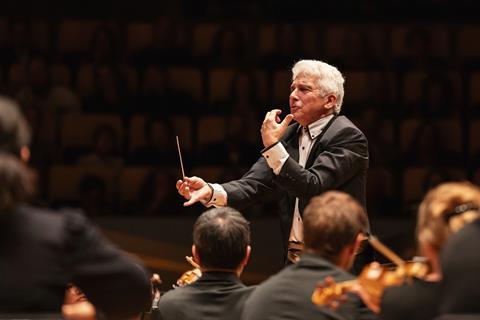
Itzhak, when you watch Peter on the podium, do you sense the violinist still shaping the music?
Itzhak Perlman: When we play together, Peter knows the direction of certain phrases, where they lead. Most of the time, he probably knows the pieces himself and has played them on the violin. That takes away all the worry and keeps the fun of making music – breathing together, going in the same direction, being on the same wavelength. There’s always that sense that we’re going to move forward together and just have a good time.
After everything you’ve shared over the years – music, friendship, teaching, and life beyond the concert hall – what still makes you curious about one another as artists?
Peter Oundjian: I would point to two things. First, that Itzhak, in his early to mid-20s, made a conscious choice to be a mentor. At a time when he already had an unbelievable career and could have gone anywhere and played whatever he wanted, he chose instead to teach – not just a couple of students, but a whole class at Brooklyn College. My admiration for that generosity, and for that commitment to passing on a God-given talent to others, is profound. I find it hugely inspiring.
And when Itzhak plays, it’s always poetry. There’s always a reason for what he’s doing. He never uses the music to display his talent – he’s a vehicle for the power, spirituality and beauty of the music. That’s something I’ve always tried to live up to.
Itzhak Perlman: Well, I agree with everything you said wholeheartedly. [chuckling]
But seriously, I’m always amazed by the transition you made from chamber music to conducting. For me it’s very simple: once a musician, always a musician. It doesn’t matter what you do – the relationship to music stays the same. I tell my students that we’re lucky to make a living doing something we love so deeply.
Whenever I play with Peter, I can always feel that familiarity with what music can do. You’re not fighting the music, you’re enveloping it with knowledge, love and spirituality. It’s just wonderful.
Read: The greatest storyteller: Itzhak Perlman at 80
Watch: A comparison: Itzhak Perlman plays Mendelssohn in 1983 and 2011
Read: Itzhak Perlman: If you teach others, somehow you teach yourself
Read: Peter Oundjian takes up conducting role at Colorado Symphony
Discover more Featured Stories like this in The Strad Playing Hub












No comments yet