
















Just because you are busy does not mean you are productive. Michael Brook explores how stepping back, setting boundaries and protecting attention can transform consistency and elevate musical performance
Read more Featured Stories like this in The Strad Playing Hub
No one applauds when the WiFi works, it’s the quiet expectation in our lives. But the moment it stops, everyone notices. Performance is the same way. No one praises consistency. But the moment it breaks, everyone notices.
Most advanced musicians are highly trained. But even after years of practice, consistency can be an issue. Not because of ability. Because of overload.
As musicians, we do everything. We teach, perform, collaborate, take last-minute gigs, say yes to projects, students, opportunities. And early on, that makes sense. You take what you can get. The problem is, that mindset doesn’t go away. You just keep adding more.
Eventually things crack, and the mistakes and lapses in judgement come out. Our first instinct is to do more – more practice, more meditation, more…coffee? But that’s the problem, just because you are busy doesn’t mean you are productive. You need to be doing LESS.
Steve Jobs said it best: ’People think focus means saying yes to the thing you’ve got to focus on. But that’s not what it means at all. It means saying no to the hundred other good ideas that there are.’
The real problem is that our attention is our most valuable resource, not our time. And what we focus on is what improves. Our attention is constantly being pulled in different directions from commitments, work, news, information, text, email, social media, etc.
This is especially a problem when some of these things are designed to steal your attention by keeping you emotionally reactive, such as social media and news.
Even if it doesn’t feel directly related to your playing, it affects your ability to focus, to stay calm, regulated, to be present in the moment. This prevents us from performing under pressure. If you want consistency, you have to protect your attention.
At a certain point, I realised this wasn’t just theory; it was my life. If I wanted to perform at the next level, I couldn’t keep doing everything. I had to be selective.
So I started removing things. Not small things but significant things.
If you want consistency, you have to protect your attention
First was an audit of my physical space – items, hobbies, everything. I sold a video game collection worth thousands that I never had time to play. I donated most of my clothes from years ago, the kind of things you keep ‘just in case,’ or because they represent a version of yourself you haven’t fully let go of. Along with items I told myself I would use again when I had more time (I never did, even during lockdown). Things I felt guilty getting rid of: all gone.
These weren’t just objects. They were mental commitments of small constant obligations I was carrying without realising it. A past version of myself. Who I used to be, taking up space that should have been reserved for who I was becoming.
And once that space cleared, my focus did too.
Next was performing. I had to ‘quit music’ to be a better musician. I could no longer have a fast-food approach to performing – running to sometimes three services or rehearsals a day with different groups. I could never go to the next level of performance living the last six months of my life on repeat forever. The quality must be better and fundamentally different from what I was doing.
It was one of the most difficult decisions I made. I resigned from two union orchestra jobs, including one where I held a titled chair for over a decade. Gone. A job I worked incredibly hard to audition for and win. I had to be selective. I would only keep performance commitments that met a new, higher standard. It meant pivoting my career and how I supplemented my income. It became my new identity.
If you identify as a high-level performer, your actions have to reflect that. Not occasionally. Always. It’s not about doing more, it’s about raising the minimum standard and changing how you view who you are.
In other fields, this is obvious. Athletes don’t treat performance days casually. They don’t fill their schedule with unrelated tasks and then expect peak results. They protect their time and energy. Musicians often don’t.
But the principle is the same. If your goal is to perform at a high level, then your day, your schedule, your life need revolve around it. Say ‘no’ and remove most of what you are doing.
If at this point you’re thinking, ‘I can’t do that,’ or ‘that wouldn’t work for me,’ that’s okay. That’s your nervous system trying to protect you.
See, saying ‘yes’ is safe. In fact it serves us. Gives us a hit of dopamine, makes us feel validated, important, relevant, and makes others happy.
Saying ‘no’ or removing the status quo equals risk for our nervous system. Our brains are wired to be adverse to change and uncertainty. What if you try the new changes and it doesn’t work as quickly as you expected, and now you feel like a loser; a failure? What if it does work, and now you have to commit to the newer higher standard – that’s hard to do! Will making these new changes disappoint others’ expectations? You can see the endless anxieties of why and how our brain tries to ‘protect us’ from going to the next level.
But meaningful change requires a shift in identity and a willingness of courage to act, even before the results are guaranteed. We already understand this in practice as musicians. We work on something for months or years before we see results. This is no different.
Athletes don’t treat performance days casually. They don’t fill their schedule with unrelated tasks and then expect peak results. They protect their time and energy. Musicians often don’t
So what should we say ‘yes’ to? Two things made the biggest difference for me: strength training and nervous system regulation.
There is growing research on the physical and mental benefits of strength training. It improves endurance, reduces fatigue, and allows you to perform with more energy and control. It also supports neuroplasticity and cognitive function. In simple terms, it makes you better equipped to do your job. Regular exercise also supports mental health such as reducing anxiety and helping manage stress more effectively.
The second is nervous system regulation, which is often overlooked. Should we really gamble our performance on how our body happens to feel that day? How we respond to stress (especially under pressure) has a direct impact on consistency. There are different approaches to this, but the key idea is learning how to stay regulated and present when it matters most.
One method I have successfully used is the Dynamic Neural Retraining System (DNRS) method which I enjoy practising. However there are many other methods and therapies such as Eye Movement Desensitisation and Reprocessing (EMDR) that can be explored under the direction of a licensed physician.
So what have the results been? I have never enjoyed performing more than I do now. I feel more control, more stability, and more consistency than I ever have before. Consistency is not about doing more. It’s about removing anything that doesn’t align with your standards. When you reduce the mental friction, your focus improves. Your control improves. Your playing unlocks new levels.
Do less. Practise. Be present.
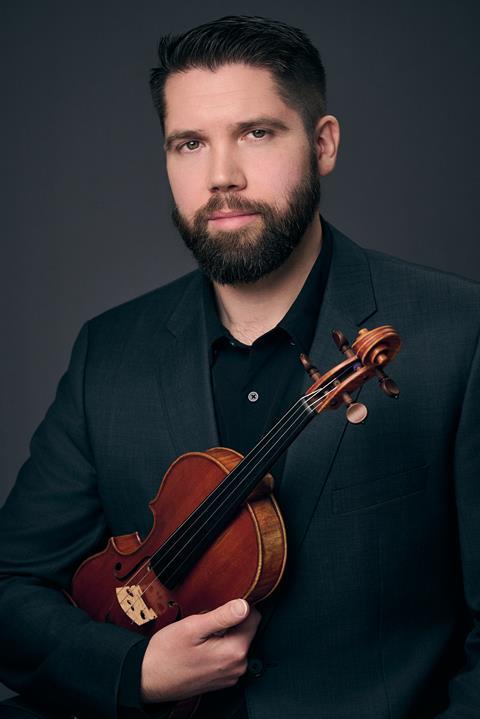
Michael Brook is concertmaster of the Longmont Symphony Orchestra and principal violist of the Colorado Ballet, and serves as dean and artistic director of Opus Colorado College of Music. He has performed at Carnegie Hall and the John F. Kennedy Center, and his work focuses on performance, training, and developing high-level musicians.















No comments yet