

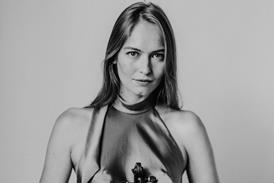
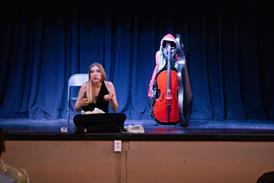
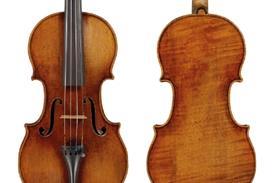




British violinist Peter Sheppard Skærved, known for his wide-ranging repertoire and interdisciplinary work, discusses the challenges and rewards of recording Hersch’s monumental cycle engaging with the paintings and drawings of Peter Weiss
Read more Featured Stories like this in The Strad Playing Hub
American composer Michael Hersch is known for music of uncompromising intensity and scale. His latest release, Zwischen Leben und Tod (’Between Life and Death’), recorded by violinist Peter Sheppard Skærved and pianist Roderick Chadwick for Métier, ranks among the most expansive works ever written for violin and piano.
At around 100 minutes and spanning 22 movements, Zwischen unfolds on an unusually large canvas. Its origins lie in Hersch’s encounter with the visual art of Peter Weiss – better known as a playwright – through W. G. Sebald’s writing. The composer’s response to the artist’s ‘familiar and alien worlds’ – marked by depictions of violence and destruction, but also moments of inward reflection – led him to engage ‘directly with images through music’. Rather than illustrate these sources, Hersch internalises their imagery into a dense and demanding musical language that places extreme demands on the performers.
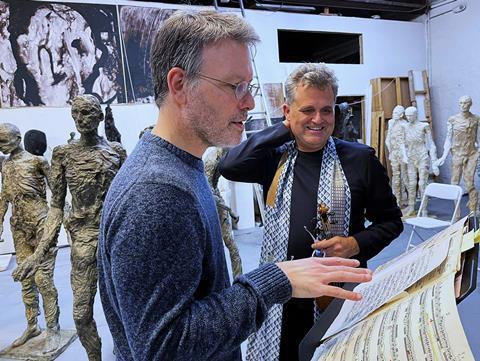
Skærved, himself also a painter and a frequent collaborator with visual artists, has worked closely with Hersch for more than two decades. Zwischen Leben und Tod marks a significant new addition to their ongoing artistic dialogue. Skærved spoke with US correspondent Thomas May about the challenges and rewards of recording this monumental cycle, and the physical and aesthetic demands it places on the performers.
You’ve collaborated with Michael Hersch for more than two decades. How has that long collaboration informed your understanding of the work?
Peter Sheppard Skærved: Zwischen Leben und Tod is one part of a long conversation which I have had with Michael Hersch since George Rochberg introduced us in 2004. Michael started writing for me soon after we met. As we have never lived in the same country, our collaboration has always been a combination of letter-writing and intense bursts of in-person work when we are on each other’s side of the Atlantic.
Our talk has always included ideas shared across the table with our respective partners, both of whom are writers: Michael’s wife, Karen Klaiber Hersch, is a classicist, and my wife, Malene Sheppard Skærved, is a poet. Energetic conversations about our various overlapping fascinations are critical for me in building understanding of the music as I play and study it.
The crucial thing about collaboration is that each stage, each step, is part of a journey, a shared evolution. Beginning work with Roderick Chadwick on Zwischen was the next exciting step on that journey, and on our long-term recording adventure (which ranges from recordings of Mozart and Ole Bull to many recordings of the composers we work with).
This is an unusually large-scale work for violin and piano. How did you approach structuring it for the recording?
Peter Sheppard Skærved: First of all, I should note, that in the last 15 years I have produced all the recordings that I make, whether solo or chamber. There’s no one sitting in a producer’s box saying ‘do it again’, no ‘hand of God’. The crucial thing for me is that the performers are deeply involved in the process at every stage. A recording session is an extraordinary opportunity to dig deep(er) into the music, to go further into the questions that we ask each other at every stage of the never-ending learning process.
In this respect, the editing process is also a continuation of that colloquy. Every time that we come to record a piece, we try and learn from the last project how to use the structure of the recording process to get as close to the compositional one as possible. It will be clear that this will not be a sequential approach, but a strategy of getting to the heart of the matter. When I put together a recording, I also plan my editing process, and build the trajectory of the recording accordingly.
There are a number of tumultuous movements in this cycle which, in a concert situation, are played just once, but in a recording, more. The time and intensity of exploring them in detail make it prudent to not immediately move on to music of great delicacy immediately afterwards. This all informs the ‘composition’ of the recording sessions.
Zwischen Leben und Tod takes the paintings and drawings of Peter Weiss as its point of departure. How does the visual impetus inform the way you think about the music?
Peter Sheppard Skærved: The relationship with the supporting/inspiring materials is a complicated and morphing one. The second piece Michael wrote for me was based on fragments of poetry by Primo Levi. At the time, we had some energetic discussions about whether the audience should be privy to these, and how.
When Roderick Chadwick and I gave our first performance of Zwischen in London, we did it with a large screen, next to us, projecting the paintings. We referenced the paintings (and drawings) extensively, as the piece evolved in our hands and imaginations. But over the years, and as we got closer to the music, the presence of the paintings, even as something immanent, lessened. This informed our decision not to include the pictures in the supporting materials.
This is an area which is important to me: I have always been a practising artist, and my painting has a contrapuntal relationship to my violin playing. I also work extensively with art, artists and museums (currently, for example, on a collaboration with the Bruegel paintings at the Fine Arts Museums in Belgium). So I am comfortable saying that the power of Hersch’s music has subsumed the pictures which triggered it.
Hersch’s music is often described in terms of intensity and extremity. But from the violinist’s perspective, what actually defines his writing – in terms of sound, gesture or technique?
Peter Sheppard Skærved: For those of us who spend a lot of time with Michael’s music, these are not qualities that come to mind immediately. I think that it is easy to be distracted by the extremities of an aesthetic. If you listen to the astonishing soprano Ah Young Hong, who has a profound importance for Michael’s work, she approaches the work as ‘daily bread’, a quotidian expression of the encyclopaedic range of human experience.
This is a quality one can see in the work of the painter Jean Siméon Chardin: it’s what W.H. Auden observed in the work of the Bruegel family. I have often paired Michael’s solo works with Telemann’s Fantasies (which I have recorded twice). The result is very far from being a dramatic contrast. These are both composers who allow the full range of what it means to be human into their music, and everyone’s life ranges from the everyday to the critical. So that’s the challenge: candour, directness, the bow on the string, a voice.
The work demands extremes of tempo, dynamics and technique. What are the biggest challenges it presents for the violinist in practice?
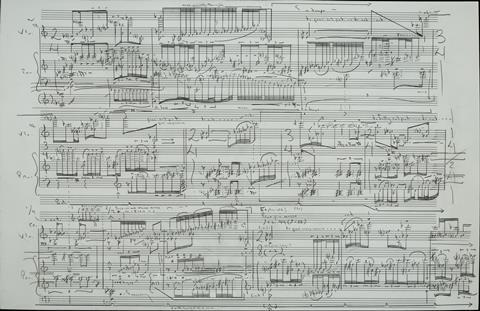
Peter Sheppard Skærved: Over the past 20 years Michael’s approach to the instrument has become more exacting. In rehearsal for recording his quartet a few weeks ago, we observed that he had eight grades of ‘sul ponticello’ indicated, and they all made perfect sense, were absolutely necessary.
Michael’s notated approach to the violin requires control of the instrument in extremis. By this I mean that the expressive shaping of material must not be abandoned when the ‘voice breaks’. Any violinist who has played John Cage’s Two⁴ will know what I am talking about.
And, of course, there is the wonderful sensation of ‘failure’ alongside the piano: think of those moments in the piano/violin literature when the composer says ‘OK, the violin can’t follow the piano here – just be quiet’. It happens at climactic moments in the Shostakovich, Respighi and Franck sonatas. But Hersch will set the piano coursing at full, explosive stretch and say to the violinist, ‘Hold on, do what you can!’. Movement VIII of Hersch’s cycle is a wonderful example of this, both players riding the storm. It’s like being in J.M.W. Turner’s 1842 painting Snow Storm: Steam-Boat off a Harbour’s Mouth.
Over the past 200 years the piano has offered an incredible challenge and liberation for the possibilities of string instruments, from Beethoven to Michael Finnissy. Hersch continues that process and, as an extraordinary pianist himself, has opened new expressive vistas for the violin.
Michael’s notated approach to the violin requires control of the instrument in extremis
There’s a striking sense that the physical act of playing becomes part of Hersch’s expressive language. To what extent do you feel the piece affects the body of the performer?
Peter Sheppard Skærved: These physical characteristics are integral to all music. We are profoundly affected physically by what we play: there is an entirely different physiology necessary to play Paganini’s 6th Caprice from say, Schubert’s roughly contemporaneous Quartettsatz. And the physical demands vary within a composer’s body of work.
When I play Zwischen with Roderick, I sit as close to him as I can (in fact he’s the only one who stands – for the inside-piano work). I need to work as closely with him as possible, literally and figuratively, to bring something of the pianistic approach to the violin, and most particularly, to bring something of Michael’s unique approach to the piano, to both our physicalities.
Michael’s work, and the physicality necessary for it to ring true, are the very embodiment of the Keats line: ‘Beauty is truth, truth beauty, – that is all’.
You’ve spoken about Hersch’s music as engaging with silence as much as sound. How does that idea affect the way you perform this piece?
Peter Sheppard Skærved: In all art, silence and space are one and the same thing. In a piece like this, it means the silence around the music (before it starts, between movements, and after it finishes), the silence within the music (fermatas, rests, pauses, caesurae) and the silence around the music (above, below, and within the choice of notes, the tessiturae). The departure from and arrival at silence is always a question of syntax and rhetoric.
Roderick and I find that the silences in Zwischen are intimately bound up with our physical deportment, and the nature of our listening, at every given moment. For instance, Movement XII begins with extremely gentle chords, plucked inside the piano. Roderick has to stand up, very still, in ‘poised readiness’, in order to find exactly the timbre he wants – while holding the sustaining pedal down – he’s slightly wrapped around the box of the piano. I am not doing anything at this moment, but I have to be observant. It’s a moment of what the late Pauline Oliveros would call ‘deep listening’.
You’ve lived with this piece for years before recording it. What made now the right moment to commit it to disc? And what does recording it capture – or perhaps miss – compared to live performance?
Peter Sheppard Skærved: I have waited a long time before going into the studio with any of Michael’s music. I play all of his multi-movement works for solo violin, and my Kreutzer Quartet has played his (hour-long) Images from a Closed Ward since 2013. All of these, like Zwischen, are part of my repertoire, my identity. But there was a definite sense that this music needed to bed down, to become part of us.
I am passionate about recording and feel that it can, when it is allowed to, go places performance sometimes cannot. In performance, there is a danger that intimacy can be lost (which is the reason that I prefer audiences close and not too large). Great music often includes infinite gradations of expression, emotion, timbre, dynamic, texture and rhetoric. Recording demands that we explore those with care and commitment.
What is difficult to bring across in the studio is the impact of the visual, so there are always fascinating conversations, in the editing process, with composer, collaborator and engineer (the wonderful Adaq Khan) as to how to use the tools available to make sure that nothing is lost. I hope that we have achieved it here.
Zwischen Leben und Tod, released on the Métier Records label, features Peter Sheppard Skærved and Roderick Chadwick and is available on multiple platforms.









No comments yet