



![Ayanna Witter-Johnson [Jordan Woods] 7](https://dnan0fzjxntrj.cloudfront.net/Pictures/274x183/4/9/4/44494_ayannawitterjohnsonjordanwoods7_224583.jpg)

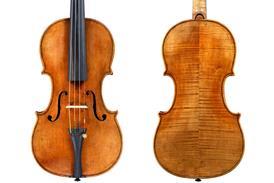



Benjamin Baker tells the story of mathematician and violinist Alexander Aitken, whose modest instrument accompanied him through the First World War and now inspires a new commission at AWE London ahead of Anzac Day, tracing memory, music and survival across a century
Read more Featured Stories like this in The Strad Playing Hub
Born in 1895 in Dunedin, on New Zealand’s South Island, Alexander Aitken stood apart early on. At Otago Boys’ High School he showed both exceptional musical ability as a violinist and a remarkably advanced mathematical mind, along with an eidetic memory. He was said to be able to recite pi to 1,000 places and multiply nine digit numbers in his head. This led to a scholarship to the University of Otago to study mathematics and languages, before his studies were interrupted by the outbreak of the First World War.
Aitken enlisted in 1915 and soon departed with the New Zealand Expeditionary Force, sailing for Egypt en route to Gallipoli. It was on this voyage that the instrument that became known as Aitken’s violin entered his life.
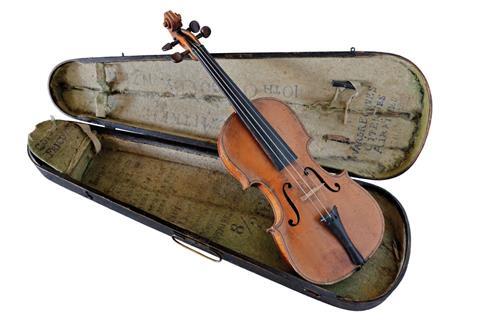
The violin had been won in a raffle by a fellow soldier on board the troopship and was given to Aitken, as he was the one who could play. Although he described it as cheap and mediocre in tone, he quickly grew attached to it, treating it as a travelling companion. Inside the case, he inscribed the stages of the journey, Indian Ocean, Aden, Suez, Cairo, Alexandria, marking his passage from New Zealand to the Middle East.
During the voyage he played for the men of his company, often by request. Bach was a personal favourite, alongside familiar tunes of the time and what became something of a signature piece, Dvořák’s Humoresque. Over the coming months he also noted down melodies he heard along the way, including Greek and Turkish folk tunes.
On arrival at Gallipoli, musical instruments were considered contraband, but with the support of his unit he managed to keep the violin with him through inspections and into active service. It became a shared object within the company, something collectively valued and protected.
At the front, Aitken continued to play when he could, often to lift morale. Damp, cold, mud and constant movement were far from ideal conditions for a violin, and its care became a communal duty. Responsibility for carrying it on marches was shared among the unit, and when an E string broke, a replacement was fashioned from strands of field telephone wire.
When the violin could be played, there was very little room to move in dugouts, often not enough for a full bow stroke. Aitken later described these performances as ’muted concerts’.
Following the withdrawal from Gallipoli, Aitken believed the violin had been lost, but it was saved and returned to him by an officer who had heard him play. He was then redeployed to the Western Front in France, where he continued to play, though less frequently, noting that to play in the open would be dangerous.
Despite the conditions, he remained deeply engaged with the culture around him, carrying a book of French poetry and continuing his language studies. Just before the Somme, he cycled to Abbeville to buy a new bow from a local luthier, only to snap it moments after leaving, returning sheepishly for another as the luthier’s wife laughed until she wept.
His extraordinary memory also found a place in wartime. When a roll book was lost, Aitken was able to reconstruct it in full, recalling the name, regimental number and next of kin details for every member of his former platoon, 56 men in total. This capacity to remember everything he encountered would remain with him throughout his life, though not without cost.
Music also shaped how he understood what he was hearing around him. On one night before a major offensive on the Somme, he described a German soldier playing the flute across the trenches, beginning with folk songs before turning to the Funeral March from Handel’s Saul, which Aitken felt spoke directly across the lines, ’for you tomorrow night, Kameraden’. In such moments, music became inseparable from the atmosphere of the front.
In 1916, during the fighting around Morval on the Somme, Aitken was severely wounded. In the confusion of battle and evacuation he was separated from the violin, and returned to New Zealand in 1917 believing it lost. In fact, it had been kept by members of his company. Passed between them and preserved through the remainder of the war, it was eventually returned to him around 18 months later, its case covered in the signatures of those who had carried it.
The war left a lasting mark on Aitken. In 1923 he returned to Scotland to study at the University of Edinburgh, where he would later hold the chair of mathematics for nearly two decades. During the Second World War he also worked at Bletchley Park on codebreaking efforts connected to Enigma.
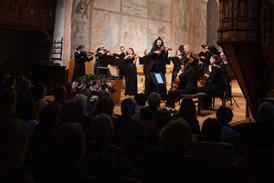
Aitken’s story sits at the heart of At the World’s Edge (AWE) London, a chamber music festival unfolding in the days leading to Anzac Day, 25 April 2026. The programmes trace a journey exploring the values associated with Anzac that have come to shape New Zealand and Australian identity, set across two contrasting performance spaces, from the immediacy and street level energy of the Fidelio Café in Bloomsbury to the stillness of the Victorian clock tower above St Pancras railway station. At its centre is a new commission inspired by the journey of this violin.
Aitken’s Violin, by Sebastian Black, receives its world premiere as part of the festival. Black, a UK and New Zealand dual national with family ties to Central Otago, draws on the idea that we can never fully know what Aitken experienced, but that even an attempt to imagine it can shape how we listen. The work reimagines an Edwardian hymn tune, transforming it across the piece as a thread through Aitken’s journey.
The work will be premiered at the St Pancras Clock Tower on 21 April 2026, before travelling to New Zealand for its New Zealand premiere in October as part of AWE Festival in Central Otago. The full programme launches on 1 May 2026. Further information can be found on the AWE London website.
At the World’s Edge (AWE), launched in 2021 in the Queenstown Lakes region of Central Otago, is an annual spring chamber music festival with international chapters in Chicago and London. Rooted in Aotearoa New Zealand, AWE connects audiences and musicians across generations and continents through the intimate and personal experience of chamber music, while sharing New Zealand creativity on the international stage.
Read: ‘Music is part of our existence, even under shell-fire’: String players of the Great War
Read: Violinist Benjamin Baker on curating the At World’s Edge Festival
Read more Featured Stories like this in The Strad Playing Hub



![Ayanna Witter-Johnson [Jordan Woods] 7](https://dnan0fzjxntrj.cloudfront.net/Pictures/100x67/4/9/4/44494_ayannawitterjohnsonjordanwoods7_224583.jpg)






No comments yet