



As she anticipates the premiere of her new double concerto The Book of Signatures at Next Festival, the Spanish-American cellist and composer reflects on gesture and memory in music, and on writing for the interplay between cello, percussion and strings.
Read more Featured Stories like this in The Strad Playing Hub
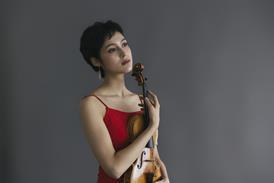
Spanish-American cellist and composer Andrea Casarrubios, who was born in rural Spain and moved to the United States at 18, has built a distinctive career spanning performance and composition. Recent works range from solo cello pieces to large-scale orchestral writing. Her latest project, The Book of Signatures, marks a further expansion of that dual role: a new double concerto for cello, percussion and string orchestra, which she will premiere on 6 June.
The work forms the centrepiece of the 2026 Next Festival of Emerging Artists, which runs from 29 May to 12 June across venues in New York City and the Hudson Valley. Now in its 14th season, Next Festival brings together emerging performers, composers and choreographers for a series of workshops and world premieres.
Written for Casarrubios alongside percussionist Garrett Arney and a string orchestra of festival fellows, The Book of Signatures is a double concerto that explores ideas of gesture and memory, contrasting the tactile act of writing by hand with the speed and saturation of digital life.
In her interview with US correspondent Thomas May, Casarrubios reflects on the origins of the concerto, the interplay between cello and percussion and why the physical act of making a mark by hand became central to the piece.
What was the starting point for your new double concerto The Book of Signatures – and how did the idea behind the title take shape as you worked on the piece?
Andrea Casarrubios: The starting point was the idea of the signature as both a personal and historical gesture, a small mark that carries memory and intention. I keep noticing how centred I feel when writing by hand, when stepping away from screens, and how rare that experience has become in this and many other fields. I thought of autograph books and also remembered first learning about yearbooks when I got to the US – this is an excellent example of how charged with meaning and memory a handwritten signature can be. I feel grateful to have grown up with an appreciation for what is made by hand.
From there, my thoughts expanded beyond autograph books to petitions, manuscripts, and the physical act of leaving a trace. At a time when so much communication is digital and ephemeral, the handwritten mark feels increasingly fragile, yet enduring.
The title The Book of Signatures appeared early, but its meaning deepened as I composed. At first, it suggested intimacy and connection; over time, it grew into something more collective. I even purchased a blank book to use during performances, with the hope that performers who bring this work to life, now and in the future, will add their own signatures to it.
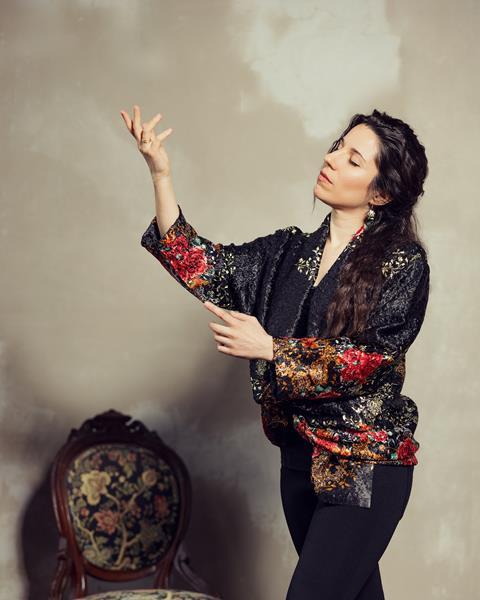
You will perform the work yourself. When writing a concerto you will also play – particularly one that involves such a close dialogue with percussion – how do you think about physical gesture and timing across those different sound worlds?
Andrea Casarrubios: In general, I think about physical gesture and timing constantly when I write. I find them more than inspirational when envisioning a new piece – really, they are essential. Maybe this comes from my experiences on stage, where those two elements become deeply personal depending on who you play with.
For this particular piece, thinking about physical gesture was even more important. I should clarify that these gestures always come from the most honest part of the music, as a vessel and with purpose, and never simply for the sake of trying something without musical reasons. In this work, gesture became inseparable from the percussion part: I thought about the weight, resistance, release, breath – the human time it takes to arrive somewhere.
In the second movement, where the cajón and the computer keyboard appear, the pacing is deliberately breathless: alluring, yet almost exhausting, mirroring the relentless rhythm of digital life. By contrast, the final movement returns to slower, more human timing, shaped by touch. That is where the percussionist plays ‘the book’.
Your 2025 concerto MIRAGE is written for cello and full orchestra. What did moving to this more focused combination of cello, percussion and strings allow you to explore differently in terms of texture and interaction?
Andrea Casarrubios: Having fewer instrumental families (no winds, for example) naturally focuses the palette, but I love the extraordinary range of colour within a string orchestra. The presence of two soloists, cello and percussion, reshaped the texture in a fundamental way and made the interactions more centred. It allowed me to introduce a tactile dimension that aligned closely with the idea of inscription, so the result feels like a completely different kind of concerto and sonic dimension from MIRAGE.
Percussionist Garrett Arney and I have worked together several times in the past, and we premiered my duo for cello and percussion, Speechless, exactly ten years ago. His artistry and openness to my creative vision have been key. Witnessing Peter Askim’s conducting has also been a great inspiration throughout the writing process, as I know I can trust him with whatever crazy ideas I might have!
The festival this year foregrounds women immigrant composers. Did that context enter into your thinking as you wrote the piece, or did it emerge from a more internal starting point?
Andrea Casarrubios: The piece began from an internal place, from personal questions about connection, memory, and the act of leaving a mark – or perhaps more accurately, others leaving marks on me. I actually learnt about this summer festival’s focus on women immigrant composers toward the end of writing this commission. Whether or not I consciously thought about that context while composing, the truth is that I have lived half of my life as an immigrant, and those many experiences will always be part of who I am.
Looking back, the notion of signatures began to carry additional weight. A signature can be proof of presence, authorship, belonging – sometimes even permission to exist within a system. That awareness may not have been explicit at the beginning, but it became increasingly meaningful as the piece took shape.
The process also led me to reflect on the many wonderful lives that have touched mine: people who have supported me in both small and profound ways over the years. Rather than dwelling on challenges, I choose to remember those who have made a positive difference in my life, and The Book of Signatures carries their presence and support.
Two such individuals, whose support made this commission possible, are Carl and Claudia Shuster. They have had a profound impact by believing in my voice, listening to my music, and advocating for it over many years. Their values and the remarkable artistic community they have built throughout their lives helped inspire the idea of the autograph book at the heart of this work.
In a festival setting like Next Festival, working closely with emerging players, does the experience feel closer to concerto playing, chamber music – or something in between?
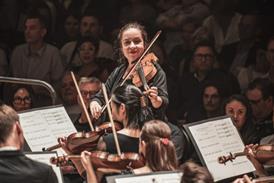
Andrea Casarrubios: Probably something in between. Ideally, the experience of concerto playing should be similar to chamber music. In this festival setting, the extra rehearsal time creates a rare depth of connection between the soloists and orchestra members, and everyone has the opportunity to truly inhabit the piece, which builds a strong sense of shared responsibility.
By the time we reach the performances, the music feels collectively owned, and this is really unique. The openness and excitement of artistic director Peter Askim and the players at The Next Festival make that process especially meaningful. There is a spirit of curiosity and commitment that transforms the experience into something deeply alive.
Andrea Casarrubios will perform THE BOOK OF SIGNATURES with percussionist Garret Arney and the Next Festival string orchestra conducted by Peter Askim at National Sawdust in Brooklyn on Saturday 6 June 7:30PM. Find out more here.
Read: Andrea Casarrubios on her Concerto for Cello and Orchestra, ‘MIRAGE’
Read: Concert review: Next Festival of Emerging Artists
Discover more Featured Stories like this in The Strad Playing Hub







No comments yet