








Rita Fernandes reports from the 2026 violin edition of the Montreal International Music Competition, which integrated new features while retaining its traditionally world-class level

Discover more Featured Stories like this in The Strad Playing Hub.
Read more premium content for subscribers here
Amid neo-Gothic architecture, converted warehouses and cobbled streets, the Cirque du Soleil’s imposing blue-and-yellow-swirled big top sits unapologetically on the Old Port of Montreal. This revolutionary circus troupe is known the world over, yet with this major performing venue it retains an enduring bond with its Montreal origins. Even Cirque du Soleil’s shows somewhat mirror Montreal, being a charmingly innovative mix of new and old, driven by a fierce pride in its individuality. The same could be said of many of Montreal’s global artistic exports: Céline Dion, Leonard Cohen and, especially in 2026, the Concours Musical International de Montréal, which took place from 27 May to 4 June. This edition had a Montrealer as jury president: Lucie Robert. ‘My mum even comes to many of the rounds!’ she told me.
Robert’s origins gave her a distinctive drive in shaping this year’s edition – one that stayed faithful to the world-renowned event she grew up hearing about while also being adapted to an evolving industry. Many stages of this year’s edition saw changes. In the pre-selection round, programme requirements included a Beethoven sonata second movement. ‘They demand a real emotional connection to the music,’ Robert said. In the semi-finals, the required work by a Canadian composer could be selected from a choice of 13. And for the first time, the finals had two rounds, on consecutive evenings. In the first, five players performed a Mozart concerto: ‘You can’t hide in Mozart – it really shows musicianship,’ said Robert. In the second round, three competitors each played a major concerto chosen from a list of 18. ‘In a professional career you need to be on such a high level both technically and artistically,’ Robert pointed out. ‘You might have to play a concerto in New York, and the next day travel to Vienna and perform another one. You have to be ready and able to do this.’
The semi-finals took place on 30 and 31 May at the Salle Bourgie. In his performance of Strauss’s Violin Sonata in E flat major, Japanese violinist Koshiro Takeuchi, 21, had a fluid singing sound that allowed him to inhabit, rather than merely interpret, the music. His agile technique made even non-idiomatic violin writing feel natural. ‘I do a lot of rubato,’ he told me, ‘so I wanted to make the tempo clear to the pianist.’ And that he did.
Throughout the competition, Sara Watanabe, 21, from Japan, displayed a distinctive assertiveness. She created dialogue and contrast in Bartók’s Violin Rhapsody no.1 while keeping the music’s muscular character and remaining fully committed to the work’s harshness – at times cleanly clipping the bow’s ferrule on the string.

The first movement of Beethoven’s Sonata no.7 in C minor in the hands of American Laurel Gagnon, 31, was robust but never heavy, with a sustained intensity. Her clear articulation brought out the intricacies that make the piece such a fascinating bridge between the Classical and the Romantic. In the second movement she displayed a different, grander, strength, which let even hemidemisemiquavers speak.
Hyper-virtuosic pieces understandably make some players fixate on technique rather than musicality. The opposite was true of 17-year-old Aozhe Zhang from China. In the fiendishly difficult Ysaÿe Solo Violin Sonata no.5 and Paganini’s ‘I palpiti’ Variations, a trance-like calm seemed to come over him. His body, hands and musicality were liberated, whereas his other – technically easier – works felt constrained.
The Enescu Violin Sonata no.3 in A minor played by Italian–Japanese Yume Zamponi, 20, was both controlled and fantastically wild, with its sharply shifting emotions given space to sound. She used every inch of energy in the untamed finale’s sul-G passage, even projecting over the thunderous piano. Although she didn’t make the finals, her performance remains memorable.
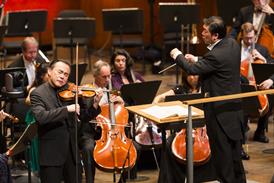
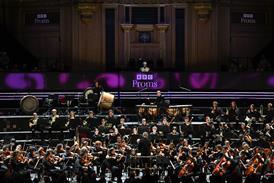
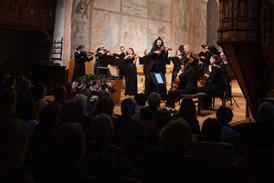
On 3 June, Zhang, Takeuchi, Watanabe, Gagnon and Turkish–Belgian Bade Dastan, 19, performed a Mozart concerto at the Maison Symphonique with the Orchestre Symphonique de Montréal. The finalists’ ages (from Zhang at 17 to Gagnon at 31) spanned almost the entire range allowable in this competition, and for Robert, this reaffirmed the difficulties of judging such competitions (though she does not vote as a jury president): ‘How do you wrap your head around that? At that age, 14 years is a lifetime!’
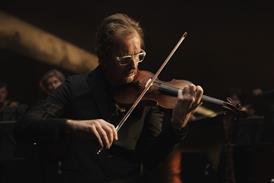
Sara Watanabe displayed a distinctive assertiveness
Gagnon’s, Watanabe’s and Dastan’s performances were clear highlights. Zhang’s and Takeuchi’s, though still at a high level, unfortunately felt occasionally stiff and unengaging. Gagnon’s Violin Concerto no.4 in D major had clear musical intentions, and she placed importance on even the smallest of details, such as the top notes of trills. She put the score first rather than blindly obeying the rules – particularly the idea of ‘purity’ – associated with interpreting Mozart. When edge was needed, she delivered.
Earlier that day, the remarkably mature Dastan told me how important lyricism is to her playing – and in her Violin Concerto no.4, she tapped into the sheer beauty of Mozart’s writing. ‘I’m an introverted person,’ she said. ‘Because Mozart was so extroverted, his music helps me put it all out there.’ This playful spirit resulted in many surprising and refreshing moments – from unexpectedly lengthened notes to sudden dynamic changes. These decisions always felt musically mature rather than uninformed.
Given the characteristic boldness of her playing, I was surprised to hear from Watanabe that Mozart is one of her favourite composers. Her performance of the First Violin Concerto convinced me. Her cadenza was spectacularly paced – a captivating balance between provocative dissonances and sweet melodies. Just as it finished, the audience let out a collective sigh, as if we had held our breath for two minutes. Watanabe, Takeuchi and Gagnon proceeded to the grand final.

Takeuchi began his Tchaikovsky Violin Concerto by matching the orchestra’s velvety tone before growing into a glorious, but never kitsch, Romantic sound. In the third movement’s famous dialogue between soloist and orchestra, where each repeats a two-note motif, the ensemble felt on the verge of bursting its confines, creating an intoxicatingly unchained momentum.
In Bartók’s Violin Concerto no.2, Watanabe commanded and cued the approximately 80-piece orchestra behind her rhythmically, musically and emotionally. A particularly impactful moment came in a downward G-string glissando following a quiet section: her energy in just this one motion animated the full orchestra into a forte tutti.
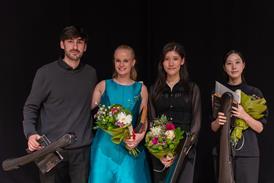
In the Brahms Concerto, Gagnon had a captivatingly warm G-string tone, and retained vibrance and core in the stratospheric heights of the E string. She ultimately won third prize, with Watanabe coming second and Takeuchi first.
Like the city that welcomed these talented musicians, this edition spotlighted tradition, innovation and originality: a new generation retained the historic competition’s world-class level; an updated finals structure showcased composers from Mozart to Bartók; and the inspiring individuality of each young performer was both encouraged and celebrated.
Read: Postcard from Montreal: 2023 Montreal International Music Competition
Read: Postcard from Canada: Banff International String Quartet Competition
Discover more Featured Stories like this in The Strad Playing Hub.
Read more premium content for subscribers here











No comments yet