





At the Newport Classical Music Festival, Rita Fernandes heard a variety of captivating performances against the elegant backdrop of a New England summer resort

Discover more Featured Stories like this in The Strad Playing Hub.
Read more premium content for subscribers here
To visit a Gilded Age mansion in Newport, Rhode Island, is to experience a kind of architectural whiplash. From an Italian Renaissance courtyard you climb a Beaux-Arts staircase to enter a Louis XIV-style morning room. These mansions – built as summer houses for America’s ultra-wealthy industrialists during the late 19th century – are dizzying displays of opulence, but in each case there is a rich, human history behind it: from the tragic suicide of Cornelius ‘Corneel’ Vanderbilt, to the dubious deeds needed to maintain vast monopolies.
Modern-day Newport is an easy-going New England town that comes alive during its festival-filled summer. And while concerts for the Newport Classical Music Festival (this year held from 2–19 July) are hosted in these decadent mansions, the performances themselves have undeniable artistic substance. This was especially evident in the introductions that the musicians gave before each concert; they were both entertaining and genuinely informative.
In the first I attended, on 8 July at The Elms, all five Resident Festival Artists – violinists Nathan Amaral and Joshua Brown, violist Joseph Skerik, cellist Leland Ko and pianist Janice Carissa – performed a programme of sonatas. In Beethoven’s Violin Sonata no.8, Brown’s captivatingly warm tone allowed for a range of moods and characters. And even in the more fragile moments, a distinctive bite remained in his sound.
In Ko’s preamble, we were not only introduced to the work, but also to the cellist’s unique charisma. After he had described the numerous markings in Debussy’s Cello Sonata in D minor as ‘neurotic’, it was impressive to see him create the music’s undulations so naturally. Whether or not he was following exactly what Debussy had written, the result most importantly had a contagious energy.

That evening at The Breakers – one of the Vanderbilt family’s several magnificent mansions – violinist Stella Chen, violist Matthew Lipman and cellist Brannon Cho achieved a balance between a unified trio sound and compelling individuality on the part of each player. In Dohnányi’s Serenade in C major for string trio, Lipman’s lyrical tone elevated the fourth movement. And in the fifth, the trio brought home the work’s rustic elements, especially with the cello and viola’s vigorous and driving drones.
I was back at The Elms on 9 July for a recital by cellist James Baik. Within only a few minutes of Shostakovich’s Cello Sonata in D minor he had seamlessly built up to the high-octane madness of the work. In the bleak third movement, he created a disconcertingly desolate mood, which was particularly intense in the moments when he deliberately and abruptly stopped his vibrato. It was enough to send chills down my spine, even as the summer heat built in the ornate ballroom.
That evening at The Breakers, we saw the unlikely pairing of solo violinist Kristin Lee and Sandbox Percussion ensemble perform two works: Vivian Fung’s Goddess // Insect, which evoked tropical forests, fire ants and arachnids, and Joan Tower’s To Sing or Dance. Each work utilised the violin and percussion combination in fascinating ways, creating unexpected and intriguing timbres.
In the hypnotising opening of Fung’s work, the percussionists dipped crotales in water to create a shiny sound that enveloped the violin’s harmonics. As I closed my eyes, these combined timbres seemed to morph and warp, filling the room with an otherworldly sound. The violin part eventually took up a solo role with wildly rhapsodic moments, accompanied by unrelenting percussion. By the end, Lee seemed to have used every possible ounce of energy, yet she later told me that in other performances of the work she had broken several E strings. ‘And Vivian still asked for more!’

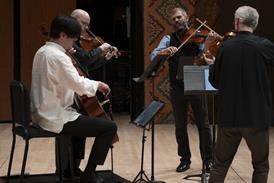
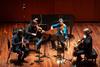
A few days before, festival director Oliver Inteeworn sang the praises of the five resident artists, who performed nine of the 30 concerts over the festival’s 18 days. ‘I don’t know how they do it,’ he told me. ‘They all have this “can-do” attitude.’ And at 5:15am on 10 July, that attitude was certainly on display during a sunrise concert in the garden of the coastal Rosecliff mansion. As the sun slowly emerged from between the trees, the performers settled into their playing and gave an impressively energised performance, particularly in Schubert’s String Quartet no.12.
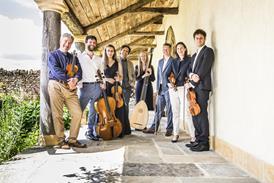
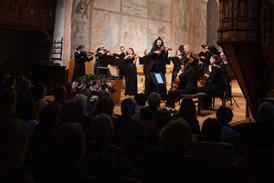
At The Breakers on 10 July, the Baroque ensemble Apollo’s Fire performed a programme inspired by the art of the duel. In some of the double concertos, the soloists literally moved towards and away from each other as if about to duel. In Bach’s Concerto for Two Violins in D minor the soloists demonstrated immediate vitality. Though their theatrical movements seemed somewhat excessive and were sometimes to the detriment of sound quality, the joy emanating from the players made up for it.
Tango Concerto (2000) for two violas da gamba, written by the group’s gambist and cellist René Schiffer, who played it alongside Rebecca Landell, was a revelation. What can only be described as ‘viola da gamba shredding’ made way for rapturous tango rhythms. It was fascinating to hear the instrument, with its distinctively muted timbre, play the role of a virtuosic protagonist.
At the outdoor concert at the Norman Bird Sanctuary (11 July), the festival artists impressed once more. In every concert their ensemble became tighter and their musical intentions more aligned. Ko had described Jean Françaix’s String Trio as ‘Poulenc on steroids’, so I was particularly excited to hear it. And I wasn’t disappointed. The piece felt almost completely random – not aleatoric, but like an unmistakably 20th-century French work written by a composer with a short attention span. Phrases would suddenly stop halfway through, and waltzes randomly become stilted. Although I couldn’t have sung a single phrase back after the performance, it was a charmingly ephemeral experience.
This outdoor concert, complete with birds chirping in the balmy air, was a fitting end to a festival with a distinctively hedonistic and summery feel to it. Yet beneath this lay serious artistic purpose, reflected in both the commitment of the musicians and the engagement of their audiences.
Read: Postcard from California: Ojai Music Festival
Read: Postcard from Port Angeles: Music on the Strait
Discover more Featured Stories like this in The Strad Playing Hub.
Read more premium content for subscribers here











No comments yet