



![Ayanna Witter-Johnson [Jordan Woods] 7](https://dnan0fzjxntrj.cloudfront.net/Pictures/274x183/4/9/4/44494_ayannawitterjohnsonjordanwoods7_224583.jpg)






US correspondent Thomas May hears Richard O’Neill and Jeremy Denk in a gripping recital presented by Seattle Chamber Music Society on 23 November 2025
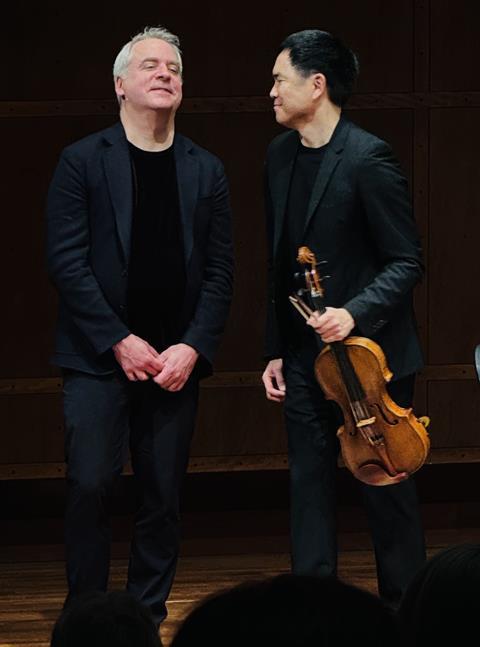
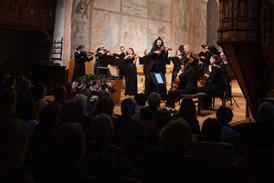
Seattle Chamber Music Society brought the inaugural season of its new Signature Series to a compelling close with this sold-out recital by violist Richard O’Neill – best known as a member of the Takács Quartet – and pianist Jeremy Denk.
The pair share a long history with the organisation, both having appeared regularly at earlier stages in their careers. That sense of return lent an affectionate charge to the matinee, as many in the passionate audience clearly remembered the artists from summer festival performances in years past. The 536-seat Nordstrom Recital Hall was filled to capacity for what proved a richly varied and wholly satisfying programme ranging from Bach to two key works of the viola repertoire from the early 20th century.
The programme opened with the G minor Sonata, BWV 1029, the third of Bach’s sonatas for viola da gamba, performed here in an arrangement for viola and piano. The duo opted for a remarkably restrained, almost understated approach marked by O’Neill’s sparing use of vibrato. O’Neill produced chaste, transparent lines that, far from feeling austere, brought a surprising warmth and honesty to the dialogue with Denk. Within this minimalism lay plenty of personality, with lightly elastic exchange in the outer movements – rhythmic inflections revealing a playful, even quirky streak – while the Adagio unfolded with a disarming, unsentimental serenity.
Hindemith’s Viola Sonata in F major, Op. 11 No. 4, dates from the period when the young composer was moving from violin to viola, and its pages betray a fascination with the latter’s dark timbre and lithe adaptability. It also offered a shift in perspective from Bach to a modern reimagining of Baroque values of clarity and counterpoint, voiced in Hindemith’s own taut, early-20th-century idiom.
O’Neill and Denk showed vivid dramatic chemistry in the opening ‘Fantasie’, balancing its rhapsodic freedom with moments of poised introspection. They were sympathetically attuned to Hindemith’s rejection of late-Romantic excess in favour of a leaner, more metrically supple idiom.
The variations that ensued – built on a modest theme marked ‘quiet and simple, like a folk song’ – offered a sequence of contrasts relished by the players, with the further variations in the finale full of surprising harmonic twists and a final, stern gathering of tautly combined energy.
Denk then took the stage alone for Beethoven’s Op. 110 Piano Sonata, offering a concise and beautifully heartfelt introduction before playing. He spoke of the opening movement as a pastoral evocation of Classical beauty tinged with shadow, and his interpretation captured precisely that mixture.
The first movement floated with an aerial lightness, while, following a ‘drunken interlude’ that was delightful in its volatility, the lengthy final movement staged a profound drama of grief and rejuvenation. Both fugues carried an unmistakable sense of epiphany, particularly in the lucid way Denk traced their emergence, as if a fresh hope were being flung suddenly into the light, just where it seemed impossible to go on. It was a phenomenal performance of fierce clarity, deeply expressive without a trace of heaviness.
Rebecca Clarke’s Viola Sonata – like Hindemith’s, completed in 1919 – provided a superb culmination. Clarke headed the score with an epigraph from Alfred de Musset about the wine of youth ‘fermenting in the veins of God’, and O’Neill and Denk captured that uncanny mix of drama and dreamy contemplation.
O’Neill navigated the sonata’s mercurial shifts of mood with a storyteller’s ease. The muted viola in the scherzo produced an enchanting sonority – teasing and faintly Debussyan yet unmistakably Clarke’s own voice. Among the striking effects was a moment in the finale in which O’Neill sustained a lengthy tremolo on the bridge, providing a foil to Denk’s rhapsodic piano.
The encore brought a poignant coda. O’Neill shared that he and Denk annually prepare a tape in honour of Toby Saks, the late cellist who founded the Society in the 1980s and led it until shortly before her death in 2013. They visit her grave each year, and this time they chose an arrangement of Schubert’s ‘Nacht und Träume’. Its forthright, unsentimental beauty cast a spell of collective stillness – a quietly moving close to several hours of exceptional music-making.
THOMAS MAY










No comments yet