











Peter Quantrill hears the performance of Bacewicz, Dvořák and Enescu at London’s Wigmore Hall on 15 July 2025
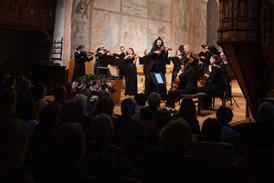
To launch this programme of Eastern European string pieces, the Kaleidoscope Collective’s cloudless consonances and summery phrasing in Grażyna Bacewicz’s Sonata for Four Violins matched the season. Immaculately proportioned in three Neoclassical movements, the sonata is no less typically Bacewicz for its elegant anonymity.
Or perhaps the op.78 Sextet by Dvořák presented an unfair comparison, when volume and tonal inflection were judged to a nicety in an acoustic that can quickly sound too small for more than a quartet. By the same token, it’s possible to imagine more unbuttoned Dvořák than this, but violinist Nathan Amaral’s contributions infused the Dumka movement with gentle melancholy, counterpointed in the following Furiant by Edgar Francis’s grainy viola.
Savitri Grier led off the evening’s main event: a rare British performance for the String Octet by George Enescu. The genuinely ‘collective’ nature of the Kaleidoscope made for outstanding clarity of counterpoint, so that Enescu’s ambition to unify four movements in one large-scale sonata form came off to exhilarating effect.
It was an education in itself to watch cellist Laura van der Heijden: she feels every note - her own and those of her colleagues. But then each member of the Kaleidoscope played off the others, raising tension and drama until the finale fairly rattled along, all its complexity absorbed into the heat of the moment. If Enescu’s Octet could be performed like this more often, it would rival the Mendelssohn in the affection of audiences; who raised the roof at the Wigmore, and rightly so.
PETER QUANTRILL
Review: Kaleidoscope Chamber Collective: Transfigured
Watch: The Kaleidoscope Chamber Collective plays Mendelssohn
Review: Kaleidoscope Chamber Collective: Brahms and Contemporaries Vol.1









No comments yet