


Tully Potter reads Jay Sweet’s biography of the legendary jazz bassist (1926–2002)
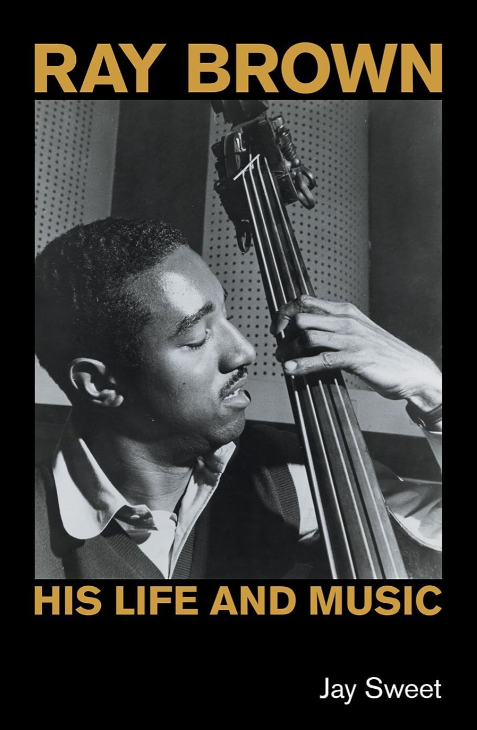
Ray Brown: His Life and Music
Jay Sweet
303PP ISBN 9781800505353
EQUINOX £32.50
Jazz’s symbiotic relationship with the recording industry delayed the emergence of great bass players; as string basses could not be heard on acoustic discs and until the advent of the microphone in 1925, brass basses of one kind or another were the rule. Despite the quality of such artists as Pops Foster, the first real star of the instrument was Jimmy Blanton (1918-42), who in a brief two-year stint with Duke Ellington set new standards of bass playing and had a huge impact on the subject of this book, Ray Brown, the finest all-round jazz bassist of the 20th century.
When Ellington and Brown made their celebrated album This One’s for Blanton, Brown contributed a note saying ‘the two reasons I began to play bass were Duke Ellington and Jimmy Blanton… I can remember clearly, as a young boy, standing outside a neighborhood bar, listening to “Things Ain’t What They Used to Be”, and always waiting to the end to hear the last two bass notes. I was playing piano at the time, but I was continually fascinated by bass. It seemed to be the heartbeat of the orchestra, especially on Duke Ellington records.’
Born in Pittsburgh on 13 October 1926, Ray Brown started piano lessons at eight – his father loved jazz piano – but at junior school there were so many pianists, he hardly got a look in, so he tried trombone before noticing that the orchestra needed bass players and there was a spare aluminium bass. ‘I started bringing it home, copying things off records.’
Racial discrimination nearly drove him into the fire service but at Schenley High School from 1940, despite being self-taught, he thrived and even managed to hear his idol Blanton. Pittsburgh had a vibrant jazz community and at 17 Brown was already becoming known. Having graduated in 1944, he went on the road with a band, encountered the innovative bassist Oscar Pettiford and in 1945 tried his luck in New York. The day before his 19th birthday he met Dizzy Gillespie, who fortuitously was in need of a bass player and became the teenager’s most important mentor, introducing him to Charlie Parker.
Author Jay Sweet, himself a bassist, can analyse Brown’s playing at all stages of his amazing career. He developed a dazzling array of pizzicato effects, rhythmic variations, slides and note bends but by 1946 was playing arco on a record – it was an aspect of his playing that he worked at, and he always had a bow handy on stage. He played with virtually every big name of his time – Miles Davis at notable exception – and by the end of the 1940s had met three crucial colleagues, singer Ella Fitzgerald, to whom he was married for a time, impresario and recording supremo Norman Granz, and Canadian pianist Oscar Peterson.
Brown worked with Peterson in a duo and the best years of his Trio, when the third member was a guitarist, Barney Kessel and then Herb Ellis – I first became aware of him via the Ella (Fitzgerald) and Louis (Armstrong) records from 1956–7, when the Trio was supplemented by a drummer. From 1959 it took on the usual formation with Ed Thigpen on drums. Brown left Peterson in 1965 and later had his own trio. His last famous small group was the LA Four with guitarist Laurindo Almeida. But he was constantly working and he can be heard on innumerable recordings with small and large groups. He diversified into cello, inventing the Kay Jazz Cello, and electric bass. His death on 2 July 2002 was quite unexpected.
Sweet gives us every recording session, including seven with André Previn, but does not explain how Brown coped with the logistics of moving such a huge instrument about. I found no mention of his small Silvestre, recently consumed in the Californian fires (he also had an Italian bass about two centuries old). The overall impression is of a basically nice guy who never stopped working on improving his artistry.
TULLY POTTER
Read: Masterclass: Bow techniques for jazz bass
Read: Making Matters: Differences in set-up between classical and jazz bass
Read: Masterclass: Using classical music in jazz improvisation







No comments yet