














Alex Laing reads Georgina Leach’s books for beginner violinists, violists and cellists
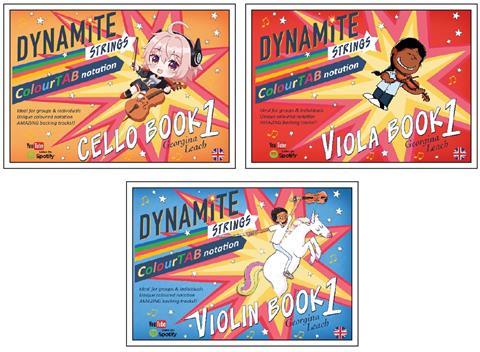
Dynamite Strings
Georgina Leach
Violin Book 1: 40PP ISBN 9781838309008
Viola Book 1: 42PP ISBN 9781838309046
Cello Book 1: 42PP ISBN 9781838309039
Dynamite Music Publications £8.95 each
On the surface, there appears to be nothing new or special about these books. Dynamite Strings is a set of colourful A5 volumes for the beginner string player, with charming cartoons of musical unicorns and pop stars designed to make playing stringed instruments accessible and relevant for very young players. As with other volumes, the young musician is taken from open strings and pizzicato to using the bow with initial left-hand fingerwork. A little theory is incorporated with good use of colour strings: notes are described as A1 (first finger on the A string) with the letters coloured for crotchets, hollow for minims and so on, as well as presented traditionally (notes on the stave). Each exercise or tune comes with a backing track, which is free on Spotify.
What separates Dynamite Strings from the bunch is the care that has been taken with each instrument’s individual book. Georgina Leach is a violinist who also plays the viola and the cello, and it is evident that she knows what she is doing. The material for the viola and cello can be paired with the violin volume, but it is arranged differently and in a more suitable order for each instrument. For example, the development of the left-hand shape for the cello (where the third finger is so important) is introduced earlier than for the violin.
The backing tracks are a triumph. Playing along will be great fun for all (including teachers). The simple, open-string writing fits beautifully into the textures, which include excellently played parts in various styles including Bluegrass, blues, disco and reggae, as well as the more traditional. I found myself believing I was part of a backing group for the latest Coldplay hit on the second track (‘The Open String Song’).
There are, however, missed opportunities with these volumes. While different genres of music are presented, little effort is made to explain them. Young musicians could be encouraged to listen to the different styles of beat in, say, disco and reggae. Sadly, no technical advice is offered in the books: while the order of material is well organised for violin, viola and cello, there are no reminders of why the cello hand shape is so important, for example.
These books would work well for groups of young musicians – the violas even get an individual voice in Twinkle. I can see these books as being excellent for teachers to use as fun early repertoire, alongside their own technical guidance with their younger performers.
ALEX LAING
Book review: Together on Strings
Book review: Violin in Action
Book review: London College of Music Violin Handbooks




















No comments yet