




Following the release of her album Shiva’s Shoes, the Tunisian-Indian violinist shares how her classical foundation forms the basis of her work that bridges various genres
Read more Featured Stories like this in The Strad Playing Hub
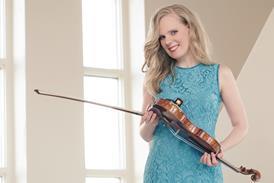
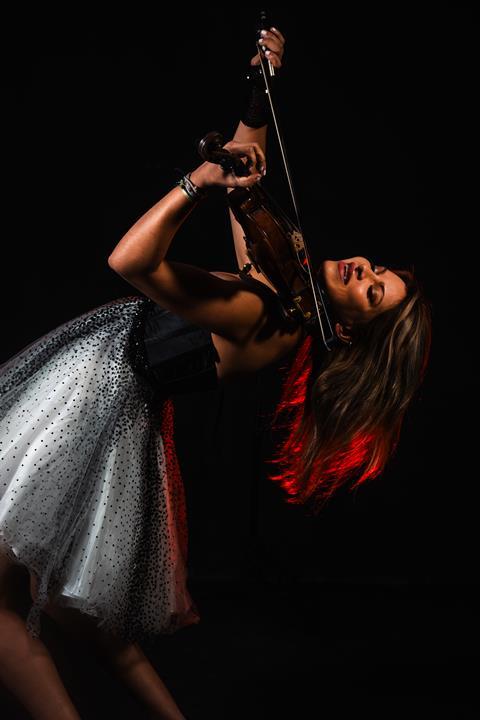
Yasmine Azaiez is a Tunisian-Indian violinist, singer, and composer based in Los Angeles. Trained at the Yehudi Menuhin School and New England Conservatory, she has performed at the Royal Albert Hall, Cairo Opera House, and Carthage Festival, and shared stages with artists including Mstislav Rostropovich and Naseer Shamma.
Azaiez blends her North African and Indian heritage with classical virtuosity, most recently on her 2025 album Shiva’s Shoes, produced by Ashish Manchanda.
She speaks to The Strad about how her work bridges contemporary classical, global rhythms, and modern production.
How do you adjust classical technique when you perform in electronic or rhythm‑focused styles?
Working in rhythm-focused or electronic settings shifts my approach from traditional classical phrasing toward a dialogue between sound, rhythm and space.
This mindset influenced my album Shiva’s Shoes. Compositionally it brought me back to basics. My previous records often had more complex arrangements, but for this project I focused on core grooves, violin textures, and strong melodic ideas.
Many pieces began as improvisations; I would record them, then shape the music by editing, rearranging phrases, and refining the form. It allowed the music to feel more raw and immediate. My classical training provided the technical foundation, while my experience with improvisation and free music allowed the melodies to evolve organically in real time.
The result is a sound world where classical contemporary and more traditional techniques, global rhythm, and improvisation coexist. I was also extremely fortunate to have performed and recorded these pieces with the incredible percussionist Tj Troy and bassist Miles Jay who have extensive knowledge of improvisation and World music. Many of these pieces were performed from beginning to end with no edits in the studio.
In highly rhythmic or dense musical textures, what becomes most important is not only the notes themselves but also the spaces between them. Silence and restraint can be just as expressive as sound, allowing the rhythm and the ensemble to breathe.
It also requires a different physical and sonic relationship with the instrument. My classical training provided the technical foundation, while my experience and studies with improvisation and free music allowed the melodies to evolve organically in real time. The result is a sound world where classical technique, global rhythm, and improvisation coexist.
Ultimately, performing in these contexts feels like composing in the moment. Each phrase melody and shape exists only once, and that fleeting quality is what makes improvisation so powerful and alive.
Silence and restraint can be just as expressive as sound, allowing the rhythm and the ensemble to breathe
How have you developed new physical ways of playing that come from working outside classical music?
Working outside of classical music has required me to rethink certain traditional violin techniques. Classical training emphasises a very specific type of tone production, precision and intonation, but the sound world can be quite different when performing in world, jazz, or rhythm-driven contexts.
I personally think having a classical music foundation is an amazing skill that opens doors to new kinds of sounds and ideas; I would not trade my classical training in both playing and composition for anything.
Very early on in my journey I began exploring alternative approaches to bowing, articulation, and intonation, which is particularly highlighted in my new album- These explorations became central to Shiva’s Shoes. Because the compositions were more stripped back, the violin itself became the main vehicle for texture, rhythm, and color, allowing these techniques to take a more prominent role.’
This process came largely through years of listening, transcription, and my heritage – studying musicians who think about sound through breath and phrasing, such as guitarists, saxophonists, and trumpeters. Wind players in particular use air and breathing to shape their sound, and I became interested in translating that sense of flow and phrasing through the bow.
The bow itself became a major tool for experimentation. I explored different attacks, slides, and fingerings to create more fluid, vocal, or percussive effects. Techniques like glissandi, altered intonation, and expressive slides help emulate the inflections of other instruments and musical traditions.
I also spent time imitating different instrumental textures – for example, using sul ponticello to create a kind of distortion, or adapting plucking techniques inspired by flamenco guitar. Much of this exploration revolves around how the bow interacts with the string: pressure, speed, and placement all shape the character of the sound.
Developing these approaches took many years of experimentation and practice, but it ultimately allowed me to expand the expressive possibilities of the violin and adapt it to a wider range of musical languages and classical training has been an important part of that.
How do you shape your own sound when combining contemporary classical writing, global rhythms and modern production?
My sound is deeply connected to my heritage. My North African and Indian background has influenced the way I approach phrasing, rhythm, and intonation. I’m especially drawn to asymmetrical rhythms and strong grooves that create movement within the music. I spent some time learning and internalising different grooves from various African traditions which was so satisfying and a lot of fun!
With my new album Shiva’s Shoes, I intentionally returned to a more raw and instinctive compositional process. Some pieces were written in less than a day – I would improvise, record the ideas, and then reshape the material by editing and rearranging sections.
Embracing the ‘raw’ essence of these compositions was a huge challenge compared to my other albums. The album focuses less on elaborate arrangements and more on rhythm, melody, violin technique, and the emotional core of the music. My favourite piece on the record is ‘Balladi,’ which plays on the words ‘Bledi’, which means my country or home in Arabic, and ’Ballad’.
What also has defined my sound goes beyond music alone. I see artistic identity as something also shaped by the broader cultural environment we live in – food, architecture, visual art, dance, fashion, and the way people express themselves in everyday life.
All these elements influence how we experience rhythm, colour, and emotion. At the same time, I believe intuition plays a crucial role. I trust my instincts and follow what feels natural.
What skills do you think young violinists should learn today to prepare for a more genre‑fluid future?
One essential skill is improvisation. Historically, musicians, especially in the Baroque era, were expected to improvise, but many students today are trained to fear ‘wrong notes’. Part of the process is learning to trust your ear and your instincts.
Deep knowledge of the fingerboard and strong intonation are fundamental. Many classical violinists already possess incredible technical abilities, yet they don’t always realise how easily those techniques can translate into creative improvisation. I am always practising my classical ‘chops’ to retain that athleticism and freedom to choose in real time.
Another valuable skill is learning to sing while playing. It took time for me to develop this, but it has deeply influenced my musicianship. Thinking like a singer encourages phrasing, breathing, and musical storytelling. I often harmonise with myself, which strengthens the connection between the ear, the voice, and the instrument.
Listening and transcription are also key. Jazz musicians often practise phrases they admire in every key, building both vocabulary and freedom. This builds both technical freedom and musical vocabulary. It is about finding sounds that inspire you and then making them your own with confidence. If you truly believe in what you are playing, the audience will believe it as well.
As Miles Davis famously said: ’If you hit a wrong note, it’s the next note you play that determines whether it’s good or bad.’










No comments yet