











The violinist discusses recording Bartók’s 44 Duos with Antoine Tamestit, reshaping the pieces for violin and viola, and drawing on the composer’s own field recordings to look beyond the printed score.
Read more Featured Stories like this in The Strad Playing Hub
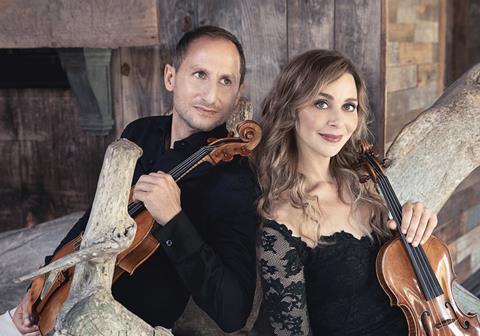
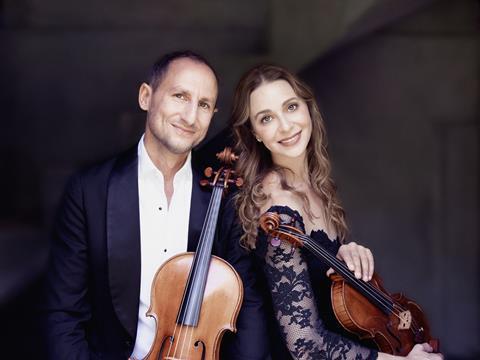
Bartók’s 44 Duos are familiar to generations of violinists, but they remain relatively unusual on recital programmes, especially when performed complete. On their new harmonia mundi album, violinist Alexandra Preucil and violist Antoine Tamestit approach the two-violin collection from a new angle, recasting it as a violin-and-viola dialogue and weaving in 11 of Bartók’s original field recordings, made in Slovakia, Romania, Ukraine, Hungary and Algeria between 1907 and 1916.
The recording presents the two musicians as the Starker Duo, named after Preucil’s grandfather, the Hungarian cellist János Starker. The use of Bartók’s source recordings places the duos close to the folk material that shaped them. The violin-and-viola pairing also became part of the interpretation: as Preucil explains below, the two musicians decided case by case which instrument should take which line, rather than simply handing the second violin part to the viola.
Bartók composed the 44 Duos in 1931 in connection with a violin method by Erich Doflein and Elma Axenfeld. Though published in an order of increasing difficulty, the pieces were not fixed in that sequence: as Claire Delamarche notes in the album booklet, Bartók allowed for concert performances arranged according to ‘a more musical logic’.
In this interview with US correspondent Thomas May, Preucil discusses recording the 44 Duos with Tamestit, working between Bartók’s score and his field recordings, reshaping the two-violin collection for violin and viola and connecting the project to her Hungarian family inheritance.
Bartók’s 44 Duos were conceived for two violins and arranged in order of difficulty, but your album turns them into a violin-and-viola journey with Bartók’s own field recordings threaded through it. How did you and Antoine Tamestit decide what shape the recording should take?
Alexandra Preucil: From the very beginning, Antoine and I played these duos together because of our mutual love of Bartók and Hungarian music. We had both played these pieces as children with our parents, and so it felt natural to play them together at home for the pure enjoyment of the music. We found ourselves wanting to know more and searching for ways to get closer to Bartók’s inspiration, which is when we began our study of the field recordings. It was at that moment that we realised we wanted to share this experience with others through this recording.
What did the field recordings reveal to you as a player – especially about timing, attack, sound, slides, vibrato or intonation – that the printed score alone could not fully convey?
Alexandra Preucil: I have always loved the extraordinary freedom of expression in these field recordings. Even with Bartók’s detailed transcriptions, the notation on the page can only capture part of what he experienced in the villages he visited. Antoine and I worked back and forth between the score and the recordings to understand the origin of each composition. We experimented with different kinds of vibrato and slides to reflect the colours and emotions of the human voice, varied our bow placement to imitate the timbre of different folk instruments, and always tried to think beyond bar lines and classical structures in order to find the natural flow of speech and dance in our playing.
What changed when the second violin part became a viola part? Did the darker colour of the viola open up possibilities, or create problems of balance and register that you had to solve?
Alexandra Preucil: One common misconception is that we simply gave the second violin part to the viola. We actually approached every single duo individually and experimented with which instrument should play which line. We listened to the field recordings and studied the stories and traditions behind each piece to guide these decisions.
Sometimes I play the first violin part and sometimes the second – and in one exceptional moment we change lines for just two notes within a duo! Maybe our listeners will be able to find that moment? Our goal was never simply to adapt the music to different instruments, but to deepen the sense of dialogue and character within each song, dance and story of every duo.
The notes suggest that you approached this music partly through living folk traditions, including táncház dance-hall practice. What did you hear or observe from folk players that changed the way you performed Bartók’s notation?
Alexandra Preucil: Growing up surrounded by my Hungarian relatives in America gave me a strong connection to the culture from an early age, but I wanted to rediscover that connection now that I live in Vienna. At the same time, Antoine has had a lifelong fascination with Hungarian music, and together we wanted to come as close as possible not only to the past but also the present of this culture.
Visiting a táncház was an important part of that journey. We were impressed by the musicians and their natural and relaxed technique, but even more inspiring was seeing the young children who came with their parents to learn and have fun with these dances. Even if they didn’t know all the steps yet, they moved naturally and instinctively to the complex rhythms. That image continues to remind us that this music was created to be lived, danced and shared – not simply performed. We tried to bring that same sense of freedom into our interpretation.
The Starker Duo takes its name from your grandfather János Starker. Did that Hungarian family connection make this Bartók project feel different from other recording projects you have undertaken?
Alexandra Preucil: I suppose the best answer is that I never really thought of this as a recording project but rather a musical need to connect my past to my present. This all began simply because Antoine and I loved playing these duos together, wanted to understand them more deeply, and in that process we looked back at the world of my grandfather.
The research, the field recordings and all of our present-day explorations happened purely out of mutual curiosity, and so it felt completely natural that this music should become our first recording together. We are so happy to honour my grandfather through our duo and hope to continue making music together that reflects his values, ideas and legacy.
Bartók: 44 Duos & Original Field Recordings, featuring Alexandra Preucil and Antoine Tamestit, is available here on the Harmonia Mundi label.












No comments yet