
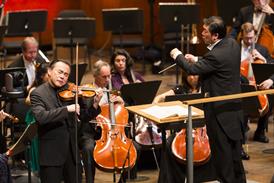


Ahead of a New York premiere on 27 October, composer Daniel Bernard Roumain shares the responsibilities and opportunities behind his work America, To US?, a violin concerto written for Tracy Silverman that ‘reflects the sounds of the world’
Discover more Featured Stories like this in The Strad Playing Hub
When I began writing America, To US?, I wanted to confront the complicated country I am living in – a deeply divided nation – and the many Americans and other humans within it. In this concerto, the soloist inhabits the role of witness in front of an orchestra that reflects our American culture in its embrace of and opposition to ideas. That tension, between witness and culture, is at the centre of this work.
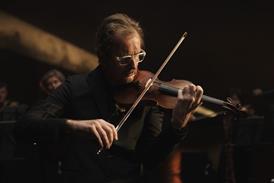
Just as importantly, this work was written for the great American violinist, Tracy Silverman, who has had violin concertos written for him by legendary composers such as John Adams, Terry Riley, and Roberto Sierra.
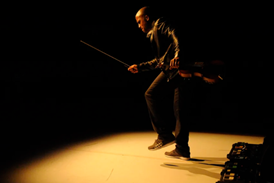
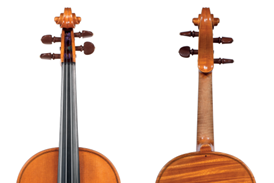
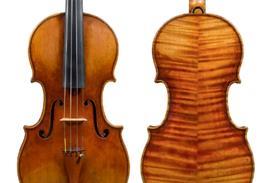
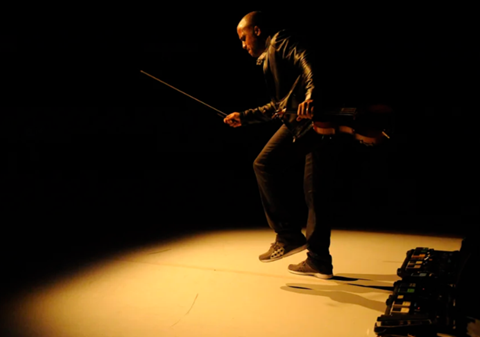
The score begins with disruption and a recurring theme of volatility. The six-string violin (tuned from a low F-C-G-D-A-E) and use of multiple sonic effects allow for a deeper and richer sound than a more traditional instrument. These effects include reverb, chorus, delay, flanger, tremolo, filters, and distortion. The names of these effects accurately depict the sounds that they make. In this, the violin doesn’t sound like a violin – it reflects the sounds of the world.
Throughout the concerto, the violinist navigates riffs, glissandi, fragments, grooves, long-lined melodies, and moments of improvisation. The music alternates between large, dense orchestral textures and intimate, clear, chamber music textures, where individual members of the orchestra collaborate closely with the soloist. A recurring rondo theme, entitled ‘In the Shadow of Moonlight’, is a slow, languid, and anguished melody that expresses my feelings of loneliness, helplessness, and yes, hope for our country.
In this, the violin doesn’t sound like a violin – it reflects the sounds of the world
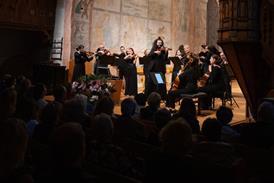
It was important to me, in a piece that is fundamentally exploring democratic ideas, that audience members be allowed to participate, speak, be seen, heard, and collaborate with their local orchestra. I invented a technique called ‘Town Hall Cadenzas’: a moment where the soloist, orchestra, and select audience members will collaborate in a spontaneous and artistically vulnerable interaction.
Similar to a town hall meeting, two microphones are placed in the aisles, on stage, or made available to the audience by two ushers. Audience members are invited and allowed to speak, sing, use sign language or movement, spoken word, or poetry, to express how they feel for one minute each. The soloist and members of the orchestra can also participate in this moment, either as one of the speakers or in a musical duet with the soloist.
This moment aligns with composed music in the score for the orchestra and improvised music for the soloist. The soloist, similar to any solo cadenza, improvises their part in response and reaction to the audience members or members of the orchestra.
Why do this? Why create a work for a very specialised instrument? Why include audience members in the piece? Why pack a violin concerto with new sounds, new ideas, people speaking singing, and expressing themselves in ways that can be deeply controversial and possibly political? Why take so many risks?
I think artists have a unique responsibility to uphold morality. A musical score holds notes, sounds, feelings, and sometimes, the morality of the composer and the community they represent. There are endless works by composers that speak to these ideas around a shared morality, and I fully embrace this tradition in America, To US?. The title is the first invitation to how I feel our country is struggling to find and define ourselves, and it is an ongoing question embedded in the founding and fabric of our country.
I think artists have a unique opportunity to share magic. Any commission is an invitation to share your imagination with an audience, and many composers have created works that inspire audiences to experience feelings that reside beyond words and past idle conversations. Where dialogue and discussion might fail, haven’t our dreams sometimes made things more clear? As a dad to a young son, I dare to dream about a more loving country, and as a composer, music has always turned the most mundane ideas into the most wondrous magic.
America, To US?, is a concerto that turns a violin into a magical instrument, capable of producing sounds beyond the limits of its own tradition; a score that allows and invites audience members into the performance of the work to contribute to its expression; and it’s an imaginative way to locate and define what might be this ever-elusive pursuit of a shared morality where peace, equality, purpose, and love anchor a small common ground for a large global community.
At its most substantial, this music is a portrait of conflict and joy and the many ways we keep dreaming, defining, and destroying ourselves in relation to one another.
My hope is that listeners hear themselves in this music, in its tenderness, terror, groove, grief, questions and resolve.
Daniel Bernard Roumain’s violin concerto America, To US? receives its New York Premiere as part of American Composers Orchestra programme Hello, America: We Gather Here presented by Carnegie Hall on 27 October.
Read: ‘I was terrified of the blank page’: Andrew Yee on becoming a composer
Read: How can a concert heal?
Discover more Featured Stories like this in The Strad Playing Hub








No comments yet