
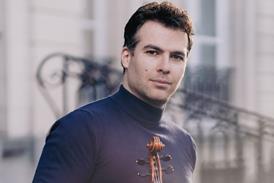

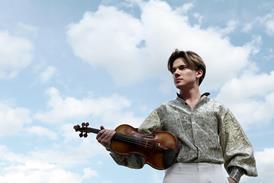
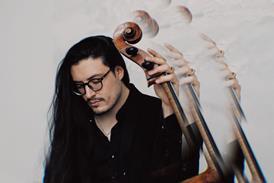
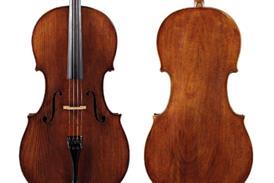
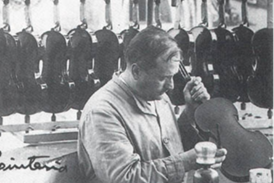


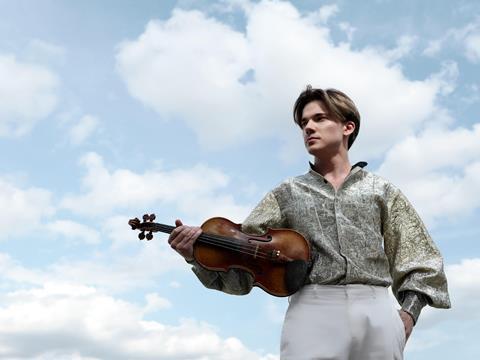
Violinist, composer and multidisciplinary artist Yury Revich shares the process behind his composition ahead of its world premiere on 12 November, which aims to bring attention to the threats of climate change
Discover more Featured Stories like this in The Strad Playing Hub
I can sit beside the ocean for hours and be perfectly happy doing very little. I watch the surface, listen to the waves and lose track of time. When I was asked to compose OCEAN, my first thought was to follow that movement: an almost minimal piece, with patterns gradually changing their rhythm, shape and intensity. But another idea kept coming back. What if I followed a person travelling across the ocean, whose home was the ocean itself?
That became my way into the piece. I imagined someone discovering places, encountering different people and carrying those experiences onwards. The ocean connects countries and cultures that can seem impossibly far apart. In the music, moods change and melodies overlap, as impressions do when we travel. It became a very human, emotional journey. I wanted the listener to feel the ocean from inside that experience, with all the wonder and uncertainty of being on it.
Nature had been finding its way into my music long before I consciously understood how much it meant to me. I looked at titles I had given my pieces: Choriner Wald, Violet, Morning Shine, my Violin Concerto Awakening, and Magic Forest, the third movement of my First Symphony, Kaleidoscope.
Environmental awareness has also been part of Festival Nights, my decentralised interdisciplinary festival. Recently in Basel, I presented PASTORALE, my vision of Beethoven’s ‘Pastoral’ Symphony for chamber ensemble, with poetry, my own compositions between the movements and visuals I created after Paul Klee’s paintings of nature. Klee had also played the violin professionally, and his love of Beethoven’s music made that connection particularly interesting to me.
There is also a neuroscientific dimension to working with sound and images: what we hear can influence what we see, and vice versa, sometimes without our noticing. Bringing music and visual art together thoughtfully can deepen the emotional experience. I find that meeting of the senses enormously inspiring. One of the mottos of my interdisciplinary work is ’seeing music and hearing art’.
One of the pleasures of composing is the feeling that I can play instruments I have never learnt. I have played the violin since I was five. On my father’s side, generations of my family have been violinists since the 19th century. I practise it, perform on it and spend a considerable part of my life with it. Composing lets me enter instruments I cannot play. I hear a wind instrument or a harp in my imagination, write for it, and feel, for a moment, that I am playing it myself. I love that freedom.
Most of my composing happens at the piano. But when I am searching for something especially melodic or emotionally exposed, I reach for the violin, even if the line will eventually belong to another instrument. Vocal music is the clearest example: I always compose vocal lines on the violin, never at the piano. With vibrato and bow technique, a stringed instrument can move between fragility and great emotional intensity. That versatility brings it wonderfully close to the human voice.
Each note has a character that can change while it is sounding, through bow speed, contact, pressure and vibrato. When I write a melody, I feel that movement as well as hear it. The hand may know where a phrase needs to go before I have found the words to explain why. This is especially present at the beginning of composing, when I am improvising or searching for a melody or other musical material. Even a bow change can make me think about continuity, interruption and where the musical thought is heading. Those questions follow me into the orchestral writing too.
I always compose vocal lines on the violin. A stringed instrument can move between fragility and great emotional intensity.
I draw enormous inspiration from violinists who were passionate about composing: Tartini, Viotti, Paganini, Sarasate, Kreisler, Ysaÿe. Their music carries knowledge of the instrument from the inside, and such different imaginations. They remind me that the repertoire we now study as tradition was once somebody trying out their own ideas. The violinist-composer became less central to mainstream solo playing in the later twentieth century, although the tradition never fully disappeared. I would love composing to feel like a more natural possibility for violinists today. For me, it has opened another relationship with the audience.
When I play someone else’s music, I feel something like an interpreter, bringing another person’s language to listeners. I find that responsibility beautiful. With my own music, I connect with the audience through my own language. For me, the connection between my music, my performance and the audience has to be emotional as well as conceptual. That emotional exchange is a central reason why I compose and perform.
In OCEAN, the relationship between violin, marimba and orchestra grows from my fascination with combining sounds. I love the sound of the marimba and the way its attack differs so much from that of string instruments. I am drawn to winds, harp and percussion, and to combinations that might not immediately suggest themselves as duo partners. Sometimes the interesting thing happens when these instruments play together, even in unison, and their identities begin to merge.
This connects with my work as an interdisciplinary artist, composing and directing what I think of as global artworks, where music, images, movement and technology belong to the same conception. Speaking of electronics, with a synthesiser I can build a sound by combining its components. I approach acoustic instruments with the same curiosity. If no single instrument sounds like what I hear in my head, I mix instruments and dynamics as a painter mixes colours on a palette. The balance between them creates a new colour with its own particular sound quality.
But the ocean also brings me back to something more urgent. Climate change is real, and the natural world that gives us so much is under pressure. As a composer, I find it impossible to separate what I write from what affects me outside the rehearsal room. Those concerns enter the music because they are already in my thoughts.
OCEAN ends dramatically and emotionally. I wanted that ending to carry the need to act, to protect something we depend on and can so easily damage.
I keep returning to the expression Mother Nature. We belong to what we are trying to protect. For me, that makes OCEAN deeply personal: a piece about being human, afloat in the world that sustains us.
OCEAN receives its world premiere at Carnegie Hall on 12 November, 7:30pm, performed by the MidAtlantic Philharmonic Orchestra.
Read: Ocean’s Call: Nature’s sublime beauty heard through the lens of a string quartet
Read: ‘An amphitheatre of sky and earth’ - Postcard from Montana: Tippet Rise
Discover more Featured Stories like this in The Strad Playing Hub











No comments yet