
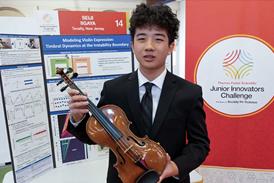












Fourteen-year-old Seiji Iigaya has won a US national science award for his project to investigate the relationship between bowing and expressive violin tone
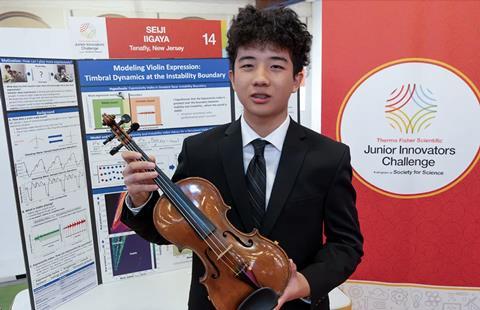
A 14-year-old violinist has won a science award for his research into how changes in bow speed and pressure affect the vibration and ‘expressivity’ of a violin string.
Seiji Iigaya, a student at Tenafly Middle School in New Jersey, US, began the computer modelling project after his violin teacher encouraged him to play with more expression. Intrigued by what that meant in physical terms, he used the programming language Python to simulate a violin string, and then modelled the interaction between bow and string, investigating how changes in bow speed and pressure affect the resulting sound.
The project, Modeling Violin Expression: Timbral Dynamics at the Instability Boundary, earned Iigaya a $3,500 educational award at the 2026 Thermo Fisher Scientific Junior Innovators Challenge, organised by the Society for Science.
‘Expressivity is inherently subjective, but in my project, I tried to quantify expressivity using an index based on spectral features,’ Iigaya told The Strad. ‘These spectral features are the spectral centroid, harmonic saturation, and microvariability. These correspond to “brightness”, “crunch” and “texture” respectively, and all contribute to what my violin teacher would call a “soloistic tone”.’
His simulations found that the index reached its highest level close to the point at which the string’s regular vibration became unstable. As bow speed and pressure increased together, the sound became ‘brighter, crunchier and rougher’ before eventually crossing the boundary into an unstable, scratchy sound.
‘I was excited to see that my simulation captured something that violinists intuitively understand: pushing the instrument toward its physical limits can produce an especially rich and expressive sound,’ Iigaya said.
Iigaya said the findings suggested that some of the tonal qualities violinists associate with expressive playing may occur within a relatively narrow range before the string’s vibration becomes unstable.
A keen violinist, Iigaya also enjoys shogi – Japanese chess – and has contributed to citizen-science projects on the Zooniverse platform. He hopes eventually to become an astrophysicist.





















No comments yet