




Ahead of a performance in London, cellist Lauren Wesley-Smith delves into how the trio expanded musical settings of the great author’s Christmas tales
Discover more Featured Stories like this in The Strad Playing Hub
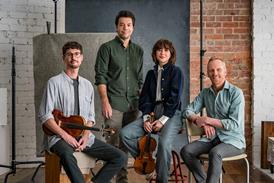
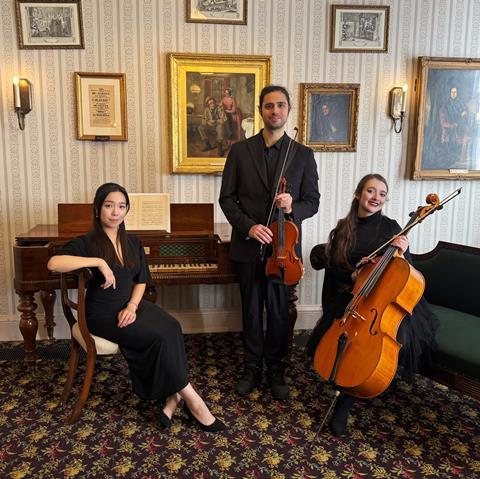
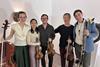
Ever since we started the Noctifer Trio in 2023, we’ve always wanted to venture beyond the canon of piano trio repertoire. Through fortuitous connections at the Charles Dickens Museum, this year we found ourselves at a table with stacks of music from the archive. Mostly for piano and voice, true, but that simply gave us a chance to do something that no-one else had.
We decided to narrow our focus to just the Christmas-related works, which still gave us plenty to work with - half the programme could have been made-up solely of sentimental ballads for Tiny Tim! Two piano works by British composers, however, naturally formed the pillars of the concert: a setting of A Christmas Carol by Alec Rowley (1892-1958), and Christmas Eve at Dingly Dell by Ezra Read (1862-1922), a descriptive fantasia of the Christmas scenes in Dickens’s Pickwick Papers.
There’s no denying that arranging an entire concert’s worth of music was a daunting prospect, but the programmatic nature of the works provided the ideal springboard. Some things jumped out at us immediately just by looking at the scores, but the real arranging was done in rehearsal.
In Rowley’s composition, we open with a cheery duet between the violin and cello, brusquely interrupted by Scrooge’s ‘Bah! Humbug!’ in the form of discordant chords for the ‘ill-tempered’ piano. There’s a moment depicting a choir of men’s voices where the cello and piano double for a wonderfully warm sound, while the chromaticism of the ghost movements lends itself well to rasping bow strokes in the cello part and eerie glissandos for the violin.
‘Mr Fezziwig’s Ball’ was especially fun to arrange, as it begins with open fifths and the instruction ‘as if tuning a violin’ – so of course we obliged! Another movement, ‘The Awakening’, indicates ‘like a harp’, making it perfect for a pizzicato interlude, following on from a movement where the solo piano shines with ringing arpeggios.
There was even more history than we bargained for, as we later discovered that Rowley was born in Ealing – where most of our rehearsals have taken place – and he later became a professor at Trinity College of Music (now the Trinity Laban Conservatoire of Music and Dance), where we we pursued our postgraduate degrees together and first established the Noctifer Trio!
Like Rowley’s composition, Read’s work also features excerpts of Dickens’s text throughout the score, and the expansion to piano trio brings to life the image of a festive party with musicians in the corner playing for the dances and games. When an old lady takes to the dance floor the violin begins to play with a creaky voice; when a little boy creeps to steal a mince pie, the strings accompany him with almost cartoonish pizzicato.
For both works it was an ongoing process to find how to best enrich the sound and, perhaps more importantly, where to step back and not play at all. Another work, The Christmas Carol Quadrilles by Edwin Merriott, benefitted from mixing up the instrumentation in its repeated sections and added flair through the use of left hand pizzicatos and ornaments.
The songs for voice and piano were more straightforward to arrange, as the violin takes the vocal line and the cello can segue between melodies, counter-melodies, and accompaniment, supported at all times by the piano. One of the biggest challenges thus far, however, has been to keep a straight face in one Tiny Tim song in which the somber lyrics ‘I begin to feel that I shall die’ are peculiarly paired with the most sing-song jovial music, making it quite accidentally humorous!
Another interesting discovery in the archive was a book of compositions for Dickens’s characters by Welsh composer Idris Lewis (1889-1952). Intended for beginner pianists, the pieces are perhaps too simple to hold up in concert as they are, but when played as a violin and cello duet the expanded timbres render them delightful.
It would have been easy to walk away from the Charles Dickens Museum with a shrug, since there was nothing in those piles of music that was actually for piano trio, but what a waste that would have been! Having the opportunity to stage the concert at Goodenough College, just a few paces away from where Dickens lived, has been a tremendous experience for us as a trio, and a chance to discover not only the voices of Dickens and these overlooked composers, but also our own.
’Noctifer Trio Presents: A Charles Dickens Christmas’ will be taking place on 5 December at Goodenough College. More information here







No comments yet