




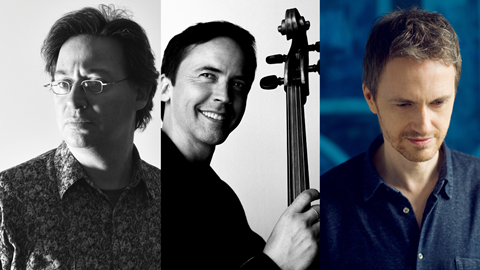
Prompted by Jean-Guihen Queyras and Alexandre Tharaud and guided by a revelation from Mozart’s Sinfonia Concertante, the composer charts the evolution of a five‑movement work where orchestra and soloists blur, collide and ultimately redefine each other
Read more Featured Stories like this in The Strad Playing Hub
Before I start a piece, I usually come up with a title, even if I have no idea what the piece will be about. The title serves as my programme and preliminary draft.
In this case, there was a request before the title: Jean-Guihen Queyras and Alexandre Tharaud asked me to write a duet for them to celebrate their 20 years of artistic collaboration. That was enough motivation.
Before I could respond, the pandemic arrived and darkened the artistic sky; making music together had disappeared. I devoted myself to writing works for soloist friends. I wrote 24 Préludes for Alexandre Tharaud, a partita for Isabelle Faust, and another partita for the Swiss harpist Nathalie Amstutz.
Then came a second call from Jean-Guihen and Alexandre. I thought they were going to tell me that there would be no more duet project. Instead, they told me to forget about the duet, that they wanted something crazier: a double concerto for them and an orchestra. I had already forgotten that orchestras even existed, but the suggestion got me thinking – the pandemic had at least one positive aspect, that we had time to think.
Too much time to think. For months, the project was called Double Concerto – so was also our WhatsApp group called – but I wasn’t convinced by the title, and without a title I can’t start working, because the title is the project.
I started listening to double concertos. The one by Brahms, which I conducted many years ago, the one by Bartók for two pianos, the one by Lutoslawski, the one by Ligeti, mysterious and not at all virtuosic, the one by Stravinsky for two pianos, brilliant but without an orchestra, Beethoven’s spectacular Triple Concerto, Bartók’s Concerto for Orchestra. I couldn’t come up with any ideas. Until, thanks to the almighty algorithm, I came across Mozart’s Sinfonia Concertante for Violin and Viola.
The first question was: Why did he call it a symphony and not a double concerto, when both forms meet the same standard? There had to be something else. And when I understood it, I realised what the challenge of my own project had to be: Mozart called it a symphony because there is no dialogue or conflict, at least not from the beginning, between the soloists and the orchestra, but actually the soloists are initially part of the orchestra, which at some point spits them out like olive pits and pushes them into the middle of the dance floor, so that, separated from the group of violins and violas, they become independent and take centre stage. The orchestra is like a choir that expels soloists and then takes them back in, a trick I often use in my operas.
That had to be my project: the soloists had to come out of the orchestra – and in return, the orchestra also had to come out of the soloists. And I set to work.
In the first movement, the trumpets begin playing inside the piano (with the sustain pedal open), causing the strings to vibrate. Various ideas arise from this gesture, from the resonance. The rest of the movement is nothing more than the distribution of this initial energy, which explodes in all possible instrumental combinations, including the two soloists – it is an invocation of movement.
There is something magical about music, because although it consists of individual notes thrown into the air by individual instruments, all of this creates a common movement, speed, and vertigo.
The second movement attempts to evoke the idea of floating through lines that resist falling and a light framework of the orchestra that tries to keep the melodies in the air. Another lesson from Mozart: music naturally tends to fall into the depths, and the composer’s task – almost the only one – is not to let it fall.
The third movement, a scherzo, depicts a ping-pong effect between the two soloists, and the orchestra prolongs this effect by extending the resonances and sound trails.
The fourth movement is called Fontana and pays homage to the painter and sculptor Lucio Fontana, who is known for his cuts that bring a third dimension to the canvas in the form of an enigmatic hole. Fontana’s cuts are represented here by rapid glissandi.
The fifth movement, a finale, takes up motifs from the four preceding movements and combines them into a kind of crowning fireworks display.
Oscar Strasnoy’s Sinfonia Concertante for cello and piano will be premiered by Jean Guihen-Queyras, Alexandre Tharaud and the Orchestre Philharmonique de Strasbourg on 6 March in Strasbourg and 9 March in Paris.
Read: Beyond the practice room: how musicians and music schools must evolve to thrive in a changing world
Read: Why practice doesn’t prepare musicians for performance
Read more Featured Stories like this in The Strad Playing Hub











No comments yet