









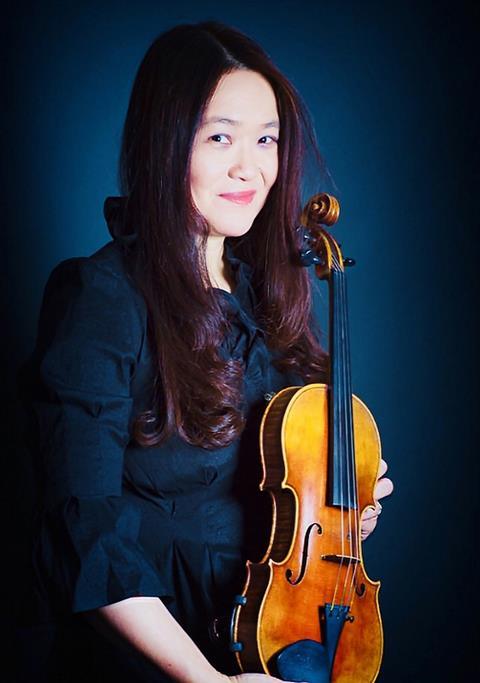
There is no shortage of recordings featuring staple violin repertoire, so why record them again? Violinist Sonia Lee makes the case for why performers and listeners keep coming back to old favourites and how there is always more to say in these pieces, as she releases her album Heartstrings Highlights
Read more Featured Stories like this in The Strad Playing Hub
There is certainly no shortage of interpretations of Bach’s Arioso, Elgar’s Salut d’amour, the Méditation from Massenet’s Thaïs, Kreisler’s Liebesleid, the Canzonetta from Tchaikovsky’s Violin Concerto, Bach/Gounod’s Ave Maria, Strauss’s Morgen!, Rachmaninoff’s Vocalise, or Monti’s Czardas. These are not forgotten masterpieces waiting to be rediscovered. They have been recorded, performed in concert halls and cherished by listeners for generations.
That, for us, was precisely the reason to highlight them.
This repertoire entered our lives when we were first becoming classical musicians. Long before recording them, they were part of the musical world in which we learnt to listen and communicate. Some pieces challenge a musician through their technical complexity; others present a different challenge altogether. Their notes may appear straightforward on the page, but their familiarity leaves the performer nowhere to hide. When an audience already knows a melody, what matters is not simply playing it beautifully, but finding something personal and sincere to say through it.
Recording this repertoire now is not simply an exercise in nostalgia, nor an attempt to produce a ’definitive’ recording of works that have already received extraordinary interpretations. Instead, Heartstrings Highlights gave us an opportunity to revisit music that helped form us as musicians and to discover what it means to us after years of living, performing and listening.
That question feels particularly meaningful in 2026. Through technology, a few taps can take us from Bach to Tchaikovsky to Rachmaninoff, performed by musicians across generations. We live with high-speed internet, artificial intelligence, social media and seemingly endless streams of information and entertainment competing for our attention.
In such a world, what is the point of adding one more recording of music people already know?
Perhaps familiarity is not the problem. Perhaps it is part of the answer.
There is a reason someone still wants to hear Salut d’amour. There is a reason the opening of the Méditation can stop us in our tracks even when we know exactly what comes next. There is a reason we return to the melancholy of Kreisler’s Liebesleid, the lyricism of Rachmaninoff’s Vocalise, or the irrepressible energy of Monti’s Czardas. And there is a reason musicians continue, generation after generation, to find something new in Bach.
These works have survived not because audiences lack alternatives, but because they continue to speak to something recognisably human.
What is the point of adding one more recording of music people already know? Perhaps familiarity is not the problem. Perhaps it is part of the answer
While preparing this project, we returned to Jonathan Swift’s Gulliver’s Travels. Readers may remember Gulliver among the tiny inhabitants of Lilliput, but most intriguing was the land of Laputa, Swift’s strange society preoccupied with mathematics, science, invention and intellectual advancement. Written nearly three centuries ago, it can feel surprisingly contemporary. Our own world is extraordinarily different from Swift’s, but his satire raises a question that remains relevant: as our capacity for knowledge and invention expands, what happens to the ordinary human experiences that give life meaning?
Technology changes. Our capacity to communicate expands. The volume of information surrounding us grows almost beyond comprehension.
Humanity, however, remains familiar.
We still fall in love. We still lose people we love. We celebrate, regret, remember, hope, laugh and grieve. We still experience moments for which words seem inadequate. And sometimes a melody written a century, or three centuries ago, reaches those parts of us more directly than anything we could say.
Perhaps that explains why these particular works have endured. Salut d’amour was written out of love. Liebesleid gives voice to love’s sorrow. Morgen! looks toward the promise of tomorrow. The Vocalise, remarkably, needs no words at all. Each approaches human feeling differently, yet each reminds us that music can articulate experiences that resist ordinary language. Together, they became the emotional thread running through Heartstrings Highlights.
There is also something wonderfully simple about the act of making this music. Musicians sit together with their voice, violin and a piano. We interact with one another, react, breathe together and make countless decisions about the direction of a phrase. Our performance is created in those interactions. Even with music we have known for years, it is never reproduced in exactly the same way.
Communication between musicians was the highlight in making this recording. Chamber music depends upon attention: not only to the score, but to the person beside you. One musician may linger for an instant and the other responds; a phrase may unfold differently because of the sound produced in that particular moment. The interpretation becomes a conversation.
And then another person enters that conversation: the listener.
That may be what makes recording familiar repertoire worthwhile. A score can remain unchanged for centuries, yet every performance occurs at a particular moment, between particular musicians, for listeners bringing their own memories and experiences to what they hear. The notes may remain the same, but neither the musicians nor the listeners do.
We approached these works with reverence for the composers who created them and gratitude for the role their music has played in our own lives. In that sense, Heartstrings Highlights looks backward, toward music that helped form us as musicians. But it is equally about the present: who we are now, what these pieces mean to us now, and what they might mean to someone encountering, or rediscovering them today.
In an age defined by extraordinary technological change, there is something reassuring about the endurance of a melody. New technologies will continue to change how music is recorded, distributed and discovered. But the fundamental impulse behind music making remains remarkably constant: one person trying to communicate something to another.
These pieces have travelled across generations because they continue to make us feel something. We did not record Heartstrings Highlights because this repertoire needed another definitive interpretation. We recorded it because this music still pulls at our heartstrings and because we wanted to add our own voices to the long conversation surrounding it.
If these performances encourage someone to stop for a moment, listen, remember and hear differently, then that is reason enough to have recorded these highlights that resonate deeply with our heartstrings.
Heartstrings Highlights featuring violinist Sonia Lee and pianist Benjamin Loeb is out now on St7dio-Classical.












No comments yet