
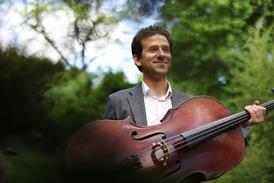
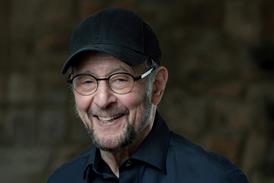



Drawing inspiration from James Turrell’s light installations, cellist Gabriel Cabezas and composer Alyssa Weinberg explore the relationship between sound, space and perception in Pieces of Light. Cabezas speaks about multitracking, extended techniques and finding freedom in interpretation
Discover more Featured Stories like this in The Strad Playing Hub
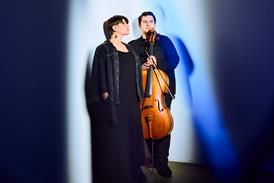
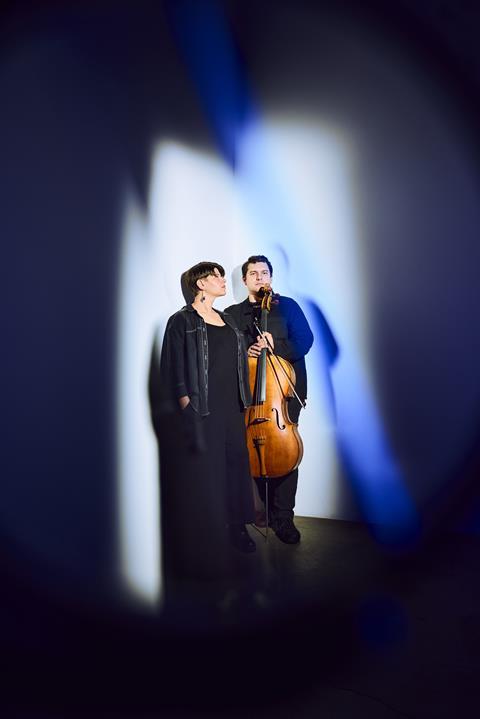
Cellist Gabriel Cabezas releases PIeces of Light, a new recording of Alyssa Weinberg’s music for solo and layered cello. Cabezas and Weinberg collaborated closely on the project, which takes inspiration from the artist James Turrell’s light installations. The works explore parallels between the properties of light and sound as well as the sensorial power they wield over human experience. Cabezas speaks to The Strad about the project, including the challenges of recording alone on solo and multitracked cello.
You and Alyssa Weinberg visited James Turrell’s Into the Light exhibition together in 2019, and that experience became a catalyst for the project Pieces of Light. What do you remember most vividly from that visit?
I mostly remember each part of the exhibition that we visited as its own completely encompassing world, where the light, or absence of light, created an environment where I felt I was sort of suspended and out of time.
I remember talking with Alyssa about similar feelings, and her music often looks to alter perception, and it only seemed natural that she use Turrell’s work as an inspiration for a big work for solo cello, which we were already discussing!
Turrell often makes you question where an object ends, and perception begins. How did Pieces of Light change the way you think about what a cello sound actually is?
There’s something about experiencing light without necessarily seeing its source, and sound without seeing its source, that has so much possibility. There’s a physical action that makes the sound on the cello, but making an album and having your listener not necessarily be immediately connected to watching your instrument gives you a lot of opportunity to create sounds that can be interpreted in many different ways. You can hear the texture of each note differently, not knowing exactly how it’s produced.
What Alyssa and I wanted to do is create sonic spaces that allow your brain to slip seamlessly into whatever kind of perception it finds natural – and I know that sometimes, listening to some of the pieces, I’m not entirely sure how exactly I made every aspect of the different sounds! It’s mostly constructed with both ’normal’ notes (including lots of harmonics) and fairly standard extended techniques (crunches, col legno ricochets, etc.), but in combination Alyssa has made clusters of sound that have their own shape and physicality. These shape the music in a way that makes your brain look for line, melody, and harmony without giving much to you outright.
You’ve said that some of the hardest material on the album isn’t the flashy high harmonics or rapid passages, but the extremely quiet music, where tiny changes in bow pressure and intonation matter. Why is playing softly so much harder than playing something technically virtuosic?
For me, virtuosity really is just control, and that can be expressed in a lot of different ways. We immediately might think of virtuosic passagework that really works out your left hand as ‘virtuosity’, but there are lots of aspects to that kind of playing that might actually be really comfortable; maybe your right hand is playing a comfortable stroke in a sort of medium dynamic, for example. It’s the control over the instrument in pursuit of some kind of expressive goal that makes it virtuosic.
So when you’re playing very softly, or looking for unstable sounds in a way where they have to be precise or sculpted outside of the norm of what we’re taught to do on the instrument, to me there’s a ton of virtuosity in that. I’ve cracked enough harmonics in my life that it’s intensely satisfying to get something soft and well placed right!
What’s strange or exciting about essentially playing chamber music with recordings of yourself?
It’s interesting, since you might inherently think about creating work with layered instruments as chamber music, but in this case adding each layer was mostly an act of creation and not interpretation, and for me that occupied a different kind of headspace.
A lot of these works started life as either completed pieces or sketches for just one cello (five of them in particular I frequently play in their original version), but we wanted to take the opportunity of making the album in a studio and not a concert hall to mess around and play with the pieces a bit, adding layers to emphasise or shade moments differently.
One of the pieces, Dissolve, was actually constructed after the recording sessions were over – Alyssa had me play a wide variety of cells of material, almost like a sample library, and she put it together in a DAW (Digital Audio Workstation) later, so the end product was a surprise to me!
I’d say the only time I was making very conscious ’chamber music’ with myself was in the two Ganzfeld pieces, which Alyssa constructed as cello choir ’chorales’ that we saturated with different techniques. I definitely had to be careful with timing and intonation on those!
How did working on such an open-ended contemporary score change how you subsequently approach more traditional cello repertoire?
Interpretation is really so fluid in any kind of score! In a traditional score, you might have some tension between what you perceive as a strict interpretation of the notation in your edition and a musical choice that’s maybe ’traditional’, but seems a little more out there.
What I think is interesting is that these both might be super valid choices – one of the things I’ve always noticed in working with composers is how mini performance traditions are almost immediately baked into a piece after a couple of concerts, and so, especially if you can trace your choice to players who worked with the composer in question, it’s possible that that’s the more ’correct’ choice, in a way!
The intent of the composer is always a bit elusive, and that’s where you come in as a performer. There’s certainly plenty of that in Pieces of Light, and there’s always a chance that an edition of it in 20 years is missing a marking or indication that Alyssa and I agreed on, and I ’correct’ that for a student, and they teach someone else that same interpretation, and on and on and on.
It’s this kind of uncertainty, that’s already in all music, that I think is freeing in interpreting scores from any time – all that matters is how much you believe in your choices and communicate them to your audience.
Pieces of Light is out now on MASS MoCA Records
Watch: Cellist Gabriel Cabezas performs Alyssa Weinberg’s ‘Pieces of Light’
Read: How can a concert heal?
Discover more Featured Stories like this in The Strad Playing Hub












No comments yet