




Violinist Oleksii Hamov on Naum Lapynsky’s 1935 Sonata and Mykola Silvansky’s Sonata in A minor (1978): two little-known works whose performance challenges had not previously received detailed analysis in Ukrainian musicology – and what they demand of a duo
Read more Featured Stories like this in The Strad Playing Hub
Ask a violinist to name a Ukrainian sonata and you will hear the same three answers: Lyatoshynsky, Kosenko, Skoryk. That is a remarkably short list for a repertoire that stretches from Maksym Berezovsky’s Sonata for violin and harpsichord, written in Pisa in 1772, to the eight sonatas Yuri Ishchenko produced between 1969 and 2006.
Two of the most rewarding works in that history had received virtually no attention from performers or scholars until I took them up for my doctoral project: the one-movement Sonata by Naum Lapynsky (1935) and Mykola Silvansky’s Sonata in A minor (1978). Both are in print, both are playable by a strong conservatoire duo, and neither has developed an established recording tradition.
Lapynsky: ten minutes that feel like forty
Naum Lapynsky (1900–60) was born in Uman and graduated from the Kyiv Conservatory in 1935 – in composition from Lev Revutsky’s class, and in violin from David Berthier’s. He spent 15 years as a rank-and-file orchestral violinist before settling in Kyiv, and the sonata he wrote in his graduation year is unmistakably the work of someone who knew the instrument from the inside.
It is a single movement of about ten minutes, neo-Romantic, in C minor, laid out as a full sonata allegro with introduction, development, recapitulation and coda. The deceptive thing is its scale: at first glance a ten-minute one-movement piece looks like a programme filler. It is not. Both players are treated as soloists throughout, and neither ever gets to hide.
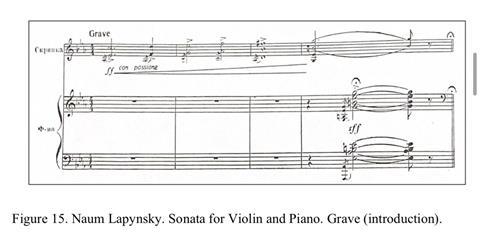
The four-bar Grave introduction is the violin alone, and it sets the terms. Lapynsky writes broken chords that climb, chord by accented chord, to a high G that hangs in the air like a question mark. The temptation is to attack each chord separately for effect. Resist it: break the chords very smoothly, keep one continuous line through them as though playing Bach, and build a single large crescendo into the piano’s entry. The wide intervals, octaves and seventh chords are uncomfortable, but the theatricality comes from the curve of the whole phrase, not from individual arrivals.
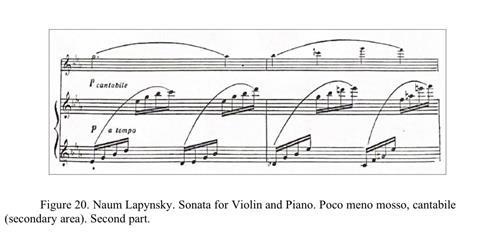
The secondary area — Poco meno mosso, cantabile — begins with the piano alone, and when the violin enters it is doubling a melodic line that sounds an octave above what you are playing. Fingering choice here decides whether the passage works. Choose positions that let the bow carry the main line without breaking the composer’s slurs and accept that this whole section must live at a genuine piano; that restraint is what makes the later climax mean anything.
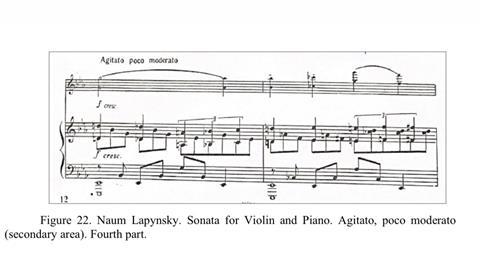
That climax arrives at bars 87–92, marked Agitato poco moderato: octave doublings and triplets in a punishing tessitura. My solution is to begin the octaves with conventional 1–4 fingering and then, as the crescendo takes you into the high positions, switch to fingered octaves (1–3–2–4). The change costs nothing musically and buys you the security to phrase rather than survive. Underneath, incidentally, the octave bass descends in a chromatic line – a passus duriusculus, the old rhetorical figure of lament, which tells you a good deal about how the passage should sound.
Silvansky: folklore with teeth
Mykola Silvansky (1916–85) came to music late – he began systematic piano study only in 1933 – trained with Yakov Flier at the Moscow Conservatory and taught piano in Kyiv from 1954. He is remembered, if at all, for children’s music. The A minor Sonata of 1978 is nothing of the kind.
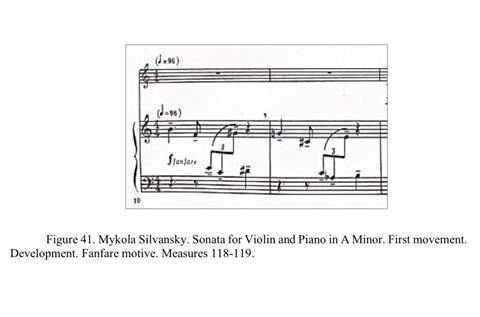
Four movements are bound together by a single ‘fanfare motive’ that first appears in the development of the first movement and returns transformed in the third and fourth. In the finale it becomes openly celebratory; in the third movement it turns declamatory and severe. Tracing that motive through the cycle is the first job a duo should do together, before a note is rehearsed.
The intonational world is Ukrainian folk song, specifically the modes with augmented seconds – Dorian and Phrygian, the augmented step falling between the second and third or sixth and seventh degrees. These intervals are not decorative. Sensitive tuning of the augmented and diminished intervals is what gives the themes their flavour, and sloppy intonation here does not sound merely out of tune, it sounds like different music.
Practical points: In the first movement, honour the Andantino: the marking exists to keep the improvisatory violin monologue from turning fussy. The development is full of augmented fourths and perfect fifths that force position changes — check them slowly and minimise the shifts.
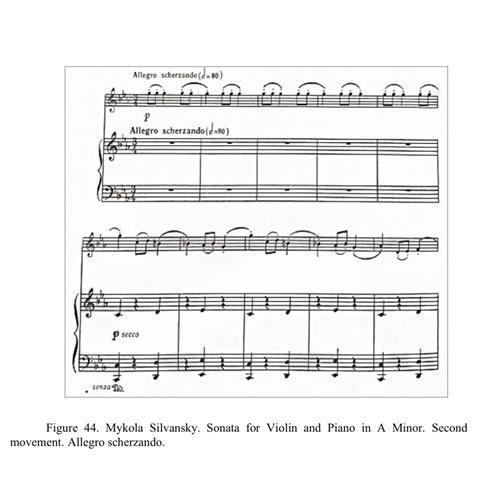
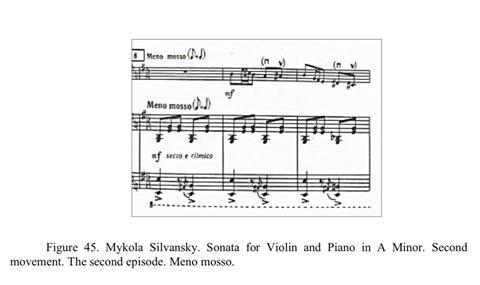
The Allegro scherzando refrain wants a saltando played on separate bows rather than one, close to the frog, with the rebound of the first note carefully controlled. Where five notes are written under one bow (bars 12–13 and their parallels), four notes per bow is a legitimate simplification that preserves the musical effect while giving the player greater control. The second episode is built on kolomyika, the Hutsul group dance, and the whole character depends on not rushing the last two quavers of the five-beat bar.
The Andante espressivo is the movement that separates good duos from great ones. Its phrase lengths are deliberately irregular – five, seven and eight bars, then five, three and ten – because that asymmetry is how Ukrainian folk song breathes. Map the phrases before you play them. The theme contains a leap of a diminished sixth on the E string; a light ‘air glissando’ connecting the two notes is idiomatic, not a lapse of taste.
In the finale, a compact staccato near the frog, crotchets taken with an attack rather than a relaxed arm, and one small colouristic gift: take the G on the A string rather than the open string, and the violin acquires the timbre of a bell.
Why now
Both scores survive in Muzychna Ukraina editions and can be found in the libraries of the Tchaikovsky Academy in Kyiv and the Lysenko Academy in Lviv, yet neither work has entered the established violin repertoire. Neither composer will ever displace Skoryk in the recital repertoire, and neither should. But a canon of three sonatas is not a canon. These works have spent decades at the margins of the repertoire. They deserve to be heard again – and they are ready when we are.
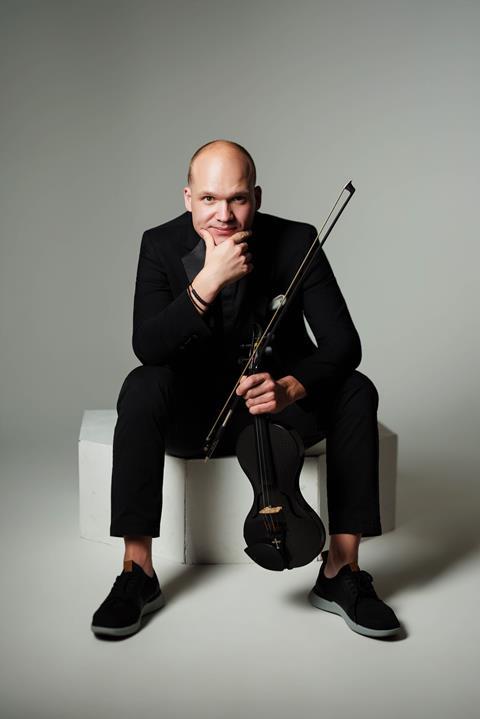
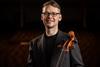
Oleksii Hamov is a violinist and former Lecturer in Strings at Colorado State University Pueblo. He is an orchestra member of the Baton Rouge Symphony Orchestra and the South Florida Symphony Orchestra. His doctoral project at the University of Nevada, Las Vegas presented the first performance-focused study of the violin sonatas of Naum Lapynsky and Mykola Silvansky in Ukrainian musicology.









No comments yet