

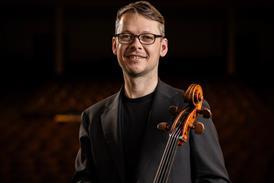


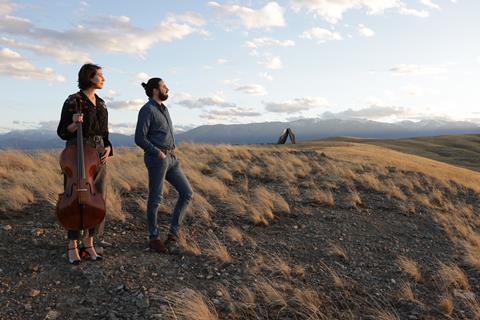
At Tippet Rise in Montana, where music meets landscape and sculpture, Franco-Belgian cellist Camille Thomas reflects on creating her new album Rendez-vous.
Read more Featured Stories like this in The Strad Playing Hub
Set on a vast working ranch in the wide-open Montana landscape near Yellowstone, Tippet Rise Art Center occupies a landscape where music, architecture and large-scale sculpture intersect in unusual ways. Spread across thousands of acres at the foot of the Beartooth Mountains, the site places works by artists such as Mark di Suvero and Ai Weiwei directly within the open terrain, so that visitors encounter them as part of a shifting natural environment of light, distance and weather.
Recordings form a central part of Tippet Rise’s activity, with projects made in the Olivier Music Barn and developed further in its purpose-built mastering studio, designed for detailed and immersive listening.
It was during a residency at Tippet Rise that cellist Camille Thomas and pianist Julien Brocal conceived Rendez-vous, a project that pairs familiar repertoire – from Bach and Satie to Saint-Saëns and Pärt – with a series of newly created ‘Reflections’. Recorded in the Olivier Music Barn and later extended through a set of short films placing performance within the surrounding landscape and among the sculptures themselves, the project moves between studio precision and a more expansive visual and spatial context.
Thomas spoke to US correspondent Thomas May the origins of the project, her experience of composing and collaborating with Brocal and the role that Tippet Rise played in shaping the work.
What was the original impulse behind the project, and at what point did you realise it would become a dialogue between past and present rather than a conventional recital programme?
Camille Thomas: The project was born from an invitation that pianist Julien Brocal and I received to spend a few days in residence at Tippet Rise Art Center in Montana, a truly extraordinary place created by very generous patrons, Peter and Cathy Halstead.
They offered us complete freedom. No constraints, no expectations, not even an obligation to produce a result. I believe this is where true creation begins: in freedom.
The idea of RENDEZ-VOUS came quite naturally. It was first a rendez-vous with silence, with nature, with a different rhythm of life, far from airports and concert halls. Then it became a rendez-vous with music itself.
I wanted to bring together pieces that are like emotional memories, almost like little Proustian madeleines for the listener – music that lives somewhere inside us, even if we are not familiar with classical repertoire. Works like The Swan, Gymnopédie, or Ave Maria. And from these, to create a second rendez-vous, a reflection: something born in the present moment, written during that time in Montana.
There are many layers of rendez-vous in this project: between Julien and me and this extraordinary place; between the audience and music they may recognise almost unconsciously; and between past and present, between these masterpieces and our reflections. And finally, a very contemporary rendez-vous, with the audience meeting us each month on streaming platforms, chapter by chapter.
I wanted to bring together pieces that are like emotional memories, almost like little Proustian madeleines for the listener
The ‘Reflections’ place you not only as interpreter but as composer. When writing them, were you thinking primarily from the physical language of the cello – bow, breath, resonance – or from a more abstract musical standpoint?
Camille Thomas: This was the first time in my life that I truly allowed myself to improvise, to feel free and even, in a way, to compose. It had been a deep desire of mine for a long time to step beyond the role of interpreter and to create, to transform existing material into something new, almost like a sculptor working with sound.
I would never have dared to do this without the trust we were given at Tippet Rise. The absence of pressure, the possibility to explore freely, made everything possible. And I could not have done it without Julien Brocal. He is a true composer, and for many years he has encouraged me to improvise. He was really the initiator of this liberation, and I am deeply grateful to him.
I see our work together almost as a dialogue, reminiscent, in a very humble way, of the relationship between Chopin and Franchomme. Having worked together on Chopin before, we somehow stepped into those roles ourselves, embodying that dialogue between composer and instrumental voice. That experience deeply inspired the way we approached Rendez-vous.
The ‘With Surprises’ pairing draws on Radiohead’s No Surprises, a song from your adolescence. What specifically did you borrow or transform – harmony, atmosphere, structure – and how did you integrate it into the classical material?
Camille Thomas: With Surprises is inspired by a song by the English band Radiohead, and at first one might wonder what the connection is with Satie. But for us, there is a very clear link.
It comes from the piano introduction of No Surprises, with its very simple, repeating notes, which deeply resonate with Satie’s musical language.
We started from a Gnossienne by Satie and integrated elements inspired by No Surprises, not as a quotation, but as a transformation. We reshaped the melody into Satie’s rhythmic language, more fragmented and pulsed.
At times, we introduced harmonies closer to Radiohead’s world, filtered through a Satie-like aesthetic, with almost oriental colours and augmented intervals that blur the boundaries between the two worlds.
What I love is that shifting perception. You think you recognise the song, and suddenly you are immersed in another world – and then you return again. That is where the true ‘surprise’ happens, and we had great joy creating this chapter.
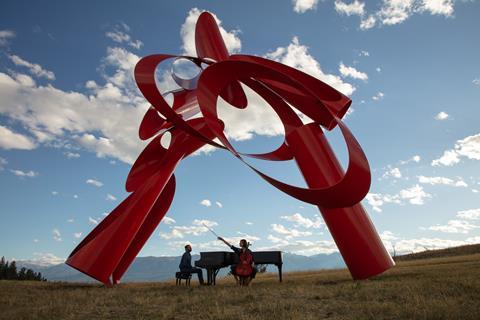
Why was Tippet Rise the right place for this project? In that environment of vast horizons and monumental sculpture, did the physical scale and silence alter your perception of tempo, projection or the length of a sustained line?
Camille Thomas: Being a musician, and the life that comes with it, carries its own weight and pressures. But at Tippet Rise, there was a sense of calm and trust that allowed us to create without fear. For a moment, the anxiety was simply on pause.
I believe something very special was born from that freedom, in the heart of Montana.
I love science fiction films like Interstellar, and for me, Tippet Rise felt like a planet of its own – a planet of vastness, beauty and nature, and an infinite hope in the power of art.
It was also a very special moment for Julien and me. The musical and creative bond that connects us could be explored there in its purest form, without the stress of concerts or travel, almost as if we were on another planet.
It was not just a place, but a state of mind, where sound and imagination could expand beyond their usual limits.
The project includes short films set within Tippet Rise’s landscape and sculptures. How were those performances realised – were they captured live in situ or conceived separately from the recording sessions – and did the presence of the camera influence the pacing or physicality of your playing?
Camille Thomas: The films were created in a second phase of the project. During the residency, we recorded the entire album in the studio at Tippet Rise, an exceptional recording environment designed to capture sound with extraordinary precision and depth. A few months later, we returned in September with filmmakers Martin Mirabel and Colin Morvan to create the visual part of the project.
The park is filled with monumental sculptures placed throughout the landscape by artists such as Richard Serra, Ai Weiwei and Mark di Suvero. These works had deeply inspired us, and we wanted each chapter of Rendez-vous to be connected to one of them. The team at the Art Center moved a Steinway piano into the open landscape, in front of each sculpture, so that we could perform and film there. It created powerful images where music, nature and sculpture enter into dialogue.
I have always believed that the more we build bridges between the arts, the stronger the emotional impact becomes. I had already explored this idea during the Covid period, filming in empty museums, and this felt like a continuation of that vision.
The album was mastered in Tippet Rise’s new Arup-designed studio for immersive Dolby Atmos release. Did knowing the listener might experience the cello in such spatial detail affect your choices of vibrato, bow speed or dynamic shading?
Camille Thomas: For me, the way an album is recorded is a little like playing for four people or for ten thousand in a concert hall. In both cases, I give everything. I always try to reach the highest level of musical and technical truth, so it did not change the way I play.
However, the experience of listening back in that studio was unforgettable. The level of detail and spatial immersion was unlike anything I had experienced before.
I remember sitting there listening, and I was deeply moved – I had tears in my eyes. It felt as if the experience of a live concert had been amplified in space in a very powerful way. This technology is truly extraordinary, and discovering it there was a very emotional moment for me.
Read: Sentimental Work: Camille Thomas
Read: Camille Thomas: Voice of Hope
Read: Camille Thomas: Saint-Saëns, Offenbach
Discover more Featured Stories like this in The Strad Playing Hub








No comments yet