







Kevin MacDonald discovers a plethora of ‘golden age’ instruments and a fine selection of bows at this season’s London sales
Read more news articles here
Read more premium content for subscribers here
Wars and rumours of wars were no doubt in the subconscious of prospective bidders in the spring sales. Overall results were only slightly better than October. Ingles & Hayday (I&H) once again just capped two million in overall sales, though with an improved sales rate of 78 per cent. Tarisio likewise increased their amount sold at first pass to 89.5 per cent. Other houses appear to have done rather less well by percentage, but Bromptons probably came tops in terms of total sales. Across the board there were fewer high ticket lots than usual and those that were offered were sometimes not easy to sell.
The top lot of the season by a long chalk was undoubtedly the c.1750 Nicolò Gagliano cello sold by Bromptons, doubling its top estimate at £600,000. It was backed up by dendrochronology from Peter Ratcliff, providing latest ring dates of 1728 and 1738, with cross-matches to other fine Italian instruments. It featured its original neck (re-angled at the heel) and was in a particularly fine state of preservation. At Tarisio, fine cellos of a newer vintage were also the order of the day with an immaculate 1933 instrument made in Turin by Annibale Fagnola, still bearing its original customs seal, selling at £160,000.
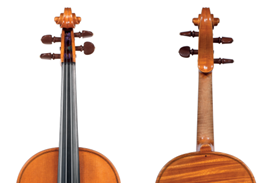
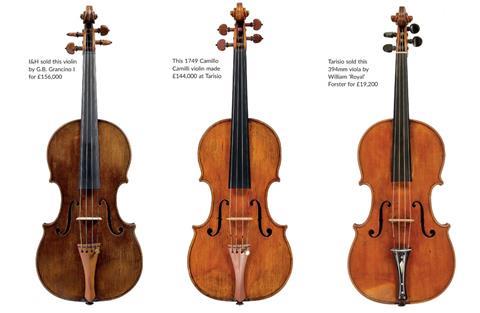
I&H offered a pair of Giovanni Battista Grancino violins (I & II). The elder’s sold for £156,000 – their top lot. It was backed up by a brace of certificates and a long pedigree of ownership. It also had its original 1698 label and is in fine condition. The second Grancino had been reassigned from previous certification from father to son via an in-house re-evaluation (the f-holes being a key diagnostic). It sold within estimate for £120,000. Of a lesser order of value, but with just as much interest, I&H doubled their top estimate on a c.1660 Antonio Mariani violin, with a superbly inlaid back, and ripe for Baroque reconversion. It sold for £24,000.
Fine cellos of a newer vintage were the order of the day at Tarisio
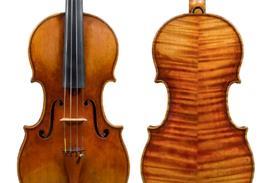
Other ‘golden age’ instruments on the block this spring included a 1749 Camillo Camilli violin contested by four bidders at Tarisio. With dendrochronological back-up from Oslo, it exceeded its top estimate at £144,000. Another major old Italian from Bromptons was a 1770 Gennaro Gagliano violin that retained most of its original varnish, and sold for £222,000. Finally, I&H offered a lot that was as much a testament to 17th-century Cremona as to the Victorian London violin trade: a c.1670 Nicolò Amati back and ribs with an 18th-century Italian top and a 19th-century English scroll. It sold for £60,000.
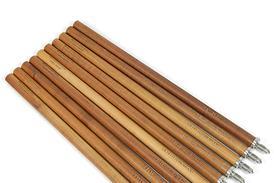
This sale found I&H offering a particularly rich range of bows, including an even dozen by Eugène Sartory. The most successful of his violin bows sold for around £20,000: a c.1930 silver-mounted viola bow made £33,600. One of their more interesting lots, however, was a gold-mounted James Tubbs violin bow inscribed ‘Made for August Wilhelmj 1887’ on the slide. It sold above estimate for £31,200.
There were some appealing historic violas across the salesrooms this season. A 394mm viola by William ‘Royal’ Forster with original neck and in historical set-up almost doubled its top estimate at £19,200 for Tarisio. Bromptons sold an ex-Donald Thompson c.1715 Landolfi workshop viola for £57,000. This very broad instrument had already been somewhat reduced in outline in order to measure a very playable 417mm. Finally I&H sold a 385mm 1805 Giuseppe & Antonio Gagliano viola with Hill certificate, and in excellent condition, for £28,800.
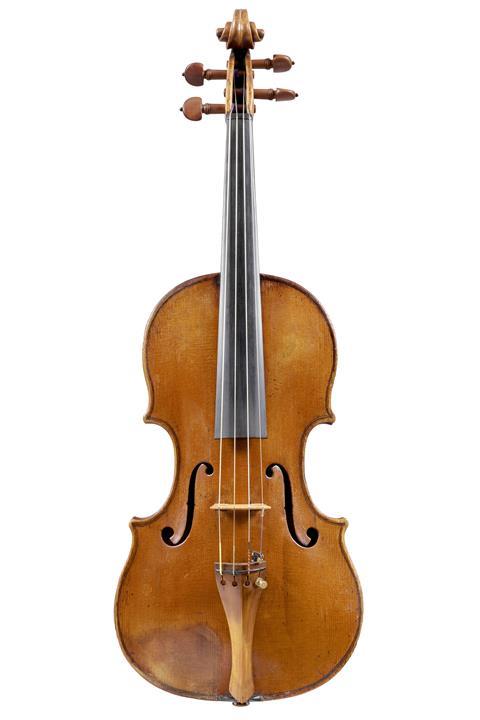
It is interesting to note that I&H sold two first-rate Fendt violins above estimate: a c.1820 Amatise Bernhard Simon Fendt I for £18,000 and a ‘del Gesù’ model Jacob Fendt (ex-Norman Rosenberg) for £26,400. It is therefore somewhat curious that they sold another violin, as ‘by Thomas Dodd’, for only £7,200, which was likely to have been by Bernhard Fendt. This may have been because it was attached to a 1958 Hill certificate attributing it to Dodd. Despite the romance of Hill erudition, it has long been known that Thomas Dodd was a sometime bow maker, mainly dealer, whose fiddles were made by Bernhard Simon Fendt I and John Lott I. These days the latter are clearly a more lucrative association.
Unusual to see on this side of the Atlantic, a fine 1889 violin by the sometimes controversial, but tonally well-reputed, German–American maker George Gemünder sold at Tarisio for £12,980. Born of a similar era, the demand for classic mahogany Hill cases remains unabated, with Tarisio obtaining £1,320 each for two well-preserved examples.
Perry (& Wilkinson) of Dublin, often underestimated, had a long-lived, diverse workshop producing instruments extending from Duke/Stainer models, to instruments of their own unique bulbous outline, to a variety of finer Cremonese variants. First-rate associates included Richard Tobin and William Ringwood. I&H offered one of the most perfect Amatise Perry & Wilkinsons I have ever seen, dated 1805 and selling at a bargain price of £4,800.
Gardiner Houlgate provided 172 interesting and moderately priced lots, the top of which was (unexpectedly) a well-preserved early 19th-century cello with Strad-ish f-holes branded ‘Corsby, Northampton’, which went above estimate for £20,000. George Corsby, originally a shoemaker, was more a dealer than a maker, and obtained most of his instruments from the London trade. It would be interesting to know whose name might be hidden inside this one.
All sale prices include buyer’s premium
Read: Auction Report January 2026: Lights in the darkness
Read: Auction Report June 2025: Mysteries, masterpieces and memorabilia
Read more news articles here
Read more premium content for subscribers here
















No comments yet