





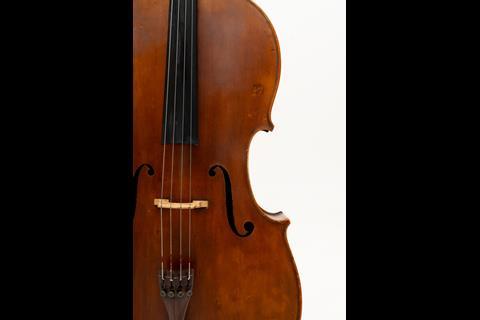
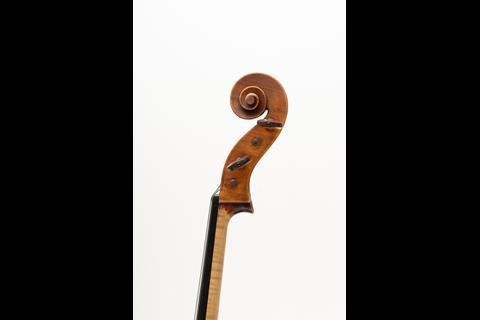
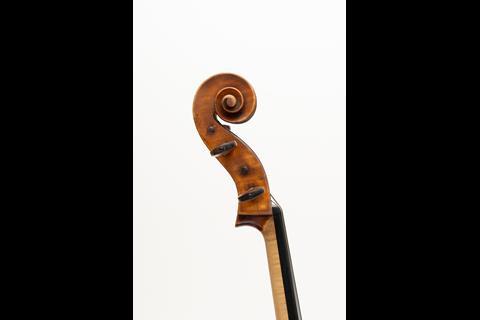
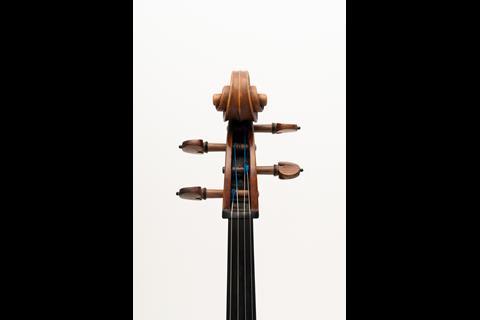
While the Polish luthier made more than 200 violins during his lifetime, only a handful of cellos are known. In the second of two articles marking the 160th anniversary of his birth on 25 June 1866, Grzegorz Kaproń looks at his limited forays into cello making, while Henry Riedstra examines an example from 1911
Discover more lutherie articles here
On 26 August 1908, Alojzy Sladek (1858–1935), cellist, professor at the Conservatoire of the Galician Music Society and musician with the Opera Theatre Orchestra in Lviv, wrote:
‘I had the opportunity to become acquainted with two new cellos built this year by Mr Władysław Baczyński. Immediately upon the first stroke of the bow, I knew I had in my hands instruments of extraordinary value. The tone was beautiful, flexible and pure, without the hum typical of new instruments; the material was very carefully selected; the form and technical finish were exemplary. These are the results of profound study and conscientious work, on which Mr Baczyński can be sincerely congratulated.’
This document was quoted in the price list published by Baczyński in 1908. In 1909 Baczyński fulfilled a commission for a cello (Opus 85) placed by the Hobert brothers from Buffalo, NY, US. On 31 March 1998, Sotheby’s auction house in London offered for sale a Baczyński cello dated to 1910 and marked ‘Opus 106’. A more detailed description can be found in the auction catalogue.
Press advertisements and letters from musicians addressed to the studio suggest that Baczyński made no fewer than six to eight cellos throughout his life. However, one should be very careful not to attribute to him the factory cellos bearing a printed label bearing the name Ladislaus Baczyński. It is worth remembering that the label is the final step in identifying the instrument’s authenticity.
Instrument
Baczyński offers four types of Concert Quality cellos in his 1909 price list: a wide Andrea Guarneri, a slimmer Giuseppe Guarneri ‘filius Andreae’, a large Nicolò Amati, and a large Stradivari. He would have had access to the measurements of some of their instruments from both his teacher in violin making, and from the aforementioned Association of Violin Makers.
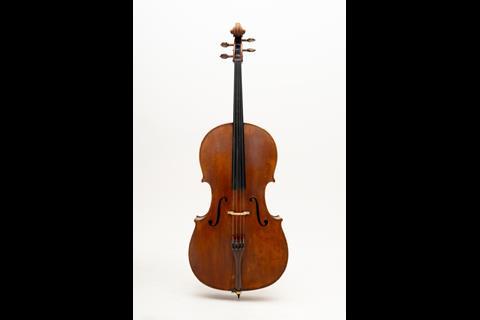
Although he is not known to have directly copied specific instruments, it would help to know which model of cello this 1911 example is. Not many Nicolò Amati cellos exist, and most Amati family cellos have been reduced in size. The Nicolò Amati cello from 1642 that was analysed in the February 2026 issue of The Strad is longer and has narrower upper and C-bouts than Baczyński’s cello.
On the other hand, when one compares the dimensions of the cellos in the Hill and Sons Stradivari and Guarneri books, the Andrea Guarneri ‘small form’ is somewhat shorter in the body and has wider upper bouts, but the same lower bouts. One of the cellos of his son Giuseppe ‘filius Andreae’ has the same length as Baczyński’s, but has wider upper and lower bouts. Stradivari’s famous B-form cellos are longer and less wide in all the bouts. In considering Strad’s ‘B picola’ model, it has the same length, but the bouts are much narrower.
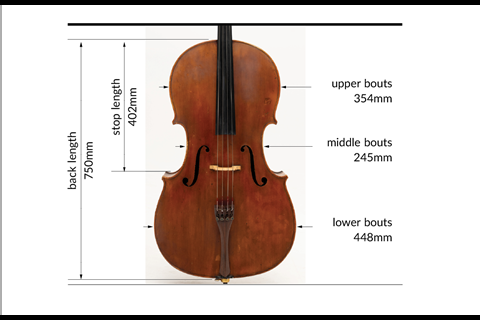
There is, however, one cello by Giuseppe Guarneri’s son Pietro Guarneri of Venice c.1740 that matches quite closely (the Hills give the dimensions in inches, but they are converted here to millimetres: L: 752.5mm, UB: 349.25mm, and LB: 447.7mm, stop length: 400.05). In addition, its ribs have the same 120mm height in the middle and lower bouts as Baczyński’s cello, but the the upper bouts differ since Baczyński tapered his upper ribs to 116mm towards the neck.
Pietro also usually did this, but not in this particular case! Since Pietro was a pupil of his father, and was inspired by his work, Baczyński’s cello is probably following a ‘filius Andreae’ model, although it has his own confidently cut Stradivari-style f-holes. The dimensions of this cello can be seen in the diagram.
Materials
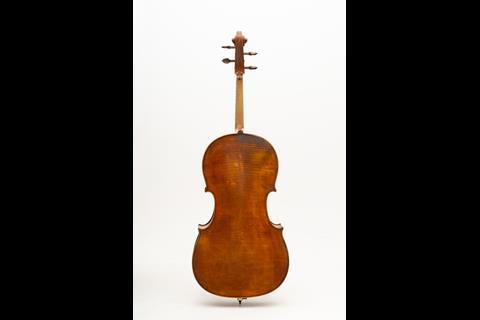
For his spruce tops, Baczyński sought out good tonewood that was 60 to 80 years old. The centre grain of the two-piece top is fairly narrow. It soon widens to 2 to 4mm, almost all the way to the edges. He used medium–hard, good quality, flamed sycamore maple (Acer pseudoplatanus) for his backs, ribs and scroll.
Label and brand
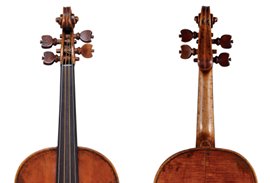
Baczyński was an experienced maker when he built this instrument. His handwritten label, in printed letters, states: ‘Opus 136. Fecit Laudislaus Baczyński Leopoli 15/XI anno 1911’, meaning it was the 136th instrument he started, and he finished it on 15 November 1911.
An additional marking is the ’WŁADYSŁAW BACZYŃSKI’ branding visible inside the body on the back plate.
Construction
Baczyński used an inner mould so that his rib structure would be accurately built. The central exterior arching of his top is medium high. The back arching is similar.
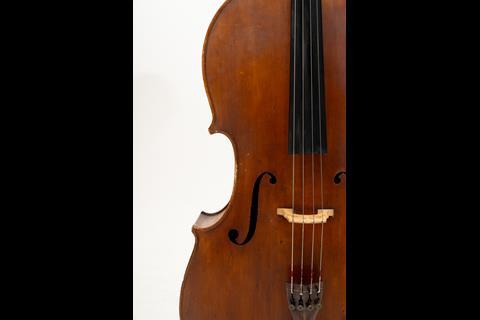
The lower wings of his f-holes are lightly fluted and follow naturally into the shallow edge channel of the C-bouts. The f-hole nicks are characteristically small. His purfling has a wider centre strip and thin ‘blacks’. It is positioned far enough in from the edges to give a feeling of strength to the well-formed outer margin. The bee-stings point to the centre of the corners, but stop about 2mm before the end of the corner.
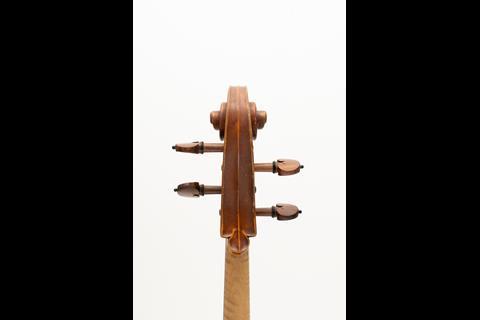
The attractive back is made of two pieces and has medium–narrow flames descending from the joint. The upper back button has been repaired. The ribs have a narrow flame that slants somewhat from the back towards the top plate. The scroll is made of plainer wood, which is easier to carve. The fluting is gouged out almost to the throat under the head.
Varnish
This is probably a spirit-based varnish, since Baczyński started using it to speed up his production in 1910. It has developed a fine craquelure in some places of the C-bouts, scroll and body. It is brown on a golden-brown ground, and has worn somewhat, but quite naturally in several places. Thus the intensity of the color varies somewhat now, but that contrast makes it more appealing to our eyes.
Thanks to Karine Baczynski, Sylwia Matuszyńska, Michał Micker and Ralph Schultz for their help with this article
All cello photos by Łukasz Rajchert
Grzegorz Kaproń is planning a book on Władysław Baczyński. Any readers who know of Baczyński instruments are invited to email him with information at: gregor.kapron@gmail.com
Read: A 1908 viola by luthier Władysław Baczyński (1866–1935)
Read: ‘Master of the violin, artist of the soul’: Władysław Baczyński








No comments yet