



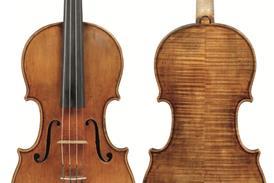

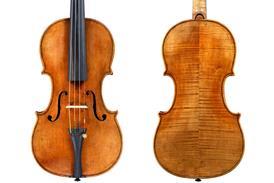




This year’s meeting of the exclusive club, open to owners and players of Guarneri ’del Gesù’ instruments, took place on 26 July as part of the Gstaad Menuhin Festival. Eric Wen reports back
Explore more Featured Stories like this in The Strad Playing Hub
Established in 1957 by the legendary Yehudi Menuhin, the Menuhin Gstaad Festival in Switzerland this year marked the debut of the violinist Daniel Hope as its new general and artistic director. Since he had attended the Menuhin School in his youth, Hope’s appointment was a natural fit. Not only was he a Menuhin protégé, but his mother had also worked as Menuhin’s personal assistant and served as administrator of the Menuhin Gstaad Festival for 17 years. Furthermore, Hope himself has considerable experience as a performer, curator and executive, in his roles as music director of the Zurich Chamber Orchestra and New Century Chamber Orchestra, artistic director of Dresden’s Frauenkirche Cathedral and president of the Beethoven-Haus Bonn.
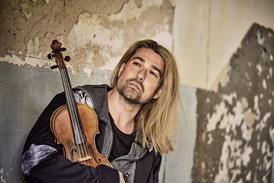
For this year’s festival, Hope had the idea to feature a public concert of Cremonese violins owned by members of the ‘Del Gesù Club’. The brainchild of the multifaceted violinist David Garrett, the Del Gesù Club was established in 2022 as a private society in which anyone who owns and/or plays a violin by the famed maker Giuseppe Guarneri ‘del Gesù’ automatically becomes a member. At its fifth anniversary this year, Hope arranged for its first public concert in the high-society Alpine resort of Saanen, a town adjacent to Gstaad.
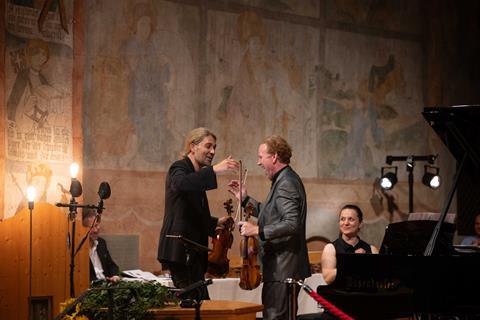
A former member of the Beaux Arts Trio, Hope is a dedicated chamber musician, and his passion was clearly in evidence at the two chamber concerts that immediately preceded the Del Gesù Club concert on 26 July. The two performances featured the eminent violinist Pinchas Zukerman as the Festival’s ‘carte blanche’ guest – which essentially meant that Hope was happy to defer to his wishes as an elder, distinguished artist. The concerts comprised three Brahms masterpieces (two of the composer’s three piano quartets and his First Violin Sonata), as well as the Schubert String Quintet in C major D956. Zukerman and Hope are themselves owners respectively of the ‘Samuel Dushkin’ and ‘Karol Lipiński’ ‘del Gesù’ violins (both made in 1742), and their chamber performances offered a sonic preview of two remarkable examples of the maker’s work. Joined by pianist Simon Crawford-Phillips, violists Ryszard Groblewski and Adrien La Marca, and the cellist Josephine Knight, these two concerts offered four masterful chamber works in readings that were not only exhilarating but a privilege to witness. Having turned 78 less than a fortnight before the two concerts, Zukerman showed no sign of his age; one could only marvel at his still razor-sharp technique, impeccable taste and consummate musicianship.
‘It was like an open candy store. These meetings are perhaps my favourite two days of the year’ – David Garrett
The three successive concerts on 24–26 July were held in Saanen’s magnificently preserved medieval church known as St Mauritius. The church was built in the early eleventh century, and its Roman bell tower stands out as a prominent landmark in the gorgeous valley. Originally built as a Catholic church, it has been superbly maintained throughout its millennium-plus history. Profusely decorated with late Gothic murals on the inner walls, it now contains a splendid 18th-century organ.
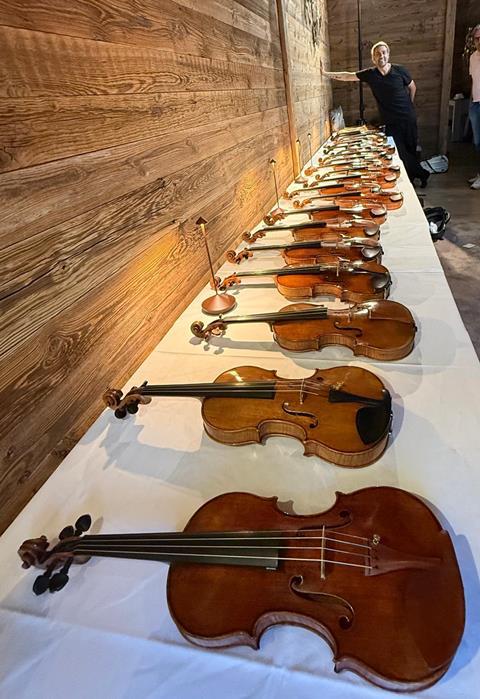
Among the 21 ‘del Gesù’ instruments featured at this year’s meeting, several had belonged to such celebrated performers as Lipiński, Charles de Bériot, Charles Dancla and Efrem Zimbalist. The earliest example of the maker was the 1726 ‘Fields’, made while ‘del Gesù’ was still in his twenties. The majority of the violins were from the maker’s ‘middle’ period during which he perfected his own model. Seven late ‘del Gesù’ violins, built in the maker’s last five years, after the death of his father, reflect the greatest expression of individuality in his making.
Besides ‘del Gesù’, this year’s meeting included four Strads for the first time. One was the 1733 ‘Prince Khevenhüller’ Strad, formerly played by Yehudi Menuhin. Menuhin was primarily a Strad player in his early years, and this violin was his concert instrument throughout the 1930 and 40s, before he purchased the 1714 ‘Soil’ Strad. (In the latter part of his long and distinguished career, Menuhin switched allegiances and became a ‘del Gesù’ player, performing on the 1735 ‘Comte d’Egville’ and later the 1742 ‘Lord Wilton’.)
Of particular interest at this year’s meeting was a sole Carlo Bergonzi from 1733. This mint-condition instrument was one of only six violins that Luigi Tarisio kept until his death in 1854 (these also included the 1716 ‘Messiah’ Strad now in the Ashmolean Museum in Oxford, and the 1742 ‘Alard’ ‘del Gesù’ in the Musée de la Musique in Paris). It also served as the concert instrument of the brilliant Romanian-born violinist Johanna Martzy, resulting in its subsequent multi-part moniker: ‘Tschudi-Martzy-Salabue-Tarisio’.
Any club is by its nature exclusive, and the Del Gesù Club – where membership is only conferred on the acquisition of an exorbitantly expensive article – is a particularly extreme example. However, its members have less in common with, for example, Lamborghini or Rolls-Royce owners than with owners of Cézannes or Picassos. Each violin not only represents a unique specimen of artistic craftsmanship, but also has the added dimension of its own unique sound. But fortunately, the Del Gesù Club is not exclusive to owners but also to players of these highly sought-after instruments. For Garrett, having performers in the Del Gesù Club is a vital element of its purpose. Bringing these instruments together, then, offers something very special. As Garrett marvelled: ‘When does one ever have so many “del Gesù” violins in the same place? If you go to a famous dealer’s shop, one might see two, possibly three by “del Gesù” at one time. If you’re lucky, maybe even four or, if you’re really lucky and it’s a special Christmas Sunday, perhaps five.’ By contrast, members of the Del Gesù Club collectively own no fewer than 48 instruments, a number that constitutes about one quarter of all ‘del Gesù’ instruments in existence.
Taken together, the violins on stage would be valued today at approximately a quarter of a billion US dollars
As for the rules of the Del Gesù Club, Garrett explained that for the first meeting five years ago he devised a strict schedule, but the moment people opened their violin cases, the schedule he had mapped out went out of the window. ‘I didn’t have to do anything. In the first several hours, everyone was playing and trying out each other’s instruments and enjoying the same shared passion. It was like an open candy store. These meetings are perhaps my favourite two days of the year. Obviously there are some rules, of which respect for each instrument is primary. Once we establish this, everything follows naturally. Sometimes an owner doesn’t want anyone to play or even touch their violin. I respect that. Just having the instrument in the room is enough. Every single person who has ever attended a meeting has come back. To me, that speaks to its success.’
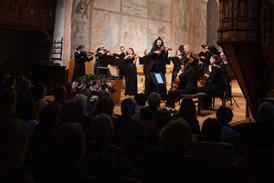
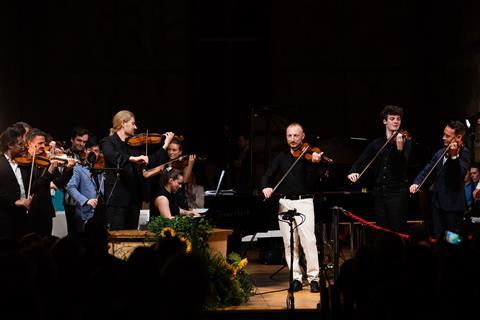
In the Del Gesù Club concert itself, David Garrett led the proceedings and gave a short introduction to each violin before each work was played. Besides playing six pieces himself, Garrett presented the line-up of excellent violinists, composed of soloists, orchestral leaders and recent competition laureates, namely Anna Agafia, Oscar Bohórquez, David Chernyavsky, Andrea Cicalese, Cristian Fatu, Francisco Fullana, Daichi Nakamura, Andrea Obiso, Liya Petrova and Linus Roth.
In order to fit in performances on all 26 instruments in a single concert, the programme was made up exclusively of short pieces. Violin fanciers were treated to such familiar fare as the ‘Méditation’ from Massenet’s opera Thaïs, Tchaikovsky’s Melody in E flat major and Sarasate’s sparkling Romanza andalusa. Along with numerous famous pieces by Kreisler, we heard his arrangements of Albéniz’s Tango, the Mélodie from Gluck’s Orfeo, Brahms’s Hungarian Dance no.17 and the Larghetto from Weber’s First Violin Sonata. Heifetz’s transcriptions also featured prominently, with Stephen Foster’s ‘Jeanie with the Light Brown Hair’, Debussy’s Beau Soir and Manuel Ponce’s Estrellita, as well as two selections from Gershwin’s Porgy and Bess: ‘Summertime’ and ‘It ain’t necessarily so’.
Amidst the familiar chestnuts, three rarities stood out: a gorgeous Nocturne by the Armenian composer Edvard Baghdasaryan, César Franck’s Mélancolie and the first of Clara Schumann’s Three Romances op.22. One unexpected surprise was a performance of the Prelude from Shostakovich’s Five Pieces for two violins by Garrett and his father, Georg Bongartz. Later in the evening, Daniel Hope joined Garrett in a delightfully rousing performance of the Waltz from the same set of Shostakovich duos.
Even in Gstaad, where wealth is the norm, it was somewhat dazzling to be in the presence of such an array of valuable artefacts. Taken together, the violins on stage would be valued today at approximately a quarter of a billion US dollars. Moreover, the opportunity to hear 26 different glorious violins one after the other in a single sitting was nothing short of awe-inspiring. Even when hearing the open strings being tuned before each performance, one could gauge that each instrument possessed a uniquely distinctive sound.
However, because the pieces played were so different – some of the works, like Raff’s Cavatina, emphasised long sustained melodic lines, while others, like Kreisler’s Syncopation, were more rapidly paced – it was not possible to evaluate each instrument’s distinct tonal qualities fully. Ideally, it would have been illuminating to hear this remarkable assembly of violins in the same piece, as on the bonus record that accompanied the famous Glory of Cremona LP on which Ruggiero Ricci played the same passage (the opening phrase of the Bruch G minor Concerto) on 15 different violins. However, the addition of such a comparison slot for the 26 violins in this year’s Del Gesù Club concert would have been wholly impractical, as it would have extended the event well beyond its already ample, intermission-free three-and-a-half-hour duration.
After hearing such a variety of pieces, ranging from Brahms’s fiery Scherzo from the ‘FAE’ Sonata to the ‘Love theme’ from Ennio Morricone’s film score to Cinema Paradiso, this memorable evening ended with Schumann’s pensive Träumerei, lovingly played by the host Garrett himself, before an impromptu performance by all twelve violinists of ‘Happy Birthday’, marking the 80th birthday earlier that month of violin dealer Peter Biddulph, who was in attendance.









No comments yet