


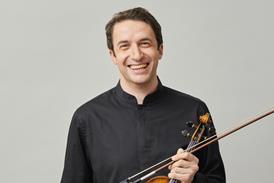
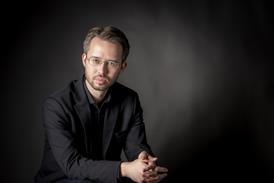








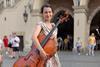
Violinist and composer Keir GoGwilt discusses the new album The Zarabanda Variations, created by the performing collective he convened to connect the familiar Baroque sarabande with a wider world of migration, improvisation and musical exchange.

Read more Featured Stories like this in The Strad Playing Hub
Keir GoGwilt first encountered the sarabande through Bach – as a rarefied, courtly Baroque dance whose phrasing demanded close attention. That familiar repertoire eventually prompted a more basic question: where did the dance come from before it entered the European suite?
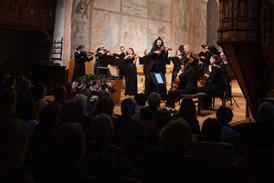
The Zarabanda Variations is both the name of the performing collective convened by GoGwilt and the title of its newly released 12-track digital album, part of a wider project that also includes a separately available physical chapbook. Commissioned and produced by the American Modern Opera Company (AMOC), the project brings together musicians working across contemporary classical music, free improvisation and Mexican folk and vernacular traditions to explore the dance’s histories across the Caribbean, Africa, the Americas and the Iberian Peninsula.
The album combines composed music, free improvisation and spoken texts by Edgar Garcia. The chapbook encompasses poetry, visual art, musical sketches, historical material and reflections from the performers. GoGwilt describes the album as the most complete distillation so far of a larger undertaking that he hopes will continue to generate new work in different configurations
Ahead of the ensemble’s concert at National Sawdust in New York on 31 August, GoGwilt spoke with US correspondent Thomas May about a different kind of instrumental virtuosity, the creative role of his collaborators and the challenges posed by the surviving colonial archive.
What first drew you to explore the sarabande’s wider history?
Keir GoGwilt: I grew up as a classical violinist practising the Bach sarabandes, so I first encountered it as a rarefied, courtly Baroque dance – something where you think very hard about the phrasing. Much later, I began hearing about research suggesting that the dance had reached Europe from the Americas by way of the Caribbean.
There are many theories about its origins. Ned Sublette, for example, traces the word zarabanda to a Bantu word from the Congo. Other research follows related dances, including the folia and chacona, travelling between Europe, Africa and the Americas. It is impossible to locate a single origin, but what became clear to me was that many dances we associate with the European Baroque emerged from colonial history. That felt worth examining more closely.

How did the project affect your approach to the violin?
Keir GoGwilt: It made me think a great deal about virtuosity. The album is very virtuosic, but not in the Romantic bravura sense: there are not many huge leaps or shifts into the instrument’s highest register. Much of the difficulty comes from fast polyrhythms, frequent changes of metre and microtonality.
The microtonal writing requires you to play very precisely in tune, but according to different tuning systems. In some ways, it demands more accuracy than 12-tone equal temperament because there may be more pitches within the scale. A lot of the music does not go much above third position; the virtuosity is packed into its rhythmic variety and changes of tuning.
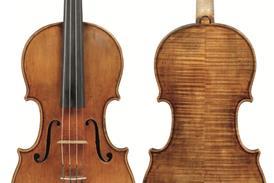
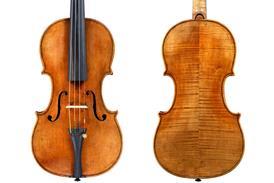
I also play the Hardanger d’amore. I originally needed a second instrument because I was using several different tunings on the violin, so I needed another instrument in ‘normal’ tuning. But its sympathetic strings, extra lower string and distinctive timbre added another element. I used it with a Baroque bow, and that set-up gave the music a sense of shorter bow strokes and long phrases, but not Romantic-style legato.

How did the performers’ different backgrounds shape the project?
Keir GoGwilt: That is what makes the project work. The musicians are almost as eclectic in their backgrounds as the history of the zarabanda itself.
Wilfrido Terrazas was one of the first people I approached. He is a flautist, composer and improviser who also plays hand percussion, whistles, an Aztec death whistle and even a duck caller. Those sounds bring verve and humour, but he also has enormous knowledge of Mexican folk and vernacular traditions. He taught me a great deal about those traditions, which I think remain living practices where the historical archive has gaps.
Mariana Flores Bucio grew up in a family that sang mariachi, bolero and other Mexican traditions. She has also studied opera and contemporary music and is a wonderful improviser – one of the few people I can think of who can bring all those things together in such an authentic and beautiful way.
The string players are exceptional contemporary musicians, while bassist Kyle Motl has a singular voice in free jazz and free improvisation. Each performer brought a different kind of knowledge to the project.
How do composition and improvisation interact?
Keir GoGwilt: I put the ensemble together with the idea that these different practices would be layered and collaged. The string group often acts as an orchestral machine, holding down much of the written material. Then there is an extended rhythm, jazz and improvisation wing, including Wilfrido, Kyle, guitarist Alec Goldfarb and percussionist Jonny Allen. Those players can have both conflicting and complementary relationships with the strings.
Some scores are fully written out. Others are written except for solos or contain textures over which I imagined particular musicians improvising. The division is never completely clean.
In Baroque Concerto, inspired by Alejo Carpentier’s novella of the same name, Baroque composers encounter musicians from Cuba and Mexico. Almost neo-Baroque passages alternate with wild improvisations from Wilfrido and Jonny, as though a European musician had overheard a street band. Even the Vivaldi-like writing is warped: the tonality is altered, the metre is a little strange and a shredding electric-guitar solo plays over it.
How did you approach the gaps in the colonial archive?
Keir GoGwilt: That was one of the hardest parts. Much of the surviving music from 16th-century South America was written either by people who came from the Iberian Peninsula or by Indigenous composers trained within European systems. On the page, it often has the characteristics of Spanish Renaissance or early Baroque music, although Indigenous American and African elements are also present. Some of the lyrics are heavily racialised and racist, and very difficult to read.
In classical music, we often try to solve this kind of problem by recovering a lost voice or composer, with representation as a blanket solution. But the history here is more complex. Rather than expecting a single composer or piece to solve the issue or redeem the tradition, we can look at the music’s DNA: shared templates such as the folia melody, the chacona bass line and the zarabanda rhythm.
As composers and improvisers, we can use those templates to create something that speaks to the present complexity of all these intersecting influences. For this group, that felt more authentic.

What role does the chapbook play within the wider project?
Keir GoGwilt: It works according to the same principle as the music: collage. It brings together Edgar Garcia’s poetry, archival material, visual art, musical manuscripts, our sketches and handwriting, reflections from the performers and short pieces of research about the dances heard across the album.
Some of Edgar’s poems come from Skins of Columbus, which grew from his reading of Christopher Columbus’s diaries. Their titles combine the historical dates with the dates on which Edgar was writing, so the past and present already coexist within them. Edgar also made collages for Skins of Columbus, and I’m even collaging his collages. It becomes a kind of meta-collage.
The Zarabanda Variations album and the separately available chapbook can be found here. The ensemble performs at National Sawdust in New York on 31 August; further information and tickets are available here.
Read: Play that funky folk-Baroque: Adventures in Scottish fiddling
Read: Did Bach dance? Stylised dance in his Solo Violin Partitas
Discover more Featured Stories like this in The Strad Playing Hub










No comments yet