







Janet Banks visited north-west Italy for the finals of the 58th Premio Paganini Competition, where three young violinists contended for the top prize and a chance to play the famous ‘Il Cannone’ Guarneri ‘del Gesù’
Discover more Featured Stories like this in The Strad Playing Hub.
Read more premium content for subscribers here
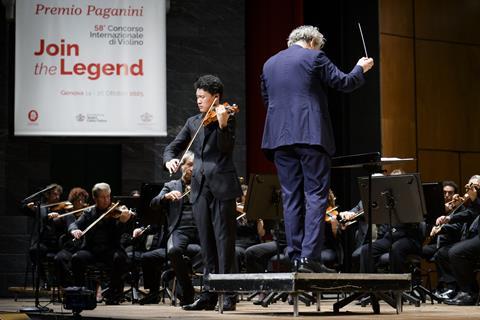
Late October, Genoa, Italy. As I arrive in Paganini’s home town I pass a statue of Christopher Columbus, the city’s other titan, looking down to the port under clear blue skies. The words ‘Join the Legend’ are emblazoned on banners hung above the streets, advertising the 58th edition of the Premio Paganini International Violin Competition (14–26 October), first held here in 1954. Ten days earlier, 24 young violinists aged 15 to 30 arrived in the city for the first round. Now only three remained, practising intensively in their hotel rooms for the finals the next day.
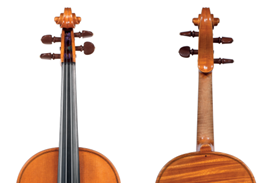
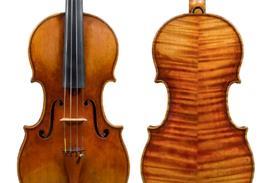
That afternoon I made my way through a maze of alleyways to the Palazzo Tursi, where the first round took place, to catch the end of an international study day on violin conservation which focused on Paganini’s 1743 ‘Il Cannone’ Guarneri ‘del Gesù’ instrument, his gift to the city. The central tension between conserving instruments and ensuring they are played came up repeatedly. The next morning I returned to the palazzo to pay homage to ‘Il Cannone’, sitting silently in its glass case, awaiting the moment the following day when it would be reverently transported in order to be played by the Premio Paganini first prize winner at the gala concert at the Teatro Carlo Felice.
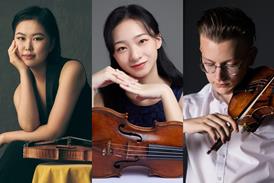
It had been a long road for the finalists: Japanese Rino Yoshimoto (aged 22), a student of Augustin Dumay in Brussels; Chinese Aozhe Zhang (aged 17), who studies with He Xian, and 15-year-old South Korean Hyun Seo Kim, the youngest ever student at the Korea National University of Arts, Seoul. They had been selected first from 116 admitted via auditions in Berlin, Genoa, Guangzhou, New York and Seoul, and (in the case of Kim and Yoshimoto) by way of prior competition wins.
Along with 17 others in the first round – comprising a solo recital of Bach, Paganini and a newly commissioned piece by Daniela Terranova – they had been narrowed down to twelve for the second round, a recital with piano including Schumann’s demanding Violin Sonata no.2.
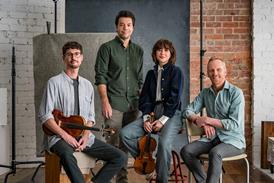
From these candidates, six, all from East Asia, were selected for the semi-finals – a chamber-music round (a new initiative this year). The six players were required to join established chamber ensembles in works by Haydn, Stravinsky and Schumann before showing off their technical virtuosity in either Paganini’s fiendishly difficult solo Variations on ‘Nel cor più non mi sento’ or his Variations on ‘God Save the King’.
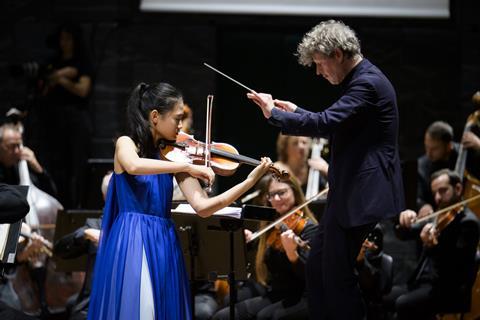
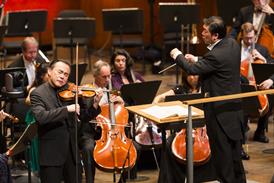
Now here we were at the finals, held at the Teatro Carlo Felice, overlooking the fountain-filled Piazza Raffaele de Ferrari. Each finalist played a Paganini violin concerto first, and all chose to do no.1 in D major. This was followed by their pick of a concerto from a list comprising Beethoven, Brahms, Dvořák, Mendelssohn, Schumann, Sibelius and Tchaikovsky. All performances were accompanied by the theatre’s resident orchestra conducted by Philipp von Steinaecker.
Yoshimoto, dressed in white, was the first to play. Her authentic musicality and powers of expression really shone through in the Paganini, and some minor slips in the last movement took nothing away.
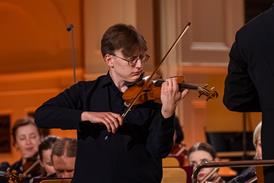
Zhang was next, a tall, serious-looking teenager, all in black, as if dressed for a school concert. His was the most technically brilliant of the three Paganini performances despite his violin having a smaller sound. While his rubato felt rather mechanical, he nonetheless spun a beautifully fine, thin thread of sound in the slow movement.
Kim then came on stage, all grace and smiles, in a blue gown. Her Paganini was all about communication – with the audience, with the conductor, with the orchestra – and boasted some beautifully strong, sweet stratospheric notes and a real sense of delight. It was immediately clear why she had won the audience prize in the Viotti competition in 2024.
It was then straight on to the other concertos and once more, Yoshimoto was up first. Her Brahms made a welcome change after hearing three Paganini concertos. She really held the stage, inhabiting the piece fully and transporting the audience with a breathtakingly beautiful opening high melody.
Zhang’s Tchaikovsky Concerto was for me the final’s deciding moment, revealing him as a musician of real stature. His expression this time came from the heart and felt truly authentic, this piece evidently resonating deeply with him. The audience, for all its chiming phones and talking in quiet moments, was won over by this 17-year-old and responded with enthusiasm.
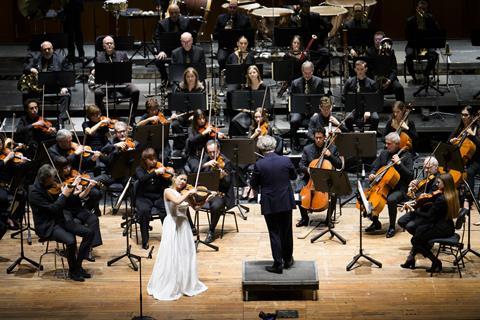
After such a towering performance by Zhang, being served the same concerto all over again straight after felt like eating the same main course twice. For all that I’d loved Kim’s Paganini, her Tchaikovsky couldn’t help feeling rather lightweight compared with Zhang’s. Her audience was loyal, however – many even getting to their feet, giving the 15-year-old the only standing ovation of the evening.
Following a break, when the jury went off to consult and the audience to reflect on what they had heard, we were back in the auditorium, waiting for the jury’s announcement. Finally, after much civic speechifying, the jury, chaired by the renowned Italian violinist Uto Ughi, came on to the stage.
First prize – €30,000, plus prestigious concert engagements and the chance to record a studio recital album with the Platoon label – went unanimously to Zhang. Yoshimoto took second, and third went to Kim, who also, unsurprisingly, won the audience prize.
After group photos, we gathered in the galleries of the Palazzo Bianco for a celebratory reception. There were no more speeches, just convivial mingling, drinking and enjoying Genoa’s focaccia, pesto and seafood. Here I caught up with the three finalists, now back in jeans and hoodies.
Kim was all smiles. ‘It was like a dream,’ she told me. ‘My biggest joy was when I really got to communicate with the audience.’ Yoshimoto spoke of the mammoth effort required. ‘It was a long, long journey – the biggest effort I have ever made for a competition. And it was tough. But it was also fun.’
Zhang, who estimated he had been working towards the competition for a year, simply said about his victory, ‘I am happy, yes,’ – and he looked it. ‘All my effort was worth it.’
I couldn’t help wondering what the experience had been like for the other competitors who had by now all flown back to their home countries. What did the competition do to ensure they did not feel too crushed? ‘I’m a violinist myself, so I know how it feels,’ artistic director Nicola Bruzzo said.
‘I tried to be in contact with them between the rounds, to be as human as possible and to make clear that just being selected and preparing for the competition is a major win for them.’
Ughi concluded: ‘We heard young musicians of exceptional calibre. The choice was not easy, but Aozhe Zhang showed remarkable talent across the complex articulation of the various stages. He now has before him an important journey that could not have begun in a better way.’
Read: Postcard from Milan: Antonio Mormone International Prize
Read: Postcard from Japan: Sendai International Music Competition
Discover more Featured Stories like this in The Strad Playing Hub.
Read more premium content for subscribers here










No comments yet