
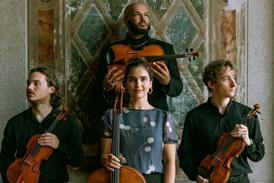


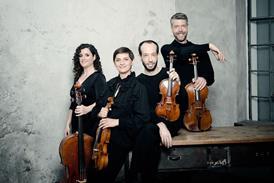


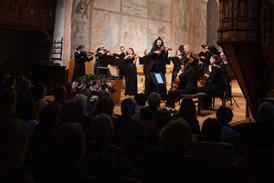



Bruce Hodges hears the quartet’s performance of at Philadelphia’s American Philosophical Society on 11 March 2026

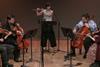
‘Groovy’ was one of the words a friend used to describe the Owls, which made its Philadelphia Chamber Music Society debut in a bracing hour with no interval, a model that has taken root during the past decade or so. (Unfamiliar works often benefit from a shorter slate.) The evening spotlit the foursome’s imaginative instincts, anchored by poles of delicacy and ferocity.
One of Owls’ two cellists is the composer Paul Wiancko (also of the Kronos Quartet) whose Vox Petra (2018) was inspired by the spare forms of artist Isamu Noguchi, and the group echoed his sculptural sensitivity. Later came Wiancko’s When the Night (2017), a wry and surprisingly effective ode inspired by the Paul McCartney classic.
Given the Owls’ instrumentation of violin, viola and two cellos, adaptation is a part of its DNA, but the reworkings were so skilful that they went unnoticed by all but the most scholarly listeners. Couperin’s Les Barricades Mystérieuses, originally for harpsichord, made a central idyll with the foursome’s feather-light textures.
Ricercar by Trollstilt (the alter ego of composers Monica Mugan and Dan Trueman) was designed for guitar and violin, yet seemed perfectly natural when transformed into a quartet.
Gabriella Smith’s latest work, Aegolius, proved intriguing, with the foursome evoking the titular bird’s mysterious night patterns. And two bits of high-energy choreography added fizz: Franghiz Ali-Zadeh’s Rəqs (‘Dance’) and, to close, ‘Good Medicine’ from Terry Riley’s Salome Dances for Peace.
Between the ensemble’s relaxed expertise and obvious camaraderie, it was all pretty groovy.
BRUCE HODGES
Read: Owls takes flight with debut album ‘Rare Birds’
Concert review: Owls, Claire Chase (flute)







No comments yet