










Robin Stowell reads Jon Banks’s history of the rise of Romani music in 19th-century Vienna
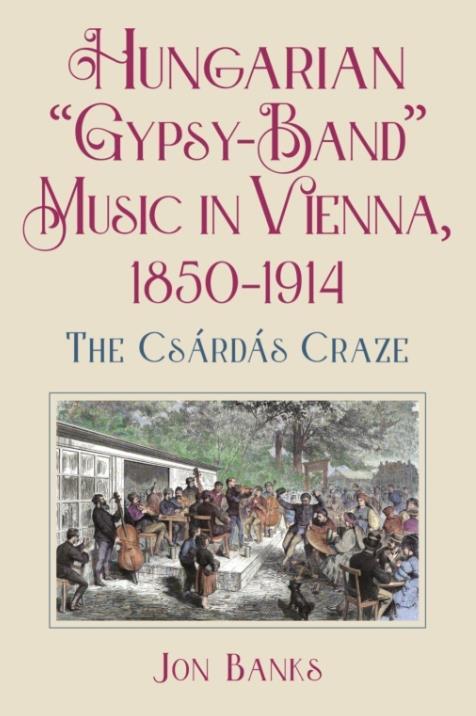
Hungarian ‘Gypsy-Band’ Music in Vienna, 1850–1914: The Csárdás Craze
Jon Banks
202PP ISBN 9781648251092
University of Rochester Press £85
Scholar and multi-instrumentalist Jon Banks plays the accordion in ZRI, a classical/‘gypsy’ band named after the Viennese tavern Zum rothen Igel (‘The Red Hedgehog’), where musicians such as Johannes Brahms enjoyed performances by visiting Hungarian bands. His book is a detailed study of those ensembles and their rich interaction with Viennese culture from c.1850 to 1914.
Through his painstaking analysis of advertisements, news reports and anecdotes in the Viennese press, contemporaneous Hungarian sources such as Liszt’s Des Bohémiens et leur musique en Hongrie (1859) and early commercial recordings, he explains how these mostly Romani musicians fed off the city’s growth, where and how they performed, how they engaged with the mainstream of Western classical music and how the conditions of their employment affected their lives and music making. Typical improvisatory fare showcased the charismatic primá (normally, but not exclusively, a band’s lead violinist) in hallgató, the emotive performance style that doubtless inspired, for example, the opening sections of Liszt’s Hungarian Rhapsodies.
Watch: Vivaldi’s Spring in Gypsy jazz and folk style
Read: ‘The violin was a lifeline’ - Resilience of the Romani people through music
Watch: Yehudi Menuhin performs Sarasate’s Zigeunerweisen
Systematically organised into five chapters, Banks’s volume begins with prefatory material in which he raises the potential sensitivities over his use of the term ‘gypsy’. He describes the continuation and intensification until c.1870 of a long-standing touring tradition of Hungarian national bands – mostly all-male and comprising strings and cymbal (cimbalom) – which performed at a variety of venues and circumstances, such as private functions, society balls, cafés, taverns and gardens rather than formal concerts.
Banks’s fourth chapter surveys the evolution and trends in these bands’ repertoire, the diversity of which ranged from traditional Hungarian material (e.g. csárdás or hallgató) to Viennese ballroom genres (waltzes, polkas), opera overtures/pot pourris and marches. He also evaluates evidence from relevant early recordings and considers how Hungarian bands were perceived in Vienna, including their close identification with canonic composers from Mozart to Brahms.
Accompanied by a thorough bibliography and a detailed index, Banks’s commendable work is well presented – just one proofing error caught my eye – and incorporates several illustrations. It demonstrates that 19th-century Hungarian gypsy band music developed into Vienna’s defining popular music c.1900 and a constant challenge to music in the Classical–Romantic tradition, impacting powerfully on the so-called style hongrois that infiltrated compositions by Weber, Schubert, Brahms and Liszt and influenced generations of Classical music composers in Vienna before World War I.
ROBIN STOWELL











No comments yet