


















Lauren Wesley-Smith reads Gidon Kremer’s autobiography, first published in 1993 and now translated into English for the first time
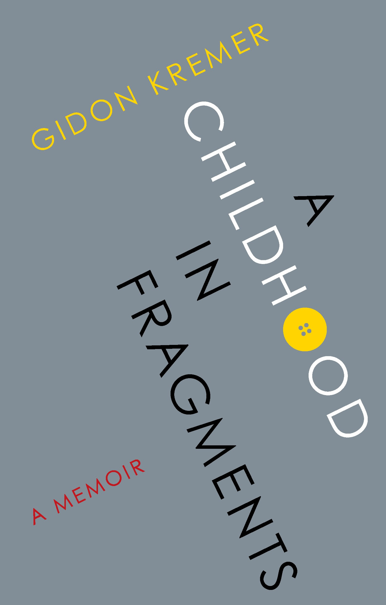
A Childhood in Fragments: A Memoir
Gidon Kremer
192PP ISBN 9781399980906
HARCAMLOW PRESS £14.99
It is remarkable that this memoir, originally published in German in 1993, has been translated into French, Russian, Latvian, Chinese and Japanese, and yet only now – over 20 years later – does it receive its English translation. I would argue, however, that it is worth the wait and has not suffered for the time elapsed.
The first half of the book is a retrospective of Gidon Kremer’s childhood and adolescence, with all the pains and heartaches of growing up. It is grouped according to abstract concepts rather than chronologically, but the storytelling unfolds quite naturally. The second half, meanwhile, includes excerpts straight from his childhood diary, giving the young Kremer a voice and allowing him to comment directly on what adult Kremer has recounted.
It’s a vivid and visceral read, sometimes perhaps too much so; I could have done without the details of his method for picking his nose as a child. Still, he conjures a compelling image of his childhood in Latvia, recalling fresh fish and harvested berries, the cold sting of the Baltic Sea, and his fondness for bright yellow.
Kremer’s family reveals a cross-section of politics and tragedy. His father, a Baltic Jew, lost 35 family members to Nazi persecutions in Latvia, including his first wife and 15-month-old daughter; his mother, while born in Germany, was ultimately forced to flee with her family owing to her own mother’s Jewish ancestry. Living behind the Iron Curtain, his parents were made to attend mandatory political seminars, and Kremer recalls both the austerity of his education and the suspicion with which interactions, even with citizens of other Soviet republics, were treated.
Read: Sentimental Work: Gidon Kremer on Raminta Šerkšnytė’s ‘This too shall pass’
Read: Gidon Kremer on Mieczysław Weinberg: Testament to turbulent times
The Strad Recommends: Gidon Kremer: Songs of Fate
Both Kremer’s parents and his maternal grandfather were violinists, and he questions whether his own career was predestined or rather put upon him. Certainly, he does not mythologise his own studies: there were long hours of critical practice, driven by impossible standards of perfection, and a deep-seated need for approval, yet all the same he often seemed on the back foot in his youthful rivalry with violinist Philippe Hirschhorn.
This book is by no means an overview of his life, and only briefly alludes to his later competition successes, which makes sense in light of the publications that were to come – although those have yet to be translated into English. Many autobiographies convey a steadfastness that comes from the adult perspective – a sense of ‘I did not know then, but I know now’ – yet this is not the case at all in Kremer’s writing. Rather, he was full of questions then, and remains full of questions still as an adult, searching for who he is. Translators Gwen Owen Robinson and Hartmut Kuhlmann appear to have done a superb job, offering a text that is evocative and emotionally resonant.
Lauren Wesley-Smith













No comments yet