









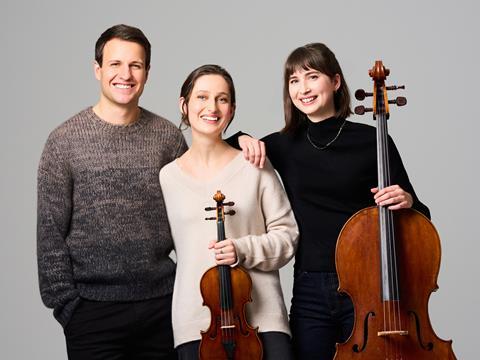
A piano trio once attributed to Brahms has largely vanished from the repertoire. But after living with the work in preparation for a new recording, Trio E.T.A. discovered why the question of its authorship remains so compelling. Cellist Nadja Reich shares the ensemble’s approach
Read more Featured Stories like this in The Strad Playing Hub
A Trio in search of its composer
A ’fourth piano trio’ by Johannes Brahms used to appear on several recordings of complete Brahms Trios, such as the one by the Trio Fontenay in 1980. Until today, almost nobody has heard of it. For decades, its authorship has been so heavily disputed that the piece has quietly disappeared from concert programmes and from memory. That mystery is exactly what drew us in.
While preparing our recording of this A major Trio, we found ourselves genuinely curious not just about the music, but about its origins. While we did not make a scientific study, before recording, we played the piece for fellow students, teachers, and friends; the reaction was unanimous:
’It sounds like Brahms!’
That instinctive response, shared by people with very different levels of familiarity with his music, is part of what makes this piece so fascinating, even though it cannot be proven that it was indeed written by Brahms.
Why it still sounds like Brahms
Music theorist Ruven Wegner, who wrote an essay for our CD booklet, traces this resemblance through the music itself. The first movement’s main theme, he notes, has the same warm, grounded, ‘homely’ sound as Brahms’s early B major Trio, op.8, its odd seven-beat motif creating a curious metrical asymmetry.
Shortly after, this same metre makes the keys seem to slide into one another – a harmonic fingerprint very characteristic of Brahms – and the piano’s left hand even echoes the rhythm of Beethoven’s fifth symphony, a kind of allusion Brahms uses with striking consistency in his early works.
The exposition dissolves over a pedal point, the recapitulation is veiled rather than announced, and the closing theme returns weakened by false cadences – all classic Brahmsian characteristics. Wegner argues the trio absorbs enough of these traits to speak in an unmistakably Brahmsian dialect, whatever its true origin.
This resemblance is also what convinced the work’s first champions, decades ago.
How the attribution came to be
The story begins in 1938, when musicologists Ernst Bücken and Karl Hasse published a piano trio in A major under Brahms’s name with Breitkopf & Härtel. The manuscript itself, in an unknown copyist’s hand, carried no indication of its composer. Bücken had acquired it back in 1924 at an auction in Cologne, from the estate of the scholar and collector Erich Prieger.
After an early performance in 1925 and two further ones in 1936–37, Bücken laid out, in lectures and in the preface to the printed edition, his reasoning for attributing the work to the young Brahms, dating it to the summer of 1853. The manuscript itself did not survive the years after publication, it was likely lost during the war.
One of Bücken’s central arguments concerned Robert Schumann. The trio’s unmistakable Schumann echoes, he argued, reflected the young Brahms’s ’first serious encounter’ with Schumann’s music – one Brahms himself dated to September 1853, while staying with the Deichmann family in Mehlem near Bonn and going through their music library. On that basis, Bücken placed the trio in ’roughly the same period’ as op.8, calling it ’typically Brahmsian’ throughout.
Dr. Michael Struck, who examined the source situation critically for our recording, dismantles this. Brahms, he notes, did not even spend the whole of September 1853 in Mehlem. He left for several days on a Rhine trip, leaving little realistic time to discover Schumann’s music, compose a trio, and rehearse it in that window of time.
Struck finds it far more plausible that the manuscript came from Friedrich Kiel’s composition class in Berlin, whose estate passed, after Kiel’s death, to his former pupil Erich Prieger, the very man from whose collection Bücken later bought the trio. Today, Brahms’s authorship is generally considered ruled out.
And yet, the piece keeps circling back to him.
Living inside the piece
Beyond the theory, what struck us most were the physical and interpretive challenges we associate directly with playing Brahms. As the cellist, I have to fight to project through the middle register; the pianist risks tangling his fingers in the constant note repetitions. It felt familiar – much like the balance problems in Brahms’s own E minor Cello Sonata, op.38, where the cello sits stubbornly in its middle range against a full piano part.
The last movement shares a rhythmic and contrapuntal clarity with that Sonata’s finale, and the scherzo may be the most ’Brahmsian’ movement of all, full of note repetitions and including an incredibly beautiful trio.
The performance markings in the A Major trio, too, reminded me of my earlier encounters with Brahms: the contrast between dolce and espressivo, the differentiation between poco forte and forte, among others are details that can be found throughout Brahms’s repertoire.
Elene Meipariani, our violinist, remarked that searching for the right sound production for this trio felt just like with Brahms’s B major Trio because you encounter the same limits: everything is dense and interwoven, and one aims not for a rigid or forced sound but rather a flexible one.
Finally, particularly in the first and fourth movements, they reminded us of the unwieldy nature of the early version of Brahms’s B major Trio which, through its many ideas and unconventional motifs, nonetheless creates a very special charm. Performing both pieces demands a similar sense of formal overview: you have to hold the architecture in mind so as not to lose yourself in the piece’s many turns and to project the nobility of the style.
These comparisons come directly from our own playing experience, which is precisely why the Brahms association feels so immediate to us.
An anecdote from Till
Till Hoffmann, our pianist, once had a memorable exchange about this trio with Wolf-Dieter Seiffert, the then-head of the Henle publishing house. Hoping to persuade him to publish the work, Till and the trio quickly discovered that Seiffert firmly disagreed that the piece was by Brahms, and declined.
Later, during a lecture on his Brahms research at Schloss Elmau, Seiffert addressed the trio directly while we performed excerpts live. In the discussion that followed, we tried to make our case for Brahms, while Seiffert patiently reminded us that the surviving sources simply did not allow for proof either way.
His lecture, though, included a striking image: the young, fiercely self-critical Brahms lying on his floor at home, watching his own failed compositions burn in the fireplace. Till has since liked to imagine that this very trio might have been there too – saved, purely by chance, through an anonymous copy that slipped out into the world before the flames could reach it. It cannot be proven. But it is a beautiful thought to hold onto.
Our conclusion
We cannot prove this trio is by Brahms, and the evidence, on balance, points elsewhere. Yet, on so many levels, it still feels as though it could be. It certainly is far too compelling a piece to remain unplayed simply because its authorship remains unresolved. Who wrote a complete piano trio so thoroughly in Brahms’s style? We would love to know what you hear in it.
For the full musicological essay by Dr. Michael Struck and the complete analytical text by Ruven Wegner, visit our website: www.trio-e-t-a.com
Nadja Reich, cellist, Trio E.T.A.




![Ayanna Witter-Johnson [Jordan Woods] 7](https://dnan0fzjxntrj.cloudfront.net/Pictures/100x67/4/9/4/44494_ayannawitterjohnsonjordanwoods7_224583.jpg)






1 Readers' comment