













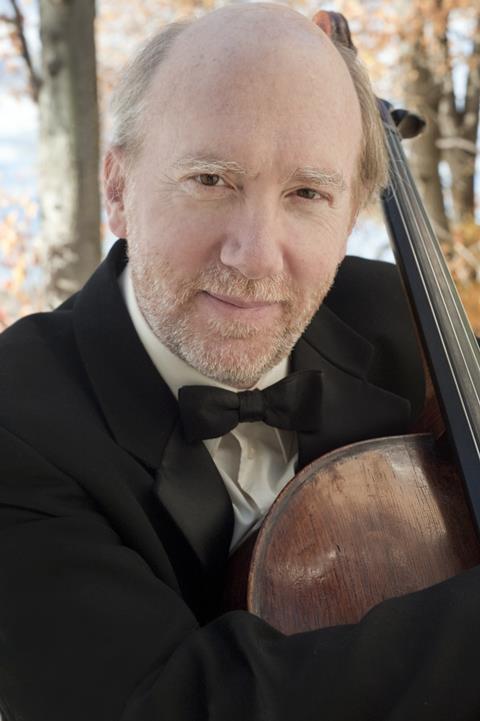
Cellist Michael Reynolds shares the importance of expressive intonation, as well as practical intonation tips that should prevent your string quartet from disbanding!
Read more Featured Stories like this in The Strad Playing Hub
Intarnation: /in-tar-na-tion/
Noun: out of tune!
Being an argument that expressive intonation is, well, just playing in tune
During my 40 years as cellist of the Muir Quartet, we had many stimulating arguments about intonation. One would think this is a fairly straightforward subject; anybody with a good ear can tell whether something is in tune or not, right? So why all the fuss?
As a quartet cellist, I realised early on the daunting responsibility of playing in tune. It turns out that this can all be a bit tricky; one person’s F-sharp can be another’s G-flat.
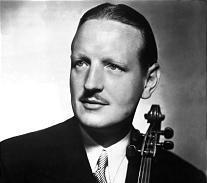
When I was a student at the Curtis Institute of Music, one of my favourite coaches and mentors was Mischa Schneider, the legendary cellist of the Budapest Quartet. In his free moments, we spent hours discussing the value of expressive intonation. A loose definition would be that one has the license to bend pitch in a particular way to create a specific feeling or character. For example, a high F-sharp in the key of G can create a feeling of yearning or reaching, whereas a slightly lower F-sharp simply sounds dull and without intention.
All of this begs the question: what to do when playing with a piano. There’s not much a pianist can do to bend pitch besides raising their eyebrows. String players have the luxury of dancing around the piano’s center of pitch for expressive purposes. Mischa would argue that sometimes on the same note one should start at a particular pitch and end on another, depending on what was happening with the key and the specific character of the moment.
One of my favourite intonation tools is scales in mixed 3rds and 4ths (in other words, first play the 3rd, then the 4th by raising the top note). I have a website called Cellozilla (cellozilla.com) where one can download scale systems that includes this tool. As I often say with students, the only truly honest intervals are 4ths and octaves. We’re always told when we are young that a 5th is an honest interval, but tell that to any student who is tuning their instrument by ear. (is the lower string sharp? Flat? Quick, get the tuner!). On the other hand, 4ths and octaves are either perfect or horrible.
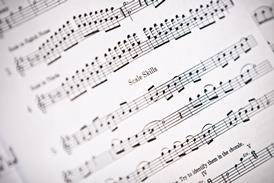
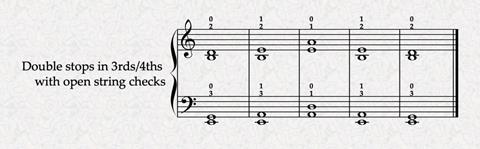
Below are a few examples around utilising 4ths. For a cellist and violist, let’s do C major (violinists, please see the example below in treble clef in G Major). In first position, start with E above the open C-string, play that with your open G, then with the A a whole step above the G, which gives you a perfect fourth. Also check the open D string with your first finger A. Continue up the scale in 3rds and 4ths, checking the open strings either above or below for possible 4ths or octaves.
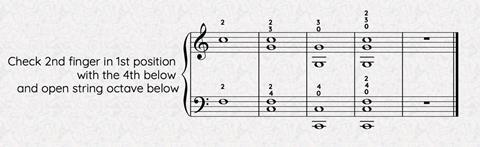
Next, check your second finger in first position with the 4th below and the open string below.
Heading another direction, always check your third finger (on the cello) or second finger (viola or violin) with your first finger in first position the string above and the open string above it.
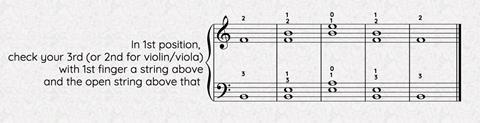
Now we get to the heart of the matter regarding expressive intonation. Before we start, it’s important to tune your 5ths as tightly as you can until the lower string almost starts sounding sharp. Anybody who plays with piano knows that this is necessary. Using the key of C major as an example, where should a B be? First play first finger E on the D-string. Check that with your open A above it. Now, check the E with the B below it. I think you will find that the B is pleasingly close to the C next to it.
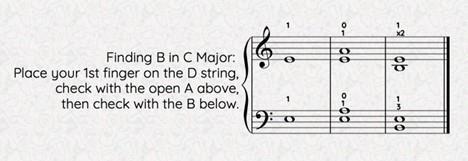
To find an F on the D-string, play the C the octave above your open C-string, then the F the fourth above. You will notice that the F is deliciously close to the E next to it.
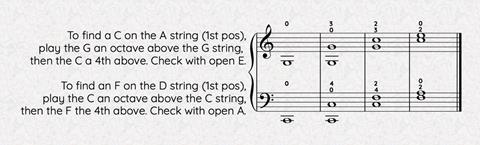
You’ll find that there aren’t many notes you can’t check if you follow the circle of 4ths far enough either up or down. As an important additional benefit, I think that you will also find that when you find the centre of a note, it will excite the harmonic overtone series on the strings you are not playing. An easy example (cellists and violists): if you play a C on the A string in tune, your open C-String should rejoice in sympathy. I think that you will find with a bit of sleuthing that most notes in the lower positions of any stringed instruments have some ghostly harmonic companions somewhere in the harmonic series around them.
Imagine playing a modern Romantic sonata (Franck or Rachmaninoff are good examples for cellists). Where would you put a C-sharp in D minor or an E-flat in C minor? As Mischa would have pointed out, they should be as close to their upper or lower neighbour as possible to create expressive tension. In other words, you have license to bend a note even further than the circle of 4ths so virtuously guides it.
To sum things up, let’s go back to our rehearsals in the quartet. One thing that kept us from disbanding other early on was that we finally came to fragile agreement about the subject of melody versus harmonic support. The harmonic underpinnings would have to compromise many of my above expressive intonation arguments in order to create a solid foundation for the melody. Whoever was playing the melody could then be free to bend pitch in ways that helped create musical character. To my ear, without that artistic licence, string quartets can start sounding a bit like oatmeal: bland and without much purpose.
A final aside: you’re welcome to visit https://classicsforkids.org/bach-suites/org and freely download any or all movements of my recording of the Bach Suites to further explore my expressive intonational meanderings.
Michael Reynolds is professor of cello at Boston University. He enjoyed a 40-year performing career of over 2,000 concerts worldwide as founding cellist of the Muir Quartet and as a soloist; accolades include a Grammy nomination, a Grammy, two Grand Prix du Disques, the Gramophone Award and a performance at the White House.
Musical examples credit: Sara Stalnaker
Read: Mastering intonation, by cello professor Antonio Lysy
Read: Cellist Pablo Casals on expressive intonation
Read more Featured Stories like this in The Strad Playing Hub













No comments yet