








How does one honour the tradition of tango without falling into repetitive imitation? Cellist Juan Sebastián Delgado shares his experiences creating his debut solo album comprising works rooted in the music of Carlos Gardel and Astor Piazzolla
Read more Featured Stories like this in The Strad Playing Hub
Tangos Imaginarios is my debut solo album, and it embodies my personal, evolving vision of tango, expressed through the voice of my instrument, the cello. The album is rooted in the music of two iconic figures, Carlos Gardel and Astor Piazzolla, each of whom, in his own way, reshaped the soul of the genre through daring compositions and unmistakable performance styles, leaving an enduring impact that continues to resonate across tango and beyond.
I reinterpret their works through original arrangements written for and in collaboration with me, incorporating improvisation, electronic elements, and contemporary aesthetics, an approach that highlights the timelessness, emotional depth, and expressive potential of this repertoire.
Recorded in Buenos Aires, Paris, Montreal, and Zurich, Tangos Imaginarios represents both the culmination of decades of research, experimentation, and performance. I bring together some of the most inventive voices in tango, each lending a unique perspective that enriches the project’s sound world. Together, we trace a dialogue between tradition and experimentation, where tango’s past and present meet and transform.
That journey across four cities mirrors the album’s structure. It began, almost by accident, in Montreal, where I was recording Veni, Vola, Veni, the second album of my duo Stick&Bow, an intense exploration of Piazzolla and Beytelmann’s music, with the legendary pianist and composer Gustavo Beytelmann himself at the piano. By the third and last day of sessions, we felt as though we had run a marathon without ever leaving the room. It was in that state, almost as an afterthought, that we decided to simply improvise – no plan, no expectations, just music. What emerged was a spontaneous take on El día que me quieras, a piece so iconic that hearing it reinvented in real time felt like witnessing it being composed all over again. That improvisation became the album’s opening track.
Alongside it sits Piazzolla’s Buenos Aires Hora Cero, a piece I have long been drawn to for its restraint and its dark, suspended nostalgia. Arranged by Beytelmann and reimagined here for marimba and cello together with percussionist Krystina Marcoux, the piece was the last one recorded, closing a circle that had opened years earlier in 2021, with the same Montreal sound engineer who guided the project from its first whirlwind session to its last.
From there, the next session was in Buenos Aires, where I recorded my own arrangements of Escualo and Oblivion, two Piazzolla works that reveal very different sides of the composer’s voice. Escualo, built on rhythmic drive and virtuosity, was reimagined for an unconventional trio of drums, electric guitar, and cello, a configuration that intentionally echoes Piazzolla’s own Octeto Buenos Aires of 1955, the ensemble that first scandalised tango purists by introducing electric guitar and cello into the form.
Recorded with renowned jazz drummer Daniel Pipi Piazzolla, Astor’s own grandson, and guitarist Federico Díaz, a childhood friend of mine, the track carries a personal and historical resonance. Oblivion, by contrast, called for restraint rather than reinvention, asking me to let fragility and space lead rather than impose new shape on the material, with some extended sections of idiomatic improvisation.
The sessions then moved to Zurich, where I recorded Cuando tú no estás and Jeanne y Paul with internationally renowned bandoneonist and composer Marcelo Nisinman. Both pieces, lesser-known works within the repertoire, unfold through delightful original arrangements for this duo by Nisinman, with solo cello moments in which the instrument indulges in a more singer-like performance practice.
And finally to Paris, where a chance meeting with Philippe Cohen Solal, founder of the trailblazer electronic group Gotan Project, led to two new tracks built from layered cello, electronic textures, and the pulse of tango itself, recorded in the very studio where Gotan Project’s albums were made, and where the celebrated Argentinian writer Julio Cortázar once lived.
At the heart of Tangos Imaginarios is a tension I set out to resolve rather than avoid: how do I approach repertoire as iconic as Gardel’s and Piazzolla’s without falling into imitation, yet without turning away from what makes that music so enduring? Reverence, for me, has always felt complicated. I did not want to repeat forms that had already been expressed so brilliantly by others, but I also did not want to abandon the tradition altogether.
I did not want to repeat forms that had already been expressed so brilliantly by others, but I also did not want to abandon the tradition altogether
That tension became the creative engine of the entire project. Finding my own voice within this music meant gaining enough distance to reshape the material, leaving space for improvisation, and reaching toward other aesthetics, particularly electronic textures, while staying honestly attuned to what this music means to me now, rather than what it once meant historically. Rather than offering a static homage, I wanted to create a living conversation with that legacy, one where the past and the present could genuinely speak to each other rather than one simply echoing the other.
I am candid that this search for my own voice is not a destination I have arrived at, but an ongoing process. That, I believe, is precisely what gives the project its meaning: not a finished statement, but a continuing act of discovery.
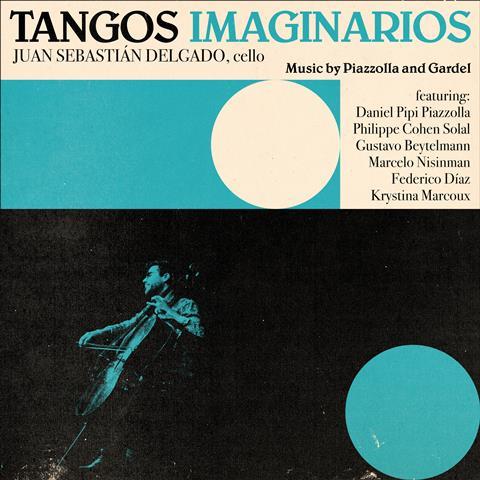
Ultimately, Tangos Imaginarios invites listeners to hear tango’s most cherished works not as museum pieces, but as living, breathing material, capable of holding both deep reverence and genuine reinvention at once.
I hope audiences will sense the dialogue at the album’s core – between cello and bandoneon, between acoustic and electronic textures, between improvisation and composition, and above all, between memory and the present moment.
I pose a final, almost playful question that frames the whole project: Gardel, a man fascinated by the emerging technologies of his era, radio and cinema among them, might today be just as drawn to discovering new ways of creating and listening to music.
Tangos Imaginarios is my answer to that imagined curiosity, an album that does not ask listeners to choose between tradition and innovation, but to experience them as inseparable parts of the same living tradition.
Read: Sebastian Plano: how I compose for solo cello
Watch: Piazzolla’s immigrant story by violinist Tomás Cotik
Read more Featured Stories like this in The Strad Playing Hub










No comments yet