






Davina Shum reports back from the Colorado Music Festival in Boulder, a hidden gem of a festival that celebrated music making with a sense of community, conviviality and commemoration of America in its myriad identities
Read more Featured Stories like this in The Strad Playing Hub
2026 is a year of milestones. The United States marks 250 years since the signing of the Declaration of Independence, while Colorado celebrates the 150th anniversary of its statehood. For me, however, the most significant anniversary on a recent trip to Boulder was a musical one: the Colorado Music Festival (CMF) is celebrating its 50th season.
Colorado is a state famous for its outdoor activities – ski resort towns such as Vail and Aspen are a few hours drive away from Boulder through gorgeous, canyon-flanked highways, plus Boulder’s downtown shopping area is full of brands specialising in outdoor wear for climbing, hiking and skiing. It’s no surprise, as Boulder sits at the foothills of the Rocky Mountains, with numerous trails for walkers and runners to enjoy alongside the stunning landscapes.
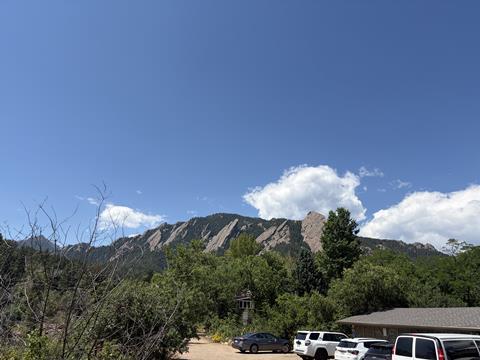
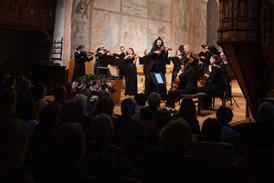
Yet Boulder offers more than outdoor pursuits. Each summer, the Colorado Music Festival takes up residence at Chautauqua, beneath the dramatic backdrop of the Flatirons. With music director Peter Oundjian at the helm since 2019, the festival brings together the Colorado Music Festival Orchestra, an ensemble of leading musicians drawn from orchestras across the United States. Selected through a competitive audition process, these players spend five weeks each summer performing a mix of orchestral and chamber music, joined by an array of internationally renowned soloists.
Their home is the historic Chautauqua Auditorium, a characterful wooden hall that resembles a barn more than a conventional concert venue. As Oundjian himself remarked, it does not look like a space that should possess exceptional acoustics. Yet somehow, it does. The result is a setting that feels both rustic and remarkable: world-class musicians making music against one of Colorado’s most iconic natural backdrops.
This unassuming barn-like structure lends the festival an air of informality and community, despite the world-class calibre of its programming. Before each concert, audience members gathered around picnic tables, sharing snacks, catching up with friends and enjoying cold drinks as the evening settled over Chautauqua.
Inside, the auditorium is striking in its simplicity. Constructed almost entirely of wood and without air conditioning, it relies instead on large ceiling fans to provide relief from the summer heat, which reached 36°C (96.8°F) during my visit. As dusk approached, the fading light filtered through the gaps between the wooden panels, illuminating the hall’s exposed rafters and high, vaulted ceiling. At first glance, it was easy to wonder whether the acoustics could possibly match those of a concert hall. Yet the stage is carefully equipped with acoustic panels that transform the space, making it possible to forget that you are sitting in a rustic venue.
I attended two concerts at CMF – a chamber music concert part of the ‘Robert Mann Chamber Series’ on 21 July, and an all-American orchestral concert on 24 July, which featured violin soloist Njioma Grevious, a former Avery Fisher Grant recipient and Sphinx Competition winner.
The chamber concert showcased some gems of chamber repertoire, opening with Mozart’s Trio in E-flat major ‘Kegelstatt’, played by Louis DeMartino on clarinet, Vivienne Spy on piano and DJ Cheek – the CMF orchestra’s principal viola, hailing from the Fort Worth Symphony. Following that was a poignant and touching new commission by composer James Stephenson – Love Notes for Trumpet and Strings. The work was commissioned by May Lu, who wanted Stephenson to write a work for her husband, and Stephenson’s childhood friend, the trumpeter Jeffrey Work.
Stephenson and Work outlined the premise of the piece which explored love in four themes: ‘Parental Love’, ‘Peer Love’, ‘Partner Love’ and ‘Personal Love’. A lifetime of friendship was evidently displayed throughout the work – Stephenson paid tribute to both Work’s childhood aptitude for trumpet playing, tongue twisters and laughter, which was amusingly orchestrated with gnarly virtuosic passages in ‘Peer Love’. How touching it was to witness a celebration of love between Work and the commissioner Lu – of Chinese heritage – seen in Stephenson’s melding of Western and Eastern harmonies in ‘Partner Love’.
The second half culminated in Tchaikovsky’s Souvenir de Florence – a lively and spirited performance given by violinists Kevin Lin and Ahra Cho, violists DJ Cheek and Darren Carter, and cellists Austin Huntington and Evan Kahn. The barn-like decor provided a certain ambience that was only added to by the wild weather that evening – thunder rolls overhead certainly added to the more dramatic moments in the sextet.
If 21 July was a chance to see Chautauqua Auditorium at its most intimate, hosting a chamber music performance, 24 July revealed the venue at its full capacity. On the programme was the CMF Orchestra conducted by Leonard Slatkin, with an all-American programme on the bill. Naturally, when one thinks of American music, one gravitates towards the music of Aaron Copland, whose Rodeo opened proceedings. With the ballet’s exuberant dances and sweeping pastoral passages, it seemed apt to be listening to this music in a barn-like venue!
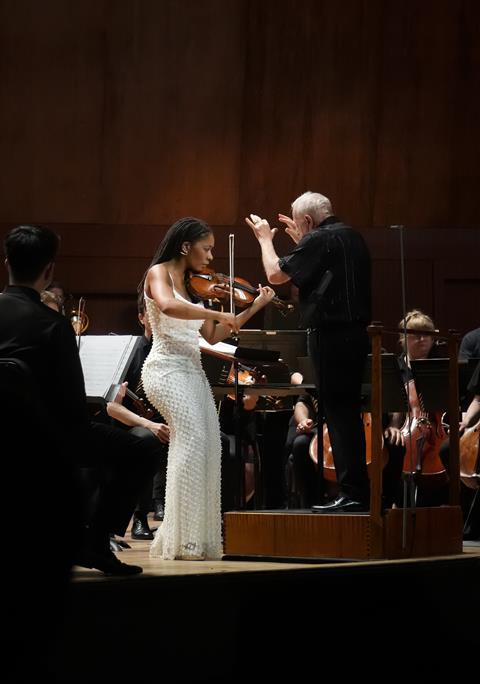
Rising 27-year-old violinist Njioma Grevious took to the stage for John Corigliano’s Chaconne for Violin and Orchestra from the 1998 film The Red Violin. Grevious weaved through the work’s programmatic themes (the film charts the journey of a violin over 300 years), from the silky, mysterious opening, to the driven, dotted rhythms. She followed up her performance with a moving solo rendition of the African-American spiritual, ‘Wade in the Water’.
Grevious received a thunderous reception before and after her performance, and it became evident that a group of youths from the Sphinx Performance Academy (SPA) had been watching. The SPA students were amid an eleven-day summer chamber music and performance programme at the University of Colorado Boulder’s College of Music, and were given free admission to watch the concert by CMF.
The second half opened with Ron Nelson’s pleasant Savannah River Holiday, followed by Cindy McTee’s haunting Adagio for String Orchestra. The work took inspiration from McTee’s former composition teacher, Krzysztof Penderecki, and was written shortly after the September 11, 2001 terrorist attacks. A complete gear-change of mood ensued for the final work – Gershwin’s jaunty and jazzy An American in Paris, followed by an encore of Carmen’s Hoedown – a charming mash-up of themes from Bizet’s opera arranged in the style and orchestration of Copland’s Rodeo, by Slatkin’s father, Felix.
A Q&A session followed the programme, held by husband-and-wife duo Slatkin and Cindy McTee, plus Grevious, where members of the audience asked incredibly compelling and inquisitive questions to the recipients. It was an illustration of the engaged calibre of audience members that attend these concerts. The breadth of topics addressed was vast – from why Slatkin chose to conduct without a baton at times (he joked that sometimes it was necessary to do so when the baton flies out of his hand) to questions about the intersectionality of females and Black musicians in the industry.
McTee and Grevious shared their experiences; McTee highlighted support she received throughout her career despite a distinct lack of female role models, while Grevious’s remarks laid bare some of the microaggressions and discrimination she has faced as a Black woman in classical music. Among the incidents she described were being forced out of an Uber in Vienna and being met with sceptical glances when entering a dressing room despite being the soloist. They were sobering accounts, highlighting the persistence of prejudices that many might assume have diminished. While the classical music industry has made meaningful strides towards greater diversity and inclusion, her experiences served as a stark reminder of how much work remains to be done.
In keeping with the all-American theme of the programme, the panel was asked a deceptively simple question: what makes American music American? Beyond discussions of Copland’s music, the panellists highlighted the influence of jazz and the rhythms of spoken language, particularly the syncopation, accents and patterns embedded within American speech and its many regional dialects. These musical characteristics, they suggested, reflect the nation’s identity as a melting pot of diverse cultures and traditions.
It was a fitting conversation for a country marking its 250th anniversary, and for a programme that explored American history and identity from multiple perspectives. From the frontier landscapes of Rodeo and the achievements of American film composers, to works reflecting a nation grappling with tragedy and loss, the evening painted a multifaceted portrait of the United States and the stories its music continues to tell.
Friday night concluded at Southern Sun Brewery and Pub, where CMF musicians and staff came together for an informal dinner and drinks. I enjoyed the sense of camaraderie in the room: musicians mingling and sharing conversations, while maestros Oundjian and Slatkin engaged in what looked to be an animated discussion with McTee. It was also a pleasure to spend time talking with Grevious and her mother, as well as members of the festival administration team.
Moments like these were what made CMF feel so special. While several summer music festivals take place across Colorado each year, CMF felt like a hidden gem tucked away in the mountains. On paper, the festival’s roster was undeniably impressive: it opened with the prodigious young violinist Himari, welcomed superstar pianist Yuja Wang early in the festival, and featured forthcoming appearances from artists such as the Danish Quartet. Yet this constellation of world-class talent gathers on a quiet hillside above Boulder, performing for a devoted and loyal audience in the intimate setting of a rustic venue.
There is clearly something compelling about this combination of artistic excellence and understated charm. It is perhaps no coincidence that Boulder has been chosen as the future home of the Sundance Film Festival, beginning next year, with the venue set to be winterised as part of the partnership. Like Sundance, CMF demonstrates the appeal of bringing globally recognised talent to a setting that feels removed from the usual festival circuit, creating an experience that is both exceptional and deeply personal.



![Ayanna Witter-Johnson [Jordan Woods] 7](https://dnan0fzjxntrj.cloudfront.net/Pictures/100x67/4/9/4/44494_ayannawitterjohnsonjordanwoods7_224583.jpg)






No comments yet