



Violinist Catherine Chautard on ma – the Japanese concept of negative space – and how it lies at the heart of bow hand equilibrium
Read more Featured Stories like this in The Strad Playing Hub
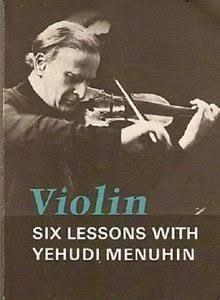
Yehudi Menuhin devoted much of his pedagogical writing to what he described as the continuous search for equilibrium in the bow arm. In Violin: Six Lessons with Yehudi Menuhin (Faber and Faber, 1971), he described how the position of the fingers changes continuously according to the direction and force of the stroke: a perpetual, fluid adaptation in the hand. The fingers, in his vocabulary, are springs. The thumb and little finger are the guardians of balance.
Writing for The Strad (August 2019), the critic Julian Haylock described David Oistrakh’s bow hold as supremely relaxed, one that never appeared to stiffen even in staccato or marcato passages. The result was a sound of sovereign warmth: consistent, rounded, apparently effortless across the full range of bow technique.
Both men were pointing at the same quality: a hand that is simultaneously stable and free. What they described can be given a logical explanation. It has a shape, a mechanism, and a direct consequence for tone. That is what this article sets out to explore.
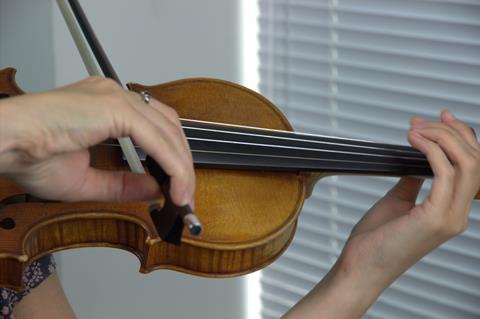
Most objects we handle are instinctively drawn into the palm for a sense of security. A knife or fork, held primarily by the fingers, comes closer in principle to the bow hold than a hammer or racket. Yet even cutlery finds its way toward the centre of the hand. The bow resists this instinct entirely. Long, seemingly fragile, with very few natural points of contact with the body, it is held entirely by the fingers. The palm never touches it. The inner space of the hand remains empty.
This is not a detail. The empty space inside the palm is the defining feature of the bow hold, and the key to understanding why freedom is possible at all. Not a passive absence but a structurally active presence: the place where balance lives, where forces meet, where control originates. And yet most pedagogy directs the student’s attention outward: to the position of the fingers, the height of the wrist, the curve of the thumb. These are the periphery. The centre is the space they surround.
Ma (間) – the Japanese concept of negative space – is not simply emptiness, but the interval that gives form its meaning. Ken Rodgers and John Einarsen in Ma: The Japanese Secret to Contemplation and Calm (Tuttle Publishing, 2025), their collection on the subject, describe ma as the emptiness in which time, space and thought are suspended, an invitation to awareness. In music it is the slight pause between notes, or the rest in a phrase, that enhances its character; in space, the interval between objects that allows each one to exist. A generative space, alive with potential, the condition that makes everything around it possible. Without it, form has nowhere to breathe.
In the body, ma lives in the intervals between joints, in the relationship between muscle and bone, in the quality of attention that neither grips nor releases but simply remains present. Order without imposition. Control without over-control.
The bow hand works on the same principle. The invisible inner space, while not in contact with the bow in any way, becomes the organising centre of the whole system: the place from which balance, alignment and freedom of movement all arise. The quality of the sound is shaped by the quality of the space the hand shelters.
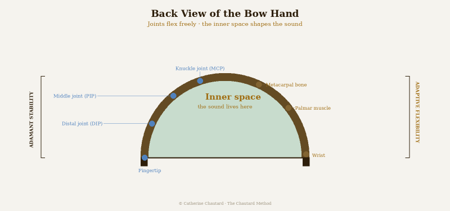
This dome shape is not an aesthetic ideal. It is the neutral, natural resting position of a relaxed hand
Seen from the back of the hand, the structure the fingers form has the quality of a dome. The metacarpal bones and knuckles create an outer arch; the joints, from fingertip to wrist, are the stones of that arch. The palmar muscles on the inner side of the hand completes the arch, giving the dome its structural depth. This dome shape is not an aesthetic ideal. It is the neutral, natural resting position of a relaxed hand, neither extended nor flexed, neither tense nor collapsed. Every joint sits at its mid-range, where freedom of movement is greatest in all directions.
The muscles are in a neutral state: neither actively contracted nor inert. The dome is the shape of readiness. For this reason the joints must remain unlocked. A joint that stiffens into a fixed position cannot return to neutral: it is held at one point in its range, and the hand loses its capacity to adapt and spring back.
This is why it works. A hand organised around this shape can move freely in any direction, toward extension or flexion, lateral or rotational, without first having to release tension or overcome a fixed position. Stability and flexibility are not in opposition here. They are both consequences of the same neutral geometry. The arch holds itself together without effort, distributing forces through its structure the way a stone arch distributes the weight of a building: not by strength, but by form.
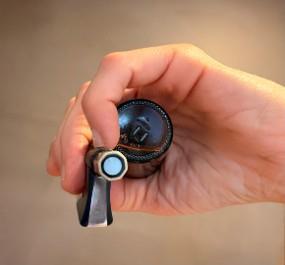
From the inside, that same space takes the shape of a cylinder. Hold a small bottle in the open palm, such as a vial of violin cleaner, and the hand naturally organises around it. The fingers curve. The palm remains free. The space is preserved and given form. When the bow is then placed in the fingers, the cylinder remains. The bottle could stay there. The palm does not interfere.
Pronation does something precise to this structure. As the forearm rotates, the dome tips. The cylinder tilts. Gravity, which had been distributed evenly through the arch, now travels in a single direction: down through the arm, through the index finger, into the string. The bottle, still held in the palm, appears to pour. That image is not metaphorical. It is exactly what is happening: weight pouring through a tilted cylinder, arriving at the point of contact with the string.
The consequence for tone is direct. Weight and pressure are not the same thing. Pressure is muscular, active, effortful, and self-limiting, because a gripping hand chokes the vibration it is trying to produce. Weight is gravitational, a constant force, sustainable and responsive, because it allows the string to vibrate freely underneath it. The dome makes weight transfer possible precisely because the fingers are free. When the joints lose their freedom, through tension or gripping, muscular pressure replaces gravitational weight, and the sound loses depth and resonance.
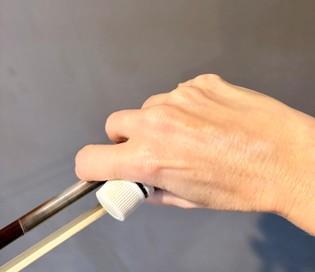
A tent-like ridge replacing the curve, a little finger that has lost its curl, an index finger wrapping too far inward, each changes the shape of the dome in a different direction but produces the same result: one or more joints lose their freedom to return to neutral, and with it the conditions that allow weight to flow freely to the string.
In the teaching studio, shifting a student’s attention from the position of the fingers to the quality of the inner space of the hand has often produced an immediate change in tone quality, within a single bow stroke. The student has not altered their finger position. Something more fundamental has been restored: the neutral shape, the free joints, the conditions under which weight can travel. The sound opens. The resonance increases. The bow begins to move with the string rather than across it.
A parallel can be drawn with what Menuhin described: fingers that change continuously according to the direction and force of the stroke, the dome adapting, springing back, always organised around the space it shelters. What Haylock noted in Oistrakh, not the absence of movement, but movement of exceptional organisation, is the same principle made audible. The hand is not built outward from the fingers. It is shaped from the inside: the emptiness comes first, and the fingers form around it. From that sheltered space, through the tilt of pronation and the channel of the cylinder, the weight of the arm flows to the string and the sound begins.
The inner space of the hand connects to the wrist, the elbow, the shoulder, the spine
The inner space of the hand connects to the wrist, the elbow, the shoulder, the spine. Each joint its own interval. Each gap its own ma. The bow hand may be simply the most visible expression of a principle that runs through the whole body: that form depends on what it shelters, that structure serves the space within it, that balance, in the hand as in the world, arises from what is not there.
Whether Menuhin and Oistrakh would have recognised the concept of ma is not something we can know. But the quality their listeners struggled to name, that stillness within motion, that equilibrium that seemed to come from nowhere, may have found its home here, in the empty space the hand shelters.
It is worth asking what else, in playing and in teaching, is shaped by what is not there.
About the Author
Catherine Chautard is a violin pedagogue and creator of The Chautard Method, based in Cairns, Australia. She trained at the Royal College of Music London and CEFEDEM Paris, and has taught violin internationally for over 30 years. Her workshop Tone Production on the Violin is available on Gumroad.
The dome model of the bow hand and its connection to the Japanese concept of ma is an original pedagogical concept developed within The Chautard Method.









No comments yet