












Ahead of the release of a full performance video on 14 October, cellist Alexander Hersh explains how a series of narrative promotional films and a surreal music video aim to spark curiosity about Paul Novak’s variations with sand in the gears and help the new work reach a wider audience.
Read more Featured Stories like this in The Strad Playing Hub
What happens to a new work after the excitement of its premiere has passed? For cellist Alexander Hersh, that question has led to another: how can performers help newly written music find an audience and a life of its own?
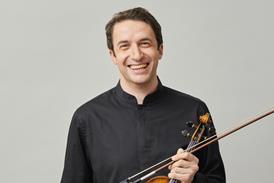
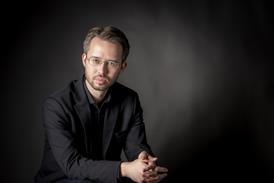
Hersh has built a career encompassing solo, chamber and concerto appearances alongside a strong interest in contemporary music and interdisciplinary projects. A prizewinner at the 2024 Walter W. Naumburg International Cello Competition, he has appeared at venues and festivals including Carnegie Hall’s Weill Recital Hall, Marlboro, Ravinia, Music@Menlo and the Lucerne Festival Academy.
His new project centres on variations with sand in the gears, a short solo work written for him by composer Paul Novak. Conceived as an encore, the piece combines virtuosic cello writing with vocalising and rhythmic drive.
Rather than simply recording a performance, Hersh and filmmaker Mike Grittani developed a series of narrative videos around the work, designed to generate interest ahead of the release of a longer, full-performance video on 14 October.
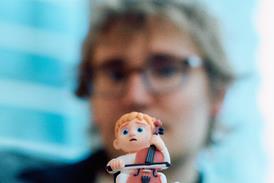
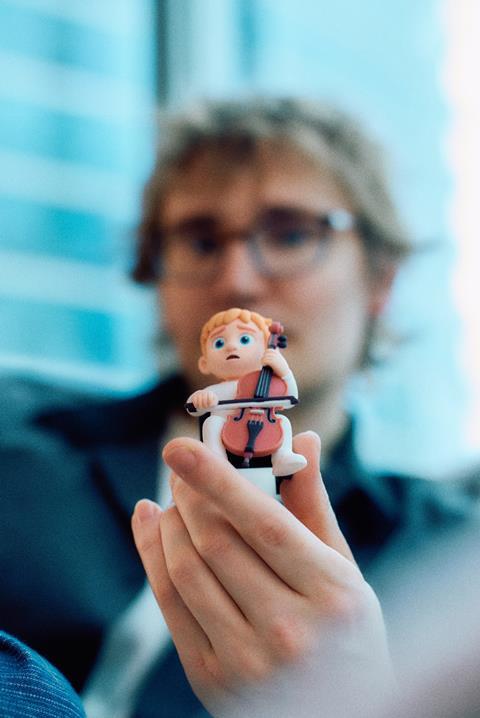
As Hersh describes it, the main video begins as an apparently conventional performance before moving into increasingly surreal territory, culminating in his transformation into a toy-sized version of himself – an idea inspired in part, he says, by his childhood fascination with Honey, I Shrunk the Kids. He hopes the combination of humour and storytelling will encourage audiences to explore music they might otherwise overlook.
Hersh has explored similar territory before: his 2023 project ABSINTHE, previously featured by The Strad, combined recorded music with narrative film, comedy and a distinctive visual identity.
Hersh spoke to US correspondent Thomas May about collaborating with Novak, creating a homemade portal for his film and why musicians should not be afraid to ‘make strange and ambitious things’.
For readers encountering the project for the first time, how would you introduce Paul Novak’s variations with sand in the gears and the film you have created around it?
Alexander Hersh: Paul’s piece is wild… but by design. I love encores, and I feel like people don’t really write them so much anymore, so one of the ideas I initially floated to Paul was writing a piece that could function as an encore for solo cello.
I told him how much I love playing Giovanni Sollima’s Lamentatio as an encore, which is this crazy piece in which the cellist has to sing and play at the same time (in addition to doing all sorts of other extended techniques). When Paul and I first started talking, I asked whether he might incorporate some vocalising into the piece. He absolutely did, and I think he pushed the combination of cello and voice to new technical heights.
The sections involving singing and playing require a kind of coordination that most of us classical musicians rarely encounter, so learning them felt like exploring completely new terrain.
The piece is full of these incredible grooves too. It’s virtuosic, beautiful, funny, and absurd, and I wanted the visual world surrounding it to feel as imaginative and unpredictable as the piece itself.
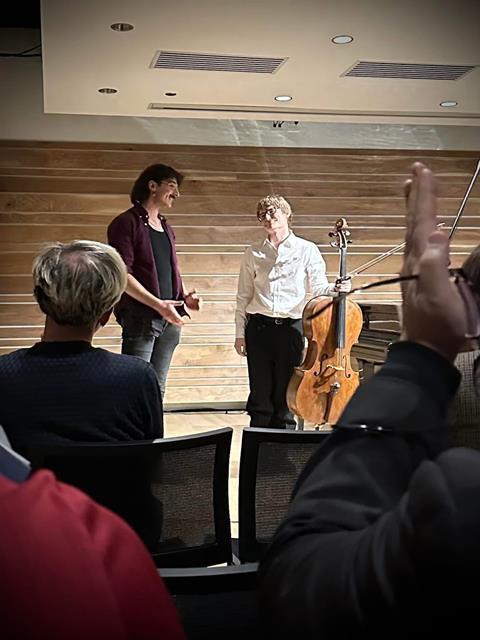
Paul describes the piece as ‘short, virtuosic and wacky’, and says that your personality, sense of humour and musical ideas found their way into it. How did the work evolve through your collaboration? Can you give an example of one of your own musical ideas that ended up in the finished piece?
Alexander Hersh: Yes to all three, and especially wacky!
I love when composers write with a specific performer in mind and allow that person’s personality to come through in the piece. In a way, it’s almost like a musical portrait.
In terms of my own ideas that wound up in the piece, Paul and I talked from the beginning about incorporating singing while playing, but we also talked a lot about groove. I told him how I love music with a strong groove, and I’m very drawn to folk music. The opening of the piece has this incredibly visceral, folky quality, and I wonder if that might’ve grown out of those early conversations.
You’ve said that the project grew out of thinking about what happens to a new work after its premiere. Why did you want to go beyond making a conventional performance video? What role do you think performers can play in helping new music develop a life beyond its first performance?
Alexander Hersh: It breaks my heart how often a composer will write a piece, it receives its premiere, and then maybe it’s played once or twice more, if at all. I compose a little myself, and I’ve always felt for composers who have watched that happen to their work.
I feel like performers can help by continuing to programme new pieces whenever we have the agency or chance to do so, but we can also advocate for them in other ways.
One of my greatest hopes whenever I perform a piece, whether it is old or new, is that someone in the audience or watching online will want to play it themselves. I love imagining this music being carried forward by generations of musicians. To me, that is how the whole industry stays alive and evolves.
Sure, a conventional performance video can be valuable, but something that’s visually distinctive with a story has the potential to make a different kind of statement and reach an entirely new audience.
You and filmmaker Mike Grittani created an entire visual world around the piece, loosely inspired by Honey, I Shrunk the Kids, with the promotional videos conceived as stories in their own right. How did that narrative world emerge, and did thinking about character, movement and the camera affect the way you approached the music as a performer?
Alexander Hersh: I say loosely inspired by Honey, I Shrunk the Kids because I loved those movies growing up, and I’ve long been fascinated by the idea of being shrunk into a toy version of myselfI love portals. They played a big role in my earlier project, ABSINTHE, and I’m drawn to the idea of using them as vehicles into other worlds. When Mike and I began imagining how I might be able to be transformed into a toy, a portal felt like a natural answer.
After months of trial and error, I found an amazing 3D toy artist on Etsy, CSSArtStudio, who created this little model of me holding a cello. Once the toy existed, I began writing a story around it.
The main film begins almost like a conventional performance video. But then, as the music grows increasingly unhinged, a portal starts to appear behind me, and eventually things get kaleidoscopic. By the end, I get transformed into a little toy. We originally imagined creating the portal with visual effects, but quickly discovered how crazy expensive it was going to be. So instead, we went super DIY and built one ourselves from iridescent paper taped to a wooden picture frame, attached it to a motorised disco ball, and used moving light to create this strange physical object behind me, which ended up being much cooler because it was actually there in the room.
I then wanted to reveal the toy through a separate ‘crime scene’ promo. That was particularly fun because technically it’s the first film I truly wrote and directed myself; I even created the shot list for it.
I also wanted the sound design surrounding the films to become genuinely strange. Some of the sounds feel almost ‘alien-like’ to me. My incredible audio engineer Charlie Post built something really imaginative around that idea, and sound designer Alec Chojnacki was amazing with the sound design.
Your 2023 album ABSINTHE also combined classical music with narrative films, comedy and a distinctive visual identity. What did you learn from that project about ‘world-building’ around music? How has your thinking developed with this new film?
Alexander Hersh: ABSINTHE taught me that it’s really cool to bring all of one’s interests together. Before ABSINTHE, I made a video project and EP called The Greenroom, which was almost like a trial run I made during the pandemic to explore this idea of ‘Can one make a narrative out of a classical piece?’ ABSINTHE was sort of the next evolution of that idea, something that was part film, part classical music, a pinch of comedy, and themed merch.
That project taught me the value of being intentional. World-building requires you to think about how every element will work together. I feel like a strong visual concept can draw someone in before they know anything about the music, and I think that can be really powerful. Whether it’s the repertoire, the setting, the clothes, the lighting, editing, or promotional material, I love to think about how all the elements can work together and interact. With this new film, I wanted to push that idea further and allow the main video to exist but to have the promotional videos become different chapters of the same story.
I hope more musicians feel inspired to experiment with their own recordings, films, and visual worlds. It still feels like a pretty untapped territory in classical music.
You describe this project as an experiment in helping unfamiliar music ‘travel further’. What do you hope it will do? Has creating this film and the wider visual project changed the way you think about commissioning, premiering and advocating for new music in the future?
Alexander Hersh: I hope more people treat premieres as opportunities to take risks and try something unexpected. Of course, I want musicians to discover Paul’s piece and play it, but I also hope the project inspires people to make strange and ambitious things of their own. As far as I’m concerned, the lane for narrative videos in classical music is still wide open, especially for weird ones.
This project is also an example of what can happen when you make things with your friends, and I would love to see more musicians embrace that. Chamber music may be the ultimate team sport, but filmmaking might be a close second. It takes a village to make even a two-minute music video, and some of the most fun I’ve ever had in life has come from making films with my friends, even when they’re bad.
Take the risk. It’s worth it.











No comments yet