




Should teachers choose repertoire that plays to a student’s strengths or addresses their shortcomings? Javier García Aranda finds answers in the writings of three influential violin pedagogues
Read more Featured Stories like this in The Strad Playing Hub
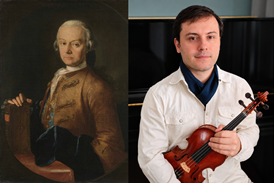
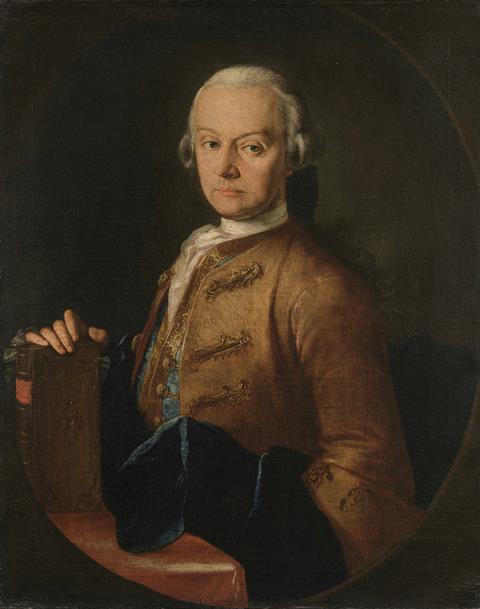
Some time ago, I read Leopold Mozart’s Versuch einer gründlichen Violinschule (A Treatise on the Fundamental Principles of Violin Playing). I was already familiar with the work, as it had been mentioned in music history classes and referred to by some of my teachers, but I had not explored its contents in depth until relatively recently.
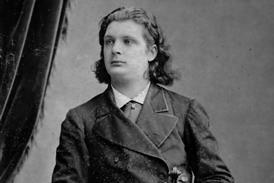
The book was published in 1756, the year his son, the great Wolfgang Amadeus Mozart, was born. It is intended for violinists of all levels and reflects Leopold Mozart’s thoughts and opinions on subjects extending beyond violin playing itself, including acoustics, philosophy and history. It is well worth reading, not least because it offers an insight into just how advanced his thinking was for his time.
’It is true that the pupil sometimes understands the division, but is not exact in the quality of the beat. In such case one must watch the temperament of the pupil that he be not spoilt for ever. A cheerful, merry, ardent person will always hurry more; a melancholy idle, cold-blooded one will dawdle. If one allows a person who has fire or spirit to play quick pieces at once, before he knows to perform the slow ones exactly in time, the habit of hurrying will cleave him for life.
’On the other hand, if one gives nothing but slow pieces to a frosty, melancholy ´moper´, he will remain for all time a player without spirit; a bad and sleepy performer. One can therefore combat such faults as originate from temperament by means of reasonable instruction. The hot-head can be held back with slow pieces, and his spirit by degrees be tempered; while the slow sleepy player can be enlivened by cheerful pieces, and at last in due time be turned from a half-dead into a living person.’
Choosing repertoire suited to each student’s temperament, whether to address weaknesses or develop certain aspects of their playing, is a particularly interesting approach. The fact that Leopold Mozart was already proposing this idea in 1756 reveals his remarkable understanding of human nature.
Two centuries later, the distinguished violin pedagogue Ivan Galamian published his book Principles of Violin Playing and Teaching in 1962. In the chapter devoted to teaching, he writes:
’Teachers should not take the line of least resistance by giving the student only those pieces for which he is most naturally adapted. The repertoire should be well rounded for all the students in order that any one-sided development may be avoided. For study purposes, the weakest points should be given special attention. For public performance, however, it will be wiser to choose a program that is best suited to the personality of the student and will show his special talents to the best advantage.’
Through this passage, Galamian illustrates the distinction between a varied repertoire aimed at addressing each student’s weaknesses and a repertoire chosen for public performance, where the performer’s best qualities can be showcased. From this, we can conclude that repertoire selection was carefully tailored to each student’s strengths and weaknesses, as Leopold Mozart had already suggested in his treatise of 1756.
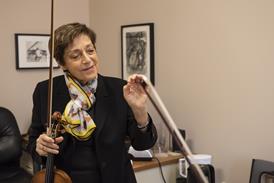
In the book originally entitled Pedagogicheskoe Nasledie (Pedagogical Legacy), dedicated to Yuri Yankelevich and written as a tribute by his sister Elena in 1983, ten years after his death, we also find reflections on this subject, with contributions from some of his most distinguished students.
In the English translation, Maya Glezarova discusses how Professor Yankelevich selected repertoire for his students and describes three approaches:
- […] The first reflects the student’s external nature, that is, choosing pieces that accentuate the natural qualities of the student—pieces that are naturally suited to him or her. The second approach only takes into consideration the student’s weaknesses. Here, in attempting to fix the weaknesses, the teachers dismiss all the positive qualities of the students and risk stifling each student’s individuality. I believe there must be a third, truer approach: to carefully combine the individual characteristics of the student with the necessary goals for his or her future development, while at the same time also correcting any weaknesses. […]
- […] Below is an approximate repertoire plan for a student starting to study with Yankelevich in the second year of the Central Music School. This is geared for a student in possession of good technical capabilities, but an underdeveloped musical and emotional side and rather lifeless dynamics and expression. […]
- […] Another student might possess a big, bright, and beautiful sound, and play very emotionally, but also with rhythmic instability, excessive vibrato, heavy left-hand technique, and limited agility. In this case the repertoire plan may be almost exactly the same, but the goals would be different—that is, maintaining stricter and calmer execution, emphasizing rhythmic stability, and developing the virtuosic components. Thus the number of pieces covered in Yankelevich’s classes remained relatively constant, but the repertoire was treated differently depending on the student’s individual characteristics.
One remarkable point is that both Leopold Mozart and Yuri Yankelevich distinguish between two main types of student.
In Mozart’s case, the distinction concerns temperament. On the one hand, he describes cheerful, merry and ardent individuals; on the other, melancholy, idle and cold-blooded ones.
In Yankelevich’s case, the two profiles are associated, firstly, with a student who has good technical abilities but insufficient musical and emotional development, with rather lifeless dynamics and expression; and secondly, with a student who possesses a powerful, bright and beautiful sound and great emotional expressiveness, but struggles with rhythmic instability, excessive vibrato, limited agility and other technical difficulties.
Two concepts can be identified that both Mozart and Yankelevich express in similar ways: vitality (Mozart: ‘reviving’; Yankelevich: ‘lifeless’) and tempo (Mozart: ’exactly in time’; Yankelevich: ’rhythmic stability’). These are key to developing solutions to the problems presented by the two types of student. In Mozart’s case, the proposed solution involves choosing repertoire aimed at addressing these weaknesses, whereas Yankelevich proposes working on them regardless of the piece being played.
Ivan Galamian takes a pragmatic approach to this question. The repertoire studied should be varied, but focused either on addressing the student’s weaknesses or on highlighting their strengths, depending on the context. We can therefore appreciate the great importance he attached to repertoire selection, adapting it to each situation.
It would, of course, be incorrect to generalise by assuming that a cheerful, fiery individual would necessarily have rhythmic difficulties, while a more apathetic person would display limited musical expressiveness. Human personality, and the ways in which it manifests itself, are too complex to be easily classified. Nevertheless, I do not believe it would be appropriate to underestimate the ideas of two of the most distinguished pedagogues in history. Drawing on their experience, they observed two tendencies that they considered noteworthy and chose to describe them.
In learning music, variety in the repertoire studied is crucial. From the very beginning, students should be aware of the stylistic richness of music. Although certain works will be more naturally understood and felt than others – two concepts that remind me of the title Feeling-Thinking (Sentir-Pensar), by the distinguished violinist and pedagogue Evelio Tieles, a book that explores the relationship between the two in depth – the teacher must be capable of proposing a varied and appropriately tailored repertoire.
In learning music, variety in the repertoire studied is crucial
This means alternating between works that suit the student’s personality and tastes and others that present a challenge, particularly when the student has developed the potential to express themselves artistically without instrumental technique becoming an obstacle.
This, in turn, allows them to develop the ability to adapt to a particular musical style while combining its characteristics with the subjectivity of their own interpretation, without negatively affecting the musical discourse or contradicting the composer’s intentions.
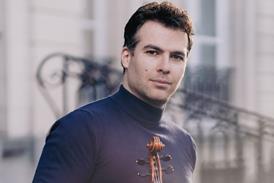
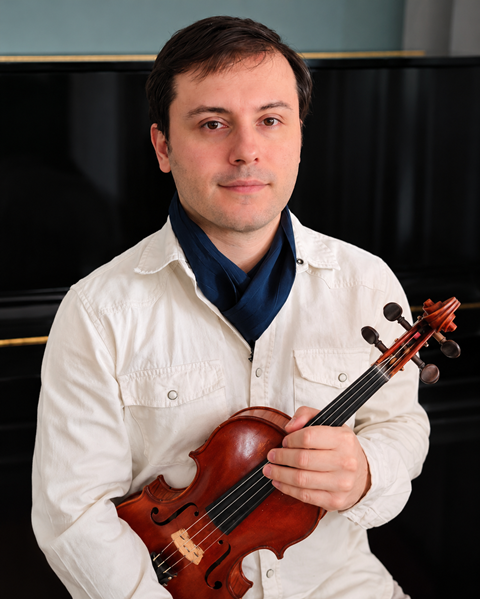
Javier García Aranda is a violinist and violin teacher based in Madrid, with a bachelor’s degree and a master’s in performance from the Royal College of Music, London.











No comments yet