
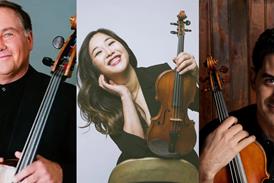
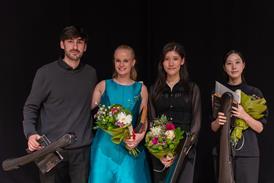

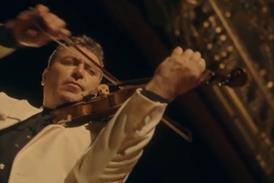
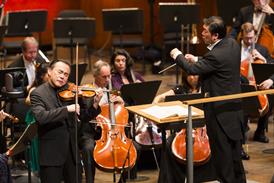




To celebrate the 90th birthday of German avant-garde composer Helmut Lachenmann, the JACK Quartet perform his three string quartets in a single evening – and reflect on their long association with his radical sound world.
Discover more Featured Stories like this in The Strad Playing Hub
Helmut Lachenmann has spent his career expanding the expressive possibilities of acoustic instruments. His concept of musique concrète instrumentale redefines how sound is produced, foregrounding the friction of bow, wood and breath, and making the physical act of music-making an integral part of the composition. For string players, his three quartets – Gran Torso (1971), Reigen seliger Geister (1989) and Grido (2001) – mark a singular achievement: works that stretch the quartet medium to its limits while opening up an unexpected, often playful musical poetry.
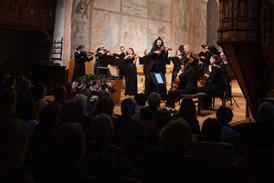
On 9 October, the JACK Quartet will perform the complete cycle at Columbia University’s Miller Theatre, launching the 2025-26 Composer Portraits series. The concert celebrates Lachenmann’s 90th birthday, and gives New York audiences a rare chance to encounter all three quartets together – an event not heard in the city for more than a decade.
For JACK, the relationship with Lachenmann goes back to their student days, when they first performed Grido under his guidance. Since then, they have recorded the quartets for Mode Records, toured them internationally, and even staged marathon performances. Known for their fearless advocacy of contemporary music, the quartet speaks of Lachenmann as a ’father figure’ whose ideas have left an indelible mark on their own artistic identity.
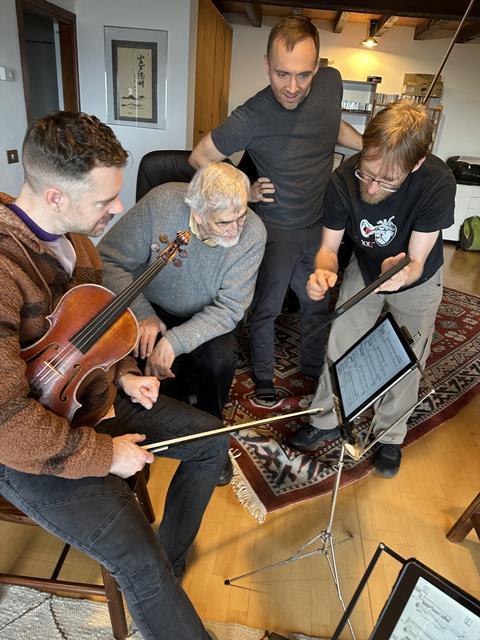
In this conversation with US correspondent Thomas May, violinists John Pickford Richards and Christopher Otto, violist Austin Wulliman and cellist Jay Campbell reflect on what it means to live with these quartets, the physical and interpretive challenges they pose and the resonance they carry at this milestone moment in Lachenmann’s career.
How did JACK first encounter Lachenmann’s music, and what was your reaction the first time you started to play one of his quartets? Have you done the marathon elsewhere?
John Pickford Richards: JACK has performed Lachenmann’s three quartets as a concert program a handful of times, most notably in New York at the Morgan Library, for which we made Che Guevara-style T-shirts of Helmut’s head! It seemed appropriate.
We first encountered Lachenmann’s music when we were students, before JACK had officially formed. While in school, the four founding members of JACK had an opportunity to perform his then-new third string quartet, Grido, at a festival where he was in residence. Our experience working with him was deeply magical. The music challenged us, and more so, it rewarded us, so we found additional opportunities to work with him and perform the work elsewhere, which led to our decision to found JACK. We like to think of Helmut as the quartet’s father figure!
Performing all three of Lachenmann’s quartets in one evening is a rare event. How do you hear the evolution of his language and ideas from Gran Torso to Grido when you perform them as a complete cycle? And how does revisiting the cycle now, for his 90th birthday, compare to your landmark Wigmore Hall performance?
Christopher Otto: I’m excited to perform the three Lachenmann quartets in a single concert. Each quartet structures the relationships between sounds and actions in its own, distinct way. When we hear them together, we can situate them within a lifetime of musical activity spanning 90 years and counting. In Gran Torso, a radical reconstruction of melody, harmony, and rhythm brings our attention to the physicality of sound production. In Reigen seliger Geister, the instruments collectivize, becoming a meta-instrument with composite rhythms dancing through wide-ranging landscapes. Grido flows with a relentless momentum, and foregrounds Lachenmann’s fondness for recontextualising tonality.
Together, the three pieces cross-pollinate each other: gestures recur and themes are recognized. Lachenmann’s ideas and attitudes to music have taken root in us and continue to bear fruit. Revisiting the quartet cycle affirms their deepening resonance today.
Lachenmann’s concept of musique concrète instrumentale pushes instruments to their limits. What kinds of sounds and gestures do these quartets demand of string players? How do you approach mastering such a radically different physical relationship with your instruments?
Jay Campbell: There are a lot of unusual techniques for a string quartet. But, I don’t think the techniques are really that “weird” – most of them are very adjacent to our regular playing technique. Things like white noise, filtered pitches, scratch tones: these are somewhat common sounds across a wide variety of music and styles nowadays.
Beyond sheer novelty, I think Helmut is thinking more about expanding the spectrum of sounds, rather than subverting traditional technique. Helmut’s sound world is full of extensions, not subversions, of the ‘regular’ sounds we would hear in classical music. That same interest in the physicality of making a standard cello tone is similar to exploring the physicality of a finding a perfectly purring overpressure sound, or an ear tingling filter sweep.
For me, his music was an essential doorway to questioning inherited ways of listening. His music really opens up when you start hearing his sound world as a fluid continuum of related sounds, starting from extremely short articulations (clicks, plucks), sped up into fast rhythms, which speed up further into the domain of pitches. Pitches then perhaps beat against each other to loop back around into the domain of rhythm, until those beats speed up into harmony….
The abstract sounds themselves, whether it’s a ‘special effect’ or a C major chord, are usually not the most interesting or unique feature of music. It’s all the other stuff – the context, the intentionality, the organisation – that gives sounds power and meaning.
For audiences encountering Lachenmann for the first time, the sound world can feel very unfamiliar. As performers, how do you guide listeners into this music and help them experience it as more than just ‘extended techniques’?
Austin Wulliman: I think the most important part of encountering this music for the first time is to take the same approach one might when seeing a new object for the first time. Maybe imagine yourself walking into a large gallery room with an unfamiliar sculpture. The room is spacious and you’re not in a hurry to be anywhere else.
What materials do you sense are present? Allow yourself to be curious about what shapes are coming into form. Stay relaxed and follow the parts of the sound world you find most fascinating. Specifically, one might consider getting interested in finding more nuance as to what a musical sound is. When does a whisper become a played note? When does a burst of noise become a percussive hit? When does a pixelated grid of rhythms begin to dance? In this space, there is the opportunity to slow down the mind’s expectation to comprehend the totality of the work immediately and be present with the sounds as they occur.
As you celebrate Lachenmann’s 90th birthday with this concert, what do you think his quartets have contributed to the evolution of the string quartet genre – and what do they mean to you personally as players?
Austin Wulliman: Lachenmann’s quartets build a new world of virtuosity from the ground up, a garden of sounds to delight in and explore. With each piece, the world unfolds itself more and more, showing its designer’s playfulness, humour and sensitivity. As its gardeners, we have the joy of caring for these carefully selected natural wonders, placed just so in Helmut’s wondrous expression of human curiosity.
More information on the JACK Quartet’s Lachenmann marathon at Columbia’s Miller Theatre here.
Read: Marathon at Wigmore: The Jack Quartet has world-burning energy to spare
Review: Concert review: Jack Quartet
Read: Irvine Arditti’s sentimental work: Helmut Lachenmann’s Grido
Discover more Featured Stories like this in The Strad Playing Hub









No comments yet