
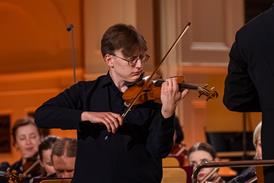

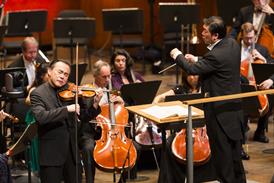
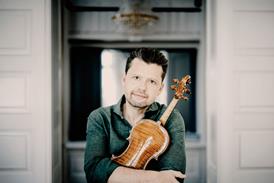
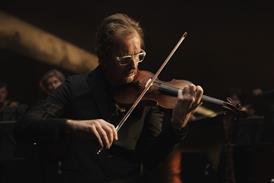


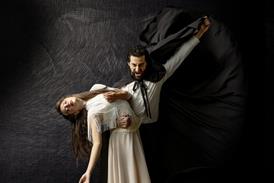
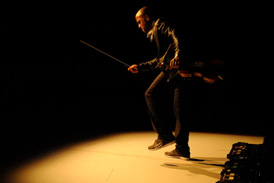


Vögele reflects on his holistic approach to music education, performance psychology and the notion of ‘success’ in music – ideas central to The Concertmaster, a film in which he features and for which he wrote the soundtrack
Read more Featured Stories like this in The Strad Playing Hub
Winfried Vögele is a a lecturer for violin and viola and conductor of the symphony orchestra at the Landesmusikgymnasium Rheinland-Pfalz in Montabaur, Germany. His professional career includes work with the Brussels Radio Symphony Orchestra, concert tours with the James Last Orchestra, numerous recording productions and extensive experience composing for film and stage productions internationally.
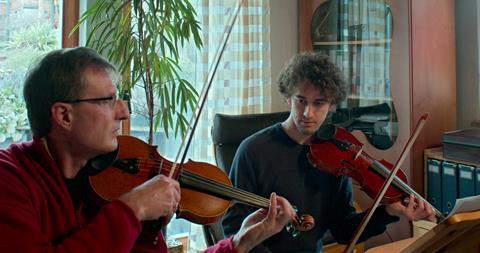
Recently, Vögele featured in the film The Concertmaster, directed by Manoj Mauryaa and winner of the Best Feature Film Award at the Berlin Lift-Off Film Festival. Vögele plays the role of conductor Frank Schubert, who, in seeking a replacement for his orchestra’s indisposed leader, discovers a young man named Walter, a florist with a hidden talent for the violin.
The film explores themes of learning differences in music, creativity and the healing power of classical music, with an original soundtrack written by Vögele himself. As a long-time pedagogue, Vögele has dedicated much of his career to developing a holistic approach to nurturing young musicians.
He shares his thoughts with The Strad.
You have spent much of your career teaching young violinists and violists. What do you think are the biggest challenges facing the next generation of string players, and how can teachers, conservatoires and the profession better safeguard their long-term development?
Young musicians today have opportunities that previous generations could hardly have imagined. With just a few clicks they can listen to the world’s greatest performers, compare different interpretations and learn from outstanding teachers across the globe. That is an extraordinary gift. At the same time, it creates a new challenge: the ability to stay focused. Information is everywhere, but deep learning still requires time, patience and undivided attention.
For me, one of the most important goals of music education is to develop perception. We can only improve what we are able to hear, feel and recognise. This applies not only to intonation, rhythm and tone quality, but equally to musical expression, physical ease and our own inner state. The more refined this awareness becomes, the more independently a young musician can grow.
The role of the teacher has also evolved. Rather than presenting a single ‘correct’ interpretation, I believe we should help students understand the principles behind musical decisions, so they gradually become independent artists. During my own studies with Nobuko Imai, she encouraged us to prepare our own fingerings before each lesson. Only afterwards would she explain why she might choose something different – often for musical rather than technical reasons. That approach shaped me profoundly because it encouraged curiosity instead of imitation.
Technical excellence remains essential, but technique is never an end in itself; its true purpose is to serve the music by giving students the freedom to discover and express their own authentic musical language.
Technique’s true purpose is to serve the music by giving students the freedom to discover and express their own authentic musical language
Concerns about burnout, anxiety and career uncertainty are increasingly common among young musicians. What practical steps can aspiring musicians take to protect their wellbeing and build sustainable careers in music?
A sustainable musical career begins long before an audition or concert. It begins with the relationship we develop with ourselves during everyday practice.
Many young musicians believe that more practice automatically leads to greater progress. In my experience, learning also requires recovery. Just as athletes need time for their bodies to adapt, musicians need moments in which body and mind can absorb what has been learnt. Short breaks, conscious breathing, movement, sufficient sleep and genuine rest are not interruptions to practice – they are an essential part of it.
Equally important is learning to recognise the early signs of unnecessary tension, fatigue or mental overload. These signals are often subtle, but if we ignore them, we unknowingly rehearse tension alongside the music itself. Under the pressure of performance, those same patterns often return. Healthy practice therefore means learning to listen not only to the instrument but also to ourselves.
Fear rarely comes from the situation itself. More often, it arises from the story we place upon the situation – about failing an audition, making mistakes or not being good enough. We cannot know whether these stories will ever become reality, yet we often believe them as if they were facts. Learning to recognise this mechanism, and gently returning our attention to the music itself, allows us to perform with greater freedom, clarity and presence.
Career uncertainty is a natural part of an artistic life. I believe it becomes much easier to navigate a career when we let go of the idea that there is only one definition of success. A fulfilling musical life is not defined solely by a solo career or a position in a major orchestra. For many musicians, fulfilment may be found in teaching, chamber music, composing, conducting or inspiring the next generation. What matters most is not how impressive a career appears from the outside, but whether it allows us to continue growing, contribute to others and live a meaningful musical life.
Above all, I hope young musicians learn to treat themselves with the same patience and kindness they would naturally offer a friend. A musical career is not a sprint towards a single goal but a lifelong journey. Taking care of ourselves is therefore not separate from artistic development, it is one of its foundations.
What matters most is not how impressive a career appears from the outside, but whether it allows us to continue growing, contribute to others and live a meaningful musical life
Your work has explored performance psychology and mental preparation for musicians. How important are these skills alongside technical training, and do you think they receiving enough attention in today’s music education systems?
For me, mental preparation does not begin a few minutes before walking onto the stage. It begins with the quality of our attention in everyday life.
Many people think performance psychology is about eliminating fear or controlling thoughts. My experience has been quite different. Thoughts naturally arise before important performances. Trying to fight them usually gives them even more importance. What matters is learning where to place our attention. Again and again, we gently return it to the music itself – to the sound we want to create, the phrase we want to shape and the next musical intention.
In that sense, every practice session is already mental training. If we repeatedly practise while distracted, impatient or physically tense, we rehearse those states as well. If, instead, we cultivate calm attention, careful listening and physical ease, these qualities gradually become available when we need them most.
For me, this extends far beyond the practice room. Whether I am teaching, practising, walking or simply talking with someone, I try to be fully present with what I am doing. Presence is not something we switch on before a concert; it is something we cultivate throughout our daily lives.
Fortunately, these topics receive far more attention today than they did in the past. Even so, I believe they should become an integral part of every musician’s education from the very beginning, because mental preparation is not separate from artistic development – it is part of it.
Ultimately, performance psychology is not about becoming fearless, nor is it about learning how to impress an audience. Our relationship with performing changes profoundly when we stop going on stage in search of approval and instead step onto the stage with the simple intention of giving something meaningful through music. The less we depend on applause, admiration or external validation, the freer we become. Music then becomes an act of genuine communication rather than self-confirmation – and, paradoxically, this is often when audiences are touched most deeply.
Our relationship with performing changes profoundly when we stop going on stage in search of approval and instead step onto the stage with the simple intention of giving something meaningful through music
The Concertmaster centers on a gifted violinist whose talents do not fit easily within conventional musical training. What conversations do you hope the film will spark about how we identify, nurture and support young musical talent?
One of the central questions in The Concertmaster is how easily extraordinary talent can remain hidden when we judge people only by conventional educational pathways.
Walter is a florist, not a conservatoire student. He possesses exceptional musical sensitivity, a beautiful tone and remarkable creativity, yet his gift remains largely unseen because inner barriers prevent him from flourishing within traditional expectations. I believe many gifted people, not only musicians, carry similar invisible obstacles.
The film also highlights the importance of the environment in which talent develops. Theodor, the blind owner of the flower shop where Walter works, believes in Walter long before Walter believes in himself. He encourages him, challenges him and creates a space where trust is stronger than fear. I believe this is one of the greatest gifts a teacher can offer. High standards and genuine encouragement are not opposites, they belong together.
Another conversation I hope the film will inspire is about creativity itself. Walter also creates music of his own. I believe improvisation can be a valuable complement to traditional musical training. It develops listening, imagination and the confidence to discover one’s own musical language. In a world where technical skills can increasingly be imitated, creativity becomes one of our most valuable human qualities – not only in music, but in life itself.
Ultimately, I hope The Concertmaster encourages teachers to look beyond technical achievement alone. Technique is indispensable, but imagination, individuality and the courage to express something deeply personal are equally essential if we want young musicians to realise their full artistic potential.
The film touches on themes of trauma, self-belief, artistic growth and alternative pathways to musical success. How do these ideas reflect challenges you have encountered in your own work with young string players, and what message would you like violinists and violists to take away from the film?
Although The Concertmaster tells the story of a violinist, I believe it speaks to something much more universal. Many people carry experiences from the past that quietly shape how they see themselves and the possibilities they believe are open to them.
Walter’s greatest obstacle is not a lack of talent. His gift has always been there. What changes is not his ability but his relationship to the stories he has unconsciously carried with him for many years. I hope the film encourages people to recognise that while we cannot change what has happened, we can change the relationship we have with the stories we continue to tell ourselves about it.
My own musical journey taught me something similar. As a young violinist, I believed success meant reaching a particular destination: a position in a professional symphony orchestra. When I finally achieved that goal, I realised that fulfilment does not come from arriving somewhere; it comes from continuing to grow. That insight gradually opened new doors: conducting, composing, arranging, teaching, film music and eventually filmmaking. Looking back, I realised that the violin was never simply my destination; it became the doorway to a much broader creative life.
Fulfilment does not come from arriving somewhere; it comes from continuing to grow
If I could leave young musicians with one message, it would be this: remain curious. Continue learning. Explore new repertoire, improvise, compose, collaborate with others and remain open to unexpected opportunities. Don’t be discouraged by rejection. Sometimes ‘no’ simply means ’not today.’
Music is far more than a profession. It is a lifelong journey of discovery, creativity and human connection. I hope The Concertmaster reminds people that our greatest artistic freedom begins when we stop trying to become someone else and instead have the courage to express, with honesty and generosity, who we already are.
The Concertmaster is now available to audiences worldwide on major digital platforms including Amazon, Apple TV and Kino on Demand. Watch the trailer (in German) below:
Read: Top awards for Singaporean animated film ‘The Violinist’
Read: How human should music education be?
Read more Featured Stories like this in The Strad Playing Hub












No comments yet