


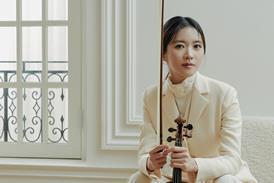




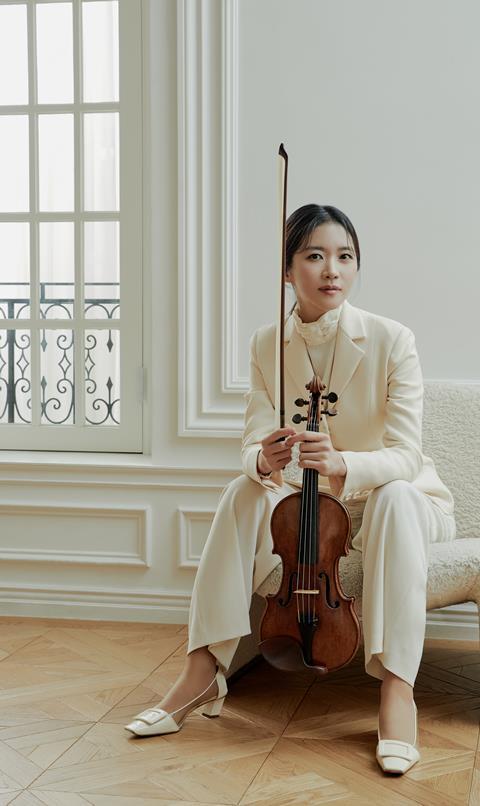
Ahead of a recording release of Vivaldi and Piazzolla’s Seasons, the violinist reflects on nature, memory and collaboration and why true originality comes not from trying to be different, but from seeing familiar music through the prism of personal experience.
Discover more Featured Stories like this in The Strad Playing Hub
There is a particular responsibility in recording a work that almost everyone already knows. With Vivaldi’s Four Seasons, the question of originality inevitably arises. Yet I have never consciously tried to be original. We each experience the world through a prism of memories, associations and emotions; even when musicians approach a score with the same intention of being faithful to the composer, what emerges will naturally differ.
This is especially true of The Four Seasons, where Vivaldi leaves unusually detailed clues in the accompanying sonnets. A cuckoo, a stream and rustling leaves are vivid, objective ‘pictures’ of nature, yet the cuckoo I hear may sound quite different from another musician’s, just as a breeze, a storm or the biting cold of winter is coloured by our individual experiences.
Nature has been intertwined with my musical imagination since childhood. I was born in the port city of Busan in South Korea – apparently, the first word I spoke after ‘Mum’ and ‘Dad’ was ‘the sea’ – and, after moving to the UK, spent three and a half years on the Isle of Man, surrounded by green fields, animals and the ever-present sea, where Vivaldi’s Four Seasons became part of my childhood soundscape.
When Vivaldi describes ‘murmuring streams caressed by gentle breezes’ in Spring, I instinctively think about their movement. A stream flows in one direction, a breeze in another, yet where they meet there is an interchange of energies. I feel that interaction in Vivaldi’s music, following the natural shaping of his phrases rather than consciously manufacturing a picturesque effect.
Nature also enters through memory. The second movement of Winter, with its warmth indoors while rain falls outside, is a scene I deeply empathise with. Cold, wet British winters – the pitter-patter of rain or snow outside while one remains cosy and warm within – are familiar to me. Three centuries on, its physical sensations remain remarkably immediate.
Faithfulness to the score does not mean controlling every detail. During the slow movement of Spring, our principal violist asked whether I preferred Vivaldi’s barking dog to be a rough dog or a nice, polite one. I asked her to go with whatever she fancied; her imagination and experience were part of the performance too.
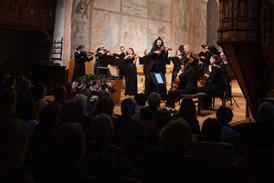
That exchange represented something of my experience recording with the English Chamber Orchestra. I prefer to lead through playing, and concertmaster Ofer Falk and the principals – particularly principal cellist Nathaniel Boyd, with whom I shared important duo passages – were such sensitive chamber musicians that a rapport developed quickly. There was a little testing of the waters at first, but when I wanted something more, or felt our ideas did not quite align, I would explain what I was looking for and the musical reason behind it. They responded with tremendous enthusiasm, and it became a genuine exchange: during breaks, players would ask what I wanted in particular passages and whether there was anything they could give me more of.
After takes, Ofer and the principals repeatedly climbed the long staircase to Abbey Road’s control room, discussing among themselves and with me how they could respond to and support me more fully. It became, in the truest sense, ‘our’ project.
This chamber-music approach extended to the recording itself. Producer Simon Kiln and I shared a conviction that the result should sound as natural as possible, almost as though a concert had simply been captured. We recorded complete takes followed by long stretches rather than in tiny fragments. Simon also used an intriguing combination of one historic main microphone and a few modern supporting microphones – fitting for a recording balancing the immediacy of live performance with modern technology. Technology, after all, should not manufacture expression; at its best, it brings the listener closer to an expression that already exists. Curiously, within the enclosed dimension of a studio and over continuous hours of recording, one’s perception of tempi could occasionally become distorted. Having heard our rehearsals, Simon’s candid ears were invaluable in nudging us back towards our original musical impulse on the rare occasions he felt it necessary.
The same principle guided the editing. I have never advocated a highly polished studio sound for its own sake; I would rather hear the texture and immediacy of a concert hall. The danger, in pursuing perfection, is that one can remove the very unpredictability that makes music feel alive. When choosing takes, a performance with risk, character and perhaps a few slight rough edges was preferable to one that was squeaky-clean but sterile.
There was something fitting about exploring this intersection between spontaneity and recording technology at Abbey Road. Entering the building was exciting: the warm welcome, photographs of legendary musicians, the red control room, and finally the famous long staircase into Studio Two. Yet there was little time to bask in history; we had to begin making music. The room felt quite dry at first but, strangely, I found this sympathetic to some of Vivaldi’s slow movements.
If in Vivaldi I felt myself becoming part of nature – almost giving myself over to the wild – Piazzolla’s Four Seasons of Buenos Aires transformed the seasons into human emotion. His world contained a wonderful mix of jazzy edges, exhilaration, lush romance and nostalgia, while possessing the scale and spectrum of the sea, with, in some nostalgic passages, a certain ‘stickiness’ I associate with salt-water air. Buenos Aires, like Busan, is a port city, perhaps one reason its mixture of sea, city and human emotion spoke to me so strongly.
Ultimately, I hope the listener is transported through two vivid worlds: Piazzolla’s restless, sensual and deeply human landscape, then the sensory nature of Vivaldi’s seasons. Nature has always been a source of healing and restoration for me, and music can give us access to such experiences even when we cannot physically reach them.
Perhaps originality resides not in striving to be different, but in allowing a work to pass honestly through the prism of one’s own experience before offering it to others, who in turn will hear it through theirs. The seasons return year after year, yet no spring, no storm and no sea is ever quite the same. Music, perhaps, belongs to that same cycle of life: continually returning to us, familiar yet transformed, bringing something new with every return.
Soojin Han’s The Seasons with the English Chamber Orchestra will be released on Orchid Classics on 25 September 2026.






No comments yet