


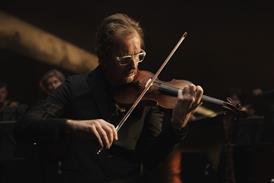




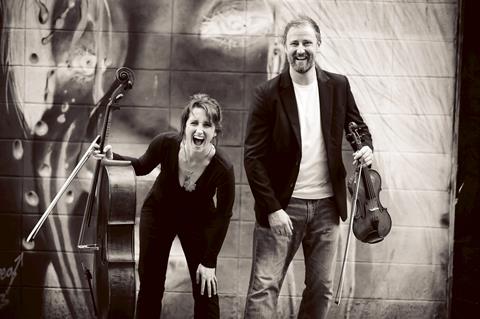
Cellist Rowena Calvert of the husband-and-wife duo shares the background, motivation and technical challenges of arranging symphonic orchestral film scores for two stringed instruments, as the duo releases its new EP Mission Impossible
Read more Featured Stories like this in The Strad Playing Hub
Apart from the obvious horrors of Covid, my husband Rhys Watkins and I, like many musicians, found it a time of deep reflection, rejuvenation and creativity.
Rhys and I were in our house together for the first time in 14 years and almost straight away, we got stuck into a pile of music that we could play together. Then we realised that this pile – for violin and cello – is really very small indeed.
Once you have played the Brahms Double, Kodály, Ravel, Martinů and a few other delights, there wasn’t so much in the repertoire that captivated our interest. We had a root around and found a beautiful piece by Samuel Coleridge-Taylor and we enjoyed playing Bach’s two-part inventions, however we immediately had a craving for so much more.
Rhys and I have been fortunate to record many major film scores – Rhys as a member of the London Symphony Orchestra and me through various London session orchestras. These scores are so vast, epic and awe-inspiring, however we felt motivated to try the impossible task of recreating them using only two instruments. Was this even going to be possible?
Some of these scores have up to 40 different parts which can include choirs, huge percussion sections, specialised instruments and sound effects. Even with the obvious challenges, this idea resonated deeply with both of us and we had to think carefully about who to approach that might actually entertain the idea of arranging these film scores for us.
The most obvious idea to us was to get in touch with composer and arranger Simon Parkin, who is arranger-in-residence for Manchester Camerata and has had great success with his recent commercial recordings including Sheku Kanneh-Mason’s album Elgar, which reached Top 10 in the UK Official Albums Charts. He seemed like the perfect choice.
How were we going to choose which scores would work? We spent hours listening to recordings trying to imagine how a reduced version might affect the overall feeling of the score as our motivation was to bring something new to the table, not to take anything away.
The challenge was that the audience already has these pieces in their minds so when you present a substantially reduced version to them, it’s important they see the music as something fresh rather than a disappointment. Somehow we had to maintain the epic flavour, even though we were working with a smaller scale. We eventually settled on 16 captivating film scores and waited patiently for Simon to work his magic.
Every time a new score arrived we would brace ourselves at how technically demanding it would be, even though we knew what was coming! It felt like Simon had used every note on the fingerboard in some of the scores, particularly ‘Duel of the Fates’ and ‘Imperial March’ from Star Wars.
These scores are so thick texturally and you can really imagine all the different instruments you are imitating as you play. Simon dealt with the lack of extra instrumentation by using multiple double stops and heavy scalic passages on both instruments. Often, octaves or even fingered octaves would provide a thicker texture and give both instruments more power. Playing passages in a different register or even up several octaves also helped create the illusion of having more instruments and excitement in the sound.
Simon’s arrangements are masterworks and we have really tried to bring everything he asked for to our performances. However, when you actually compared the original scores against two humble string instruments, even with all the technical fireworks, there was no denying that something felt missing from some of the tracks.
What began as an acoustic project was now starting to evolve into something completely different. Much as we loved performing our Film Music Programme acoustically, we now felt the need to fill out our duo parts to match the scale of the original soundtracks.
At this point we were very fortunate to be introduced to Albin Dominic, a sound engineer from India, who we worked with to fatten up the sound world to better reflect the original score size. He created this incredible texture with percussion, choirs, beats and electronics that could perform alongside the duo. Our scores were fresh and new but we now felt the same magnitude that we had been keen to capture from the originals.
We were extremely happy with the result, although during the project, we made many maddening and time consuming mistakes. The original idea for the EP was that it would feature violin and cello only and exist purely as an acoustic recording.
Having recorded without a click, we then had to create click tracks to perform with after the soundscapes were added which was incredibly confusing! Our performances had been so free which meant nothing was entirely metronomic. In retrospect, we had done the project entirely the wrong way round!
It has been an incredible process to work with Simon and Albin as well as to record with Chris Craker at Karma Studios, Thailand. It has taught us so much and has also inspired our next EP. This time however, we will be sure to keep everything simple and begin with a click track…
R2ViolinCello’s new EP Mission Impossible is out now, find out more here.
Read: The Hermes Experiment: starting an ensemble without a blueprint
Read: Thriller night: improvising scores for silent cinema on the viola
Read more Featured Stories like this in The Strad Playing Hub











No comments yet