










The Strad catches up with Opus13 following two years of competition success and accolades, as the ensemble prepares to release its debut album of works reflective of its collective identity
Discover more Featured Stories like this in The Strad Playing Hub
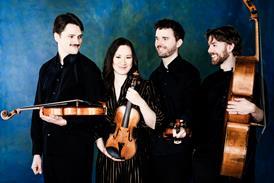
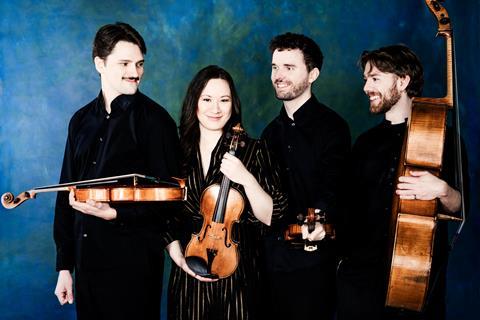
The Norwegian-Swedish string quartet Opus13 has garnered plenty of success over the last two years. 2025 was marked with victories at both the Wigmore Hall and Bordeaux international string quartet competitions. The following year, the ensemble was named BBC New Generation Artists for 2026–28 and received both the prestigious Borletti-Buitoni Trust Award and Sweden’s Sixten Gemzéus Music Award.
It’s no doubt that competition triumphs and accolades are part of the group’s springboard to success. Opus13, comprising Norwegian violinists Sonoko Miriam Welde and Edvard Erdal, Swedish violist Albin Uusijärvi and cellist Daniel Thorell, will perform at prestigious venues and festivals, as well as release its debut album of Mendelssohn and Grieg string quartets on Alpha Classics on 18 September 2026.
The quartet members spoke with The Strad about its recent success and upcoming highlights, as well as the significance of the repertoire on its debut recording.
As winners of numerous competitions, awards and accolades, you are no doubt now very busy as an ensemble. What have been some highlights of your career together as Opus13 so far, and what are some engagements you are looking forward to?
Albin Uusijärvi: We just had a very busy and fun summer with concert tours in Japan, Korea and Canada. One other really important moment for us was recording our first album, which we are very excited about!
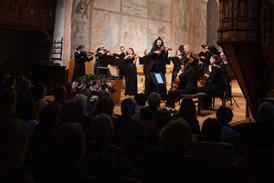
We have a lot of exciting debuts coming up, including Concertgebouw in Amsterdam, Wigmore Hall in London, Laeiszhalle in Hamburg, the quartet series in Oslo and Stockholm and many more.
Tell us about the significance of the repertoire chosen for your debut album. You’ve recorded Mendelssohn’s String Quartet in A minor, op.13, as well as Grieg’s String Quartet no.1 op.27 and a transcription of Solveig’s Song.
Sonoko Miriam Welde: I think ’identity’ is a key word here. Both of these pieces are strongly connected to who we are as a quartet, and I think in their own ways they are also explorations of identity.
Mendelssohn’s A Minor Quartet, op.13, was the first piece we learnt when we formed Opus13 twelve years ago and it was the inspiration for our name. Mendelssohn was 18 years old when he wrote it – a young artist coming into his own, clearly influenced by Beethoven’s legacy and his 16 string quartets, but also incredibly eager to pave his own way and develop his own ideas. Looking back, I think it was a perfect first piece for us. We were all around 18 years old ourselves, idealistic and excited to dive into the great world of string quartets.
The Grieg string quartet was written at a time in Norwegian history when the country was searching for its own national identity, after more than 300 years under Danish rule. The artists of that time were asking the question, ’What does Norway sound like?’ And for us, 150 years later, this is what Norway sounds like. As Norwegians and Swedes, we feel very connected to this piece, with its folk-music and dance-inspired character, as well as the images of nature it evokes.
As Norwegians and Swedes, we feel very connected to Grieg, with its folk-music and dance-inspired character
What does Opus13 bring to the interpretations of the Mendelssohn and Grieg quartets that is unique, and how have your interpretations of these works evolved throughout the years?
Daniel Thorell: It’s of course very difficult to describe, ourselves, what we bring to the interpretation of these quartets but I’d like to think that with a piece like Felix Mendelssohn’s second string quartet, it’s become like a sort of tapestry of ideas and musical memories we’ve had throughout the years.
Since, as Sonoko mentioned, it was the first piece the quartet ever played together, it has also followed and evolved with us. Tempos have changed, colours have shifted and bowings have been rewritten many times.
Sometimes there’s been musical ideas that we get back to a few years down the line, questioning what we were thinking and at other times, some ’forgotten’ ideas might be a wonderful rediscovery. I think that what we’ve ended up with for this recording is a sort of culmination of every time we’ve played this piece.
As for the Grieg, it’s a piece that’s very close to our hearts and that has also been a part of our quartet journey for a long time. It’s music that feels like an encapsulation of Norwegian nature and folklore, which makes it feel easily relatable for us and I think this affects the way we play it. I hope our interpretation on this recording comes across as a story containing all the fjords, mountains, trolls and forests that can be found in Grieg’s music.
Edvard Erdal: I find it difficult to put into words what makes our interpretations of these two pieces unique. Both works have been so important to us, and have naturally evolved throughout our musical journey. Hopefully, they will continue to do so for decades to come. But this recording will forever remain a time capsule of this very important stage in our career and musical lives.
Read: Taking the next step: an interview with Trio Azura
Read: ‘A string quartet is like a family’: catching up with the Katarina Quartet
Discover more Featured Stories like this in The Strad Playing Hub












No comments yet