





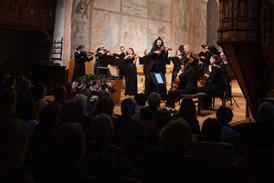



Richard Linnett reports back from Brooklyn Rider’s performance on Sunday 11 January, with a programme that explored ’questions of citizenship and the demands of democracy’

Read more Featured Stories like this in The Strad Playing Hub
You’re at a holiday dinner party and the conversation is agreeable, perhaps even entertaining. Meanwhile, outside in the real world everything is falling apart and everyone knows it. You can’t sit still. You just can’t let it go. You have to say something.
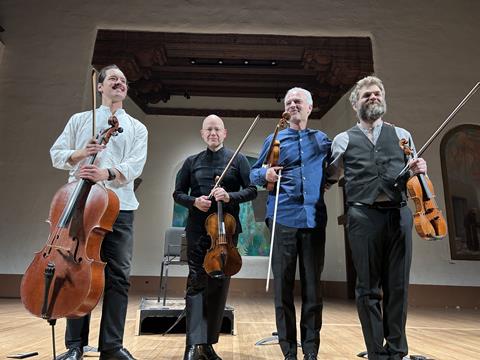
That is what the members of Brooklyn Rider did in their Santa Fe Pro Musica performance on Sunday 11 January. They said something. They spoke out. This extraordinary quartet with a social conscience took the opportunity not just to dazzle their sold-out audience with breathtaking performances of works by Haydn and Beethoven, they also made an urgent statement about contemporary events through new music written for the group.
Prior to the programme, Pro Musica sent an email giving fair warning that this would not be your ordinary classical music event:
’Brooklyn Rider views the string quartet as a microcosm of democracy – a collaboration between equal voices, each with rights and responsibilities. This concert programme titled Citizenship Notes brings this idea to life – from Haydn and Beethoven’s embrace of the ideals of the Age of the Enlightenment, to Colin’s spin on the Bob Dylan civil rights-era classic, and in new works that explore questions of citizenship and the demands of democracy.’
The Brooklynites performed Dylan’s The Times They are A-Changing adapted by Santa Fe Pro Musica’s artistic director and Brooklyn Rider violinist Colin Jacobsen, who introduced the piece by noting that Bob Dylan and Beethoven were ’true revolutionaries in their respective times’. Jacobsen’s version of this folk masterpiece launched with the composer reciting the song’s powerful opening lyrics, and then swung into a soulful and nostalgic arrangement, with a surprising swinging waltz emerging in the middle.
American composer, multi-instrumentalist and Guggenheim Fellow Don Byron was represented by his String Quartet no. 3, which the quartet performed with mind-blowing dynamism, especially the third movement, with all strings wailing in rolling waves like an air-raid siren. It was alarming and hypnotic, you could almost hear the bombs dropping. As violist Nicholas Cords noted in his introduction, the piece was partially influenced by the work of Looney Tunes and Merrie Melodies composer Carl Stalling who pioneered a synchronisation method that precisely timed music to action.
Our Children Speak Spanish and English by Puerto Rican-born composer Angélica Negrón featured pointillist string accompaniment to a recording of what sounded like children babbling. It was intriguing, somewhat incoherent but well-intentioned. The piece was intended to convey the cultural and linguistic tensions between the composer’s native country and the domineering English-speaking US.
Ted Hearne’s We Are Working Tirelessly for a Ceasefire did not follow Byron’s quartet in sequence, but it dovetailed in staggering spirit and total sonic fury. Jacobsen’s brilliant, locomotive buzzsawing on his instrument was a physical marvel to behold, a sort of punk-rock fiddle flaying reminiscent of Johnny Ramone. Hearne, known for his socially engaged compositions, titled the piece referring to Israel’s bombing of Gaza.
Citizenship Notes was bookended by Haydn’s Quartet in F Minor, op. 20, no. 5 and Beethoven’s Quartet in C Major, op. 59, no. 3. In a democratic gesture, Jacobsen stepped back to second fiddle while Johnny Gandelsman took the lead. Both pieces were presented as examples of the egalitarianism inherent in a string quartet, as they showcased each instrument individually contributing to the whole, particularly in the fugal last movement of Beethoven.
And yet it was Gandelsman who was the charismatic leader in these masterworks. With his bushy Hobbit beard and his button-down grey vest ensemble, Gandelsman was the embodiment of a steampunk superstar. He looked rugged and intense and easily capable of crushing his dainty instrument in the palm of one hand. Instead, he played each work with gorgeous delicacy, precision timing and relentless vigor. It was hard to take your eyes off him and cellist Michael Nicolas who, sporting a debonair mustache and pony-tail, traded looks and licks with Gandelsman, matching the beguiling violinist’s elegance and ferocity.
Read: Staying power: US String Quartets
Read more Featured Stories like this in The Strad Playing Hub








No comments yet