








The US violinist and composer discusses his new work inspired by Martin Luther King Jr.’s ‘Mountaintop’ speech
Read more Featured Stories like this in The Strad Playing Hub
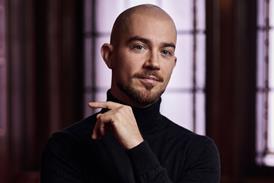
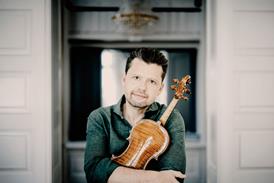
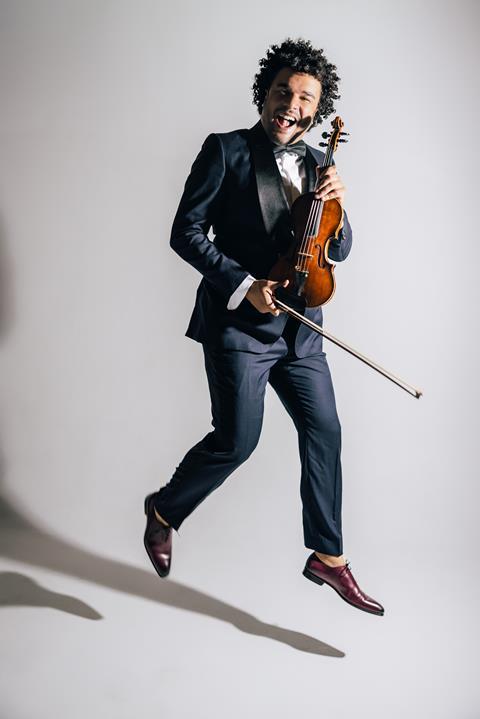
Curtis Stewart embodies a distinctly contemporary vision of the classical violinist today. On stage and off, he operates with a directness that resists polish for its own sake, favouring instead a sense of immediacy and responsibility. As a violinist and composer in equal measure, with education central to his work, he treats classical music as something to be actively made, not simply handed down.
As a violinist, Stewart moves fluently between repertoire, improvisation and newly written music, often blurring the distinction between interpretation and authorship. As a composer, he is drawn to projects that place music in dialogue with lived experience and history, asking performers and listeners to engage attentively.
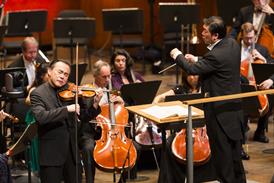
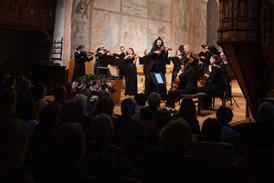
The current season finds Stewart active across a wide range of settings, from solo and chamber performances to large-scale orchestral projects. Among his many projects is the world premiere of I wouldn’t stop there: in the words of a KING, commissioned by the Virginia Symphony Orchestra and conducted by music director Eric Jacobsen on 16 and 17 January in Norfolk and Newport News, in Virginia’s Hampton Roads region.
Written for chorus and chamber orchestra, the piece is inspired by Martin Luther King Jr.’s iconic ‘Mountaintop’ speech, delivered on 3 April 1968, the day before his assassination in Memphis, Tennessee.
Stewart spoke to US correspondent Thomas May about compositional process, the physicality of sound and the responsibilities he associates with making music today.
I wouldn’t stop there: in the words of a KING is inspired by Martin Luther King Jr.’s final speech, a text that carries enormous historical and emotional weight. How did you decide what role the speech itself would play in the piece – and where the music needed to speak independently?
Curtis Stewart: I was very moved by the opening of the speech – imagining speaking to God, and fantasising about various eras of history to live in. King concludes that there is no time like the present, that witnessing the current struggle for freedom is the honour of a lifetime. The musicality of his voice, the rhythmic repetition and inflection of ‘I wouldn’t stop there’, became an earworm for me as I was studying the speech.
Once I paraphrased the speech and had most of the musical material mapped out and orchestrated, based on the intonation and rhythm of his voice, the process of placing the recorded speech became one of energetic storytelling: the music reacting to King’s urgent vocal inflection, then simmering down to let us ponder the energy of his thoughts.
King concludes that there is no time like the present, that witnessing the current struggle for freedom is the honour of a lifetime
In describing the work, you’ve talked about resisting the urge to ‘fast-forward’. How did that idea influence the pacing or shape of the music as it developed?
Curtis Stewart: I analysed the music of Stravinsky, specifically Symphony in Three Movements. Stravinsky has this remarkable way of repeating, iterating, and recombining material to create forward propulsion alongside a sense of ‘stuckness’ – we are held within a clearly defined world of musical objects, trying different permutations of harmony, rhythm and orchestration to break the lock.
The first portion of my work begins as a kind of incantation to the spirit and words of King, starting with a sharp, audible inhale from chorus and orchestra. Once the smoke has settled, the piece shockingly jerks forward and back, using developed material from the opening: different pairings return, slow and fast, like a radio dial gone mad through vague channels of history.
There is a moment of repose reflecting on King’s words as he speaks of a newfound energy. The orchestra then takes off into a huge accelerando, with the tempo doubling several times. The rhythmic material is organised so that, even as the tempo increases, it almost feels as though the beat is slowing down. No matter how fast or hard we push, we return to a sense of trudging.
This build-up crashes back into the opening breath and incantation, repeated with more and more of the ending cut away, until all that remains is the opening breath of the chorus.
The piece brings together chorus, chamber orchestra and recorded speech. What were some of the challenges – musical or otherwise – of weaving these elements into a single expressive world?
Curtis Stewart: I like to treat the voice as a percussive instrument – not like a beatbox, but more like a rap artist – with consonants, intonation, and vowel shapes used almost like two conga drums, decorating and dancing around the pulse of the orchestra.
The challenge here is maintaining simplicity of verbal content and focusing on the musical impulse, without stripping the words of their meaning through too much repetition. The chorus is mostly in vocalise, with the mantras ‘non-violence’ and ‘I wouldn’t stop there’ permeating throughout.
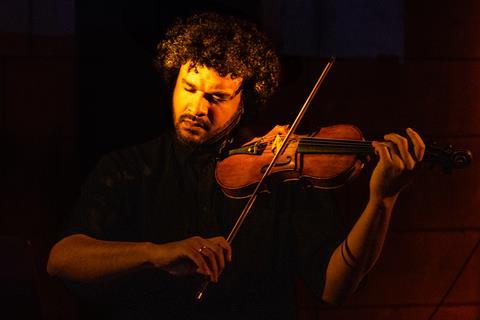
As a violinist as well as a composer, how does your physical relationship to sound – thinking in terms of breath, gesture, and touch – inform the way you write for voices and orchestra?
Curtis Stewart: I feel utterances of consonants, breath, hum, and ringing vowels as rhythmic movement; it all relates to a sense of dance. Sustain can feel natural, like a piano, and any effort required to keep sound alive and ringing reflects the tension and energy behind the music itself.
The chorus and orchestra use gasps, breath, and outbursts to gather that energy, driving it towards the climax of the work.
The premiere is taking place alongside music by Copland and Gershwin, composers often associated with defining an American sound. Did that context affect how you thought about your own piece, or how it might be heard?
Curtis Stewart: This work is lightly influenced by various contemporary musics, much as Copland and Gershwin were in their time. That is my general mode of composition, so I hope this piece feels like a continuation of that American tradition of engaging with the dance of our times – hip hop, R&B, funk, and house electronica included.
If those influences are audible – which they are not necessarily meant to be – I hope they are heard simply as the music of America. It is certainly the music of my own upbringing as an American.
What do you hope stays with the audience after hearing this piece?
Curtis Stewart: My intent is to instil a sense of hope and togetherness by the end of the work. There is so much happening in our world that is difficult for so many, and it is easy to feel like giving up – on dreams, on visions of what our world could be – in our personal lives, in our work, as artists, or as citizens.
I hope the music ignites curiosity about the intent of King’s words in 1968, and sparks the sense that we have been here before, and will be again and again. The struggles of our time are ours to own and accept – an honour to witness as much as a burden to bear. The fact that we see them and engage with them is what gives the world meaning, especially in the hardest moments.












No comments yet