



![Ayanna Witter-Johnson [Jordan Woods] 7](https://dnan0fzjxntrj.cloudfront.net/Pictures/274x183/4/9/4/44494_ayannawitterjohnsonjordanwoods7_224583.jpg)








The ensemble’s new album pays homage to its Bavarian roots and the lasting influence of Alpine folk music on Viennese Classical Music
Read more Featured Stories like this in The Strad Playing Hub
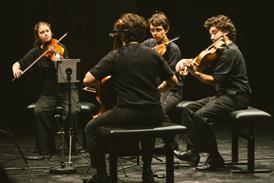
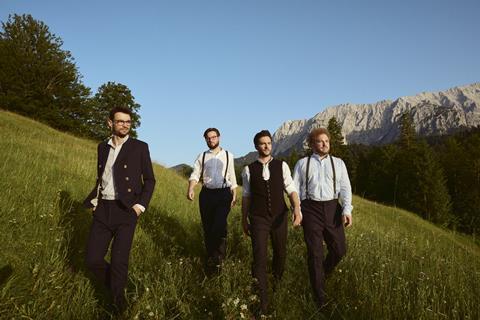
The Goldmund Quartet, comprising violinists Florian Schötz and Pinchas Adt, violist Christoph Vandory and cellist Raphael Paratore, will release its seventh and most personal album to date, Dahoam, on 19 September 2025. Dahoam translates to ‘at home’ from Bavarian, and provides the theme upon which the quartet reflects and explores through repertoire by Haydn, Mozart and Schubert.
Additionally, the quartet has also recorded original Bavarian and Alpine folk music works that have stayed with the members since childhood. This can be seen in Nobert Gäller’s Böhmischer Traum (’Bohemian Dream), a piece familiar to Munich residents that cellist Paratore describes thus:
’You sit in a full beer tent again for the first time after a year’s break, and then the ”Bohemian Dream” starts playing. And it’s clear: it’s Oktoberfest again! It’s like coming home to music: familiar, exuberant, full of joie de vivre. This is exactly the feeling we wanted to capture on the album.’
The Goldmund Quartet spoke to The Strad about the ideas behind its latest album.
The album’s name literally translates to ‘at home’ and all four members of the quartet have known each other since childhood. Can you outline how you all met, and how music played a part in this?
We’ve known each other since our teenage years. Three of us – Florian, Christoph and Raphael – went to the same high school in Munich, where we first founded what we like to call our ’classical high school band,’ the Goldmund Quartet.
We met Pinchas at the pre-college programme of the Munich Conservatory. From the very beginning, it was clear that playing in a string quartet was our shared passion, and it was really friendship and music that brought us together.
Can you explain how the music you’ve chosen reflects ‘home’ for you? What’s the typical sound of home, musically?
Growing up in Munich also means being surrounded by Bavarian folk music. It’s the sound you hear everywhere – in beer gardens, at the traditional Wirtshäuser (taverns) throughout the city and countryside, and of course during big celebrations like Oktoberfest.
For us, that sound is inseparably linked with a sense of belonging, community and warmth. It was natural to let these influences find their way into our album Dahoam (’Home’), where folk and classical traditions coexist and enrich one another.
Tell us a bit about the folk influences in the music.
Classical music has deep roots in Alpine folk traditions – the connection is unmistakable. When you listen to a minuet by Haydn or a Ländler by Schubert, you can hear the echoes of village dances and songs.
We truly believe that understanding the folk idiom of the time period helps to unlock the musical language of these composers. From Mozart to Mahler, traces of folk music are everywhere, and what makes this music so special is its directness: it communicates in the most natural, human way.
Famously, the group plays the Stradivari ‘Paganini’ quartet of instruments. How do the instruments lend themselves to playing different styles, from folk to conventional classical music?
The Stradivari instruments are astonishingly versatile. While they are icons of the classical repertoire, we found that they also respond beautifully to folk-inspired styles. By experimenting with colours and techniques that recall traditional instruments like the harmonica, guitar, zither or double bass, we discovered that the quartet could embody an entire spectrum of sound.
These instruments give us the freedom to cross stylistic borders without ever losing richness or authenticity.
Dahoam is released on 19 September 2025.
Read: The Goldmund Quartet on Schubert’s ‘Death and the Maiden’, and playing a set of Strads
Read: From carrier bag to concert hall: how I rescued Dorothy Howell’s lost string quartet
Read more Featured Stories like this in The Strad Playing Hub



![Ayanna Witter-Johnson [Jordan Woods] 7](https://dnan0fzjxntrj.cloudfront.net/Pictures/100x67/4/9/4/44494_ayannawitterjohnsonjordanwoods7_224583.jpg)






No comments yet