












On the eve of their Lucerne Festival debut, Sarah Ying Ma and Drew Dansby of the Banff-winning American Poiesis Quartet talk about a changing line-up, an expanding repertoire and the ideas shaping the ensemble’s next chapter.

Read more Featured Stories like this in The Strad Playing Hub
Formed at Oberlin in 2022 by violinists Sarah Ying Ma and Max Ball, violist Jasper de Boor and cellist Drew Dansby, the Poiesis Quartet has packed a great deal into four years. In 2025 the ensemble won First Prize and the Commission Prize at the Banff International String Quartet Competition, following its 2023 Fischoff Grand Prize; this year it received the Cleveland Quartet Award.
The quartet has also undergone its first change of personnel, with violinist Coco Mi joining Ma, de Boor and Dansby in June in place of Ball. All four musicians are still in their early-to-mid twenties and this autumn will join the Nina von Maltzahn String Quartet Program at the Curtis Institute of Music, where they will work closely with the Dover Quartet.
Poiesis’s second album, Surfacing, will be released by Bright Shiny Things on 16 October. Recorded with Ball, it looks back over the quartet’s development through music that has become part of its own history: Coleridge-Taylor Perkinson’s Calvary, the first work the original line-up played together, and Kevin Lau’s Surfacing, their first commission, alongside pieces by Brian Raphael Nabors and Sky Macklay. The new line-up is already due to make its first recording together in December.
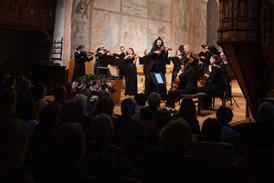
On 10 September, Poiesis made its Lucerne Festival debut at the Lukaskirche, the early-Modernist church that serves as the venue for the Festival’s Debut series. Its architects, Alfred Möri and Karl-Friedrich Krebs, had previously designed Villa Senar, Rachmaninoff’s home on Lake Lucerne – a neat musical connection.
Poiesis brought a small trove of American discoveries, in keeping with this summer’s Lucerne Festival theme, ‘American Dreams’: Jerod Impichchaachaaha’ Tate’s Pisachi: Six Epitomes for String Quartet and Perkinson’s Calvary, alongside the Ravel String Quartet. Tate and Perkinson are already central to Poiesis’s repertoire; the Ravel, by contrast, was receiving its first performance by Poiesis. The enthusiastically received programme was full of personality.
The previous afternoon, within hours of arriving in Europe to begin a tour through Switzerland, Germany and Hungary, Ma and Dansby spoke to US correspondent Thomas May about the quartet’s changing line-up, its approach to repertoire and the identity Poiesis is continuing to shape.
This is an interesting moment for Poiesis. Does it feel like a new chapter for the quartet?
Sarah Ying Ma: It does. This is our first European tour with Coco, as well as our Swiss and Hungarian debuts. At the same time, Surfacing, which comes out in October, represents the last phase of the quartet with Max, while we’re already recording another album with Coco in December. So there’s this overlap between one phase closing and another opening.
Drew Dansby: We’ve also had six new commissions since the last time we were in Europe, and they’ll all receive their European premieres on this tour.
Sarah, you came up with the name Poiesis. What did the idea mean to you originally?
Ma: I encountered poiesis while I was studying at Juilliard and taking a course at Columbia. We looked at it almost as a social philosophy – the idea of people or cultural groups who have traditionally been excluded creating a new beginning or a new sense of belonging for themselves.
When I got to Oberlin and we needed a quartet name, nobody could come up with anything, and Poiesis was simply at the tip of my tongue. We weren’t particularly serious about the group then. But as we continued and realised this was going to become a career, the name and the mission grew into one another.
Creation for us became connected with challenge and resistance: introducing repertoire that isn’t traditional in the Western European classical sense, commissioning new work and exploring other musical practices. The string quartet can create almost any sound you want it to, so we feel creatively obligated to look towards different forms of repertoire and different musical practices around the world. We also care deeply about community outreach and education with the next generation.
Queer identity is part of Poiesis. How do you embrace that without allowing ‘queer quartet’ to become simply a marketing category?
Ma: It’s tricky, because we weren’t the ones who first proclaimed ourselves a queer ensemble. That label was placed on us – not in an unwelcome way – but we didn’t really claim it until we realised that it was definitively part of who we were.
Being queer does affect our performance practice and ethos, making it more fluid and non-traditional. Representation and creating opportunities for marginalised and queer musicians are important to us. But I think it’s less about being a ‘queer ensemble’ than about being human-oriented.
Queer culture has historically had to think outside the box in order to survive, find community and create opportunities, and that absolutely influences our programming. We’re interested in bending tradition and taking existing forms and moulding them into something unexpected – rather like drag. Sky Macklay’s Many Many Cadences is a good example. [Included on the new album, the piece turns the familiar tonal cadence into a kind of comic excess, firing off hundreds of them in quick succession.] It isn’t explicitly about queerness, but we were drawn to its play and humour, and to the way it challenges assumptions embedded in Western tonality.
Perkinson’s Calvary was the first piece you ever read together. Was there something in that first encounter that made you realise there might actually be a quartet here?
Dansby: We also improvised together that day, and I think that unlocked a new way of communicating through our instruments. There was something very flexible but also very committed about the way we played together. That suited Perkinson because you have to balance the Black musical traditions inherent in the work with what our instruments can do. We seemed to have an ear for that, and the piece spoke to all of us individually as well as to the group.

The album also includes Max Ball’s arrangement of the spiritual Calvary for four violins. Where did that idea come from?
Ma: Drew and Jasper both play violin, so when we were putting together a programme for Concert Artists Guild, we wanted something that could show that range. Max arranged the spiritual for four violins, and it also played into this multi-instrumental approach that feels inherent to a lot of the traditions we work with. There’s a dramatic element too – when the bass suddenly drops in after that four-violin texture.
And what changes with Coco now in the quartet?
Ma: It’s completely different. Coco is a stabilising force – almost a navigator. She takes everybody’s personalities and finds a balance.
That comes through in Perkinson: she grounds the ensemble very strongly. Previously, we sometimes just felt things by ear and swung however we wanted to, perhaps to a fault. I think every healthy four-way relationship – or quartet – should have opposing voices; all four of us should be in dissent at some point. But Coco is very much the consolidator.
What makes something feel like a ‘Poiesis piece’?
Dansby: We increasingly think in terms of holistic programmes – putting commissions in conversation with standard or contemporary repertoire.
The music we play also tends to give a lot of individuality to the four parts. The textures make us reckon with how everybody can be heard without overpowering anyone else – how the voices can come together but also conflict a little.
Ma: Storytelling is important too. Our programmes usually have a central theme or story, and when we choose composers to work with, we’re attracted to people who have a unique story to tell.
Young quartets are often expected to build their repertoire around the familiar canon and branch out from there. Poiesis seems almost to have done the reverse, with Tate and Perkinson becoming core repertoire before Ravel. Does that change the way you hear the canon?
Ma: Definitely. We’ve always chosen repertoire through instinct rather than expectation. Our first major piece was Bartók Five, and the next was Brahms Three – even though our teachers told us the Brahms was too difficult for us at that stage.
So taking on Ravel and late Beethoven now is almost more rewarding because we don’t know them as intimately as many quartets do. We haven’t studied as much canonical repertoire as a lot of other quartets, so Ravel can almost feel like new music to me.
And Tate actually informs the Ravel. I knew there was an element of Impressionism in Pisachi, but when we began working on Ravel I found even more crossover than I expected: not only harmonically, but technically – in the strokes and in the way Tate uses techniques that Ravel solidified to create a different kind of sound, rhythm and tonality in Native American folk music. When we began the Ravel finale, Coco immediately said, ‘We’re going to be great at this two-plus-three rhythm because we’ve been playing the Tate.’
Surfacing is almost a musical autobiography, stretching from the first work you played together to your first commission. What does the album tell you about how Poiesis has developed?
Dansby: It gave us an opportunity to define what our voice is as an ensemble. We’re lucky already to have something like our own canon of repertoire.
Ma: It’s almost a research timeline for the quartet. Learning how to collaborate with composers took time: how to talk with them about the influences behind their music, research those traditions ourselves and bring them into our playing.
Kevin Lau, for example, brings Celtic fiddling, heavy metal and Baroque influences into his music. That required us to listen seriously to those traditions and work out how their sounds could enter ours.
These pieces helped establish our methodology. Macklay gave us harmony, Nabors gave us rhythm, and Perkinson gave us groove and improvisation – three pillars, in a way, of modern music.
Dansby: We’ve talked about it as flipping the script: using new music as the reference point for older music, rather than always using old music as the reference point for the new. Because of the work of so many groups before us, the whole idea of string quartet technique is changing.
You’ve developed a socially engaged identity in the US. Does it feel different bringing that to Europe at a moment when America is being viewed through an increasingly polarised political lens?
Ma: I feel very much like a visitor. We’re here to share what’s powerful for us and what we believe draws people in within our communities in the US. Europe struggles with many of the same issues, but our histories are different, so naturally the ways we respond have to be different.
There’s a lot of ground to be shared between us as people, rather than necessarily as nations – how we collaborate with one another, how we bridge divides, how we share cultures across borders. This idea of music as a universal language can really only exist if we commit to that in a material, consequential way.
Dansby: We’re not really trying to represent a particular national identity or movement. We’re interested in reflecting and contributing to people-driven movements that are already happening, regardless of who happens to have power at any given time.
It’s important that our performances aren’t just something we’ve created and imported over here, but something responsive and in dialogue with people here.










No comments yet