
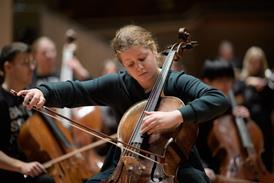
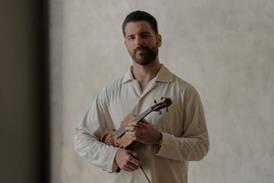
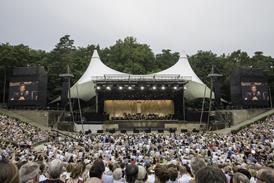
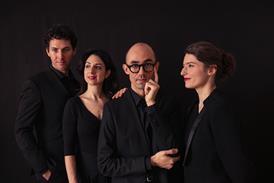






The cellist speaks about the contrasting cello concertos by Saint-Saëns and Lalo, as well as recording the works with period instrument ensemble, Les Siecles
Read more Featured Stories like this in The Strad Playing Hub
Cellists and audiences are no strangers to Saint-Saëns’s Cello Concerto no.1, one of the most popular pieces of concerto repertoire for the instrument, as well as one of the first concertos young players embark upon.
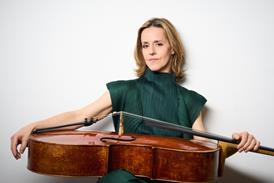
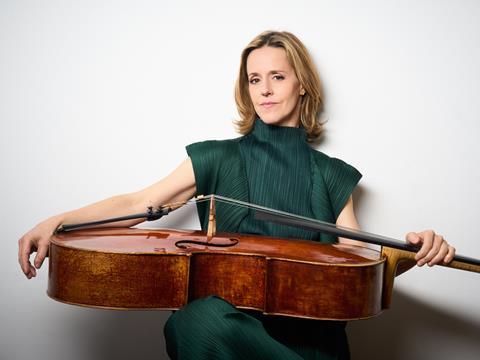
Pairing the familiar concerto with the less familiar Saint-Saëns Cello Concerto no.2 by is cellist Sol Gabetta, who releases her album of the works along with Lalo’s Cello Concerto, accompanied by Les Siècles and conductor François-Xavier Roth.
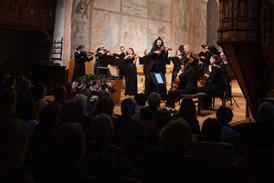
The French orchestra performs on period instruments, lending a historically informed orchestral sound to Gabetta’s solo voice. Saint-Saëns’ Concerto no.1 and Lalo’s Concerto, composed within a span of just a few years, both place a strong emphasis on the orchestra, creating a dynamic dialogue between soloist and ensemble.
By contrast, Saint-Saëns’ Concerto no.2, written three decades later, emerges as a highly virtuosic and structurally expansive work that demands exceptional technical and expressive range from the soloist.
Gabetta spoke with The Strad about her personal experience with the works, Saint-Saëns’s musical style across the two concertos, as well as recording with Les Siècles.
The first Saint-Saëns concerto is often played by cellists in their youth, often one of the first ‘proper’ concertos a young player will perform – when did you first encounter it?
I was only eleven when I first played Cello Concerto no.1 with orchestra; my preparation for it was so intense that I could practically sing along to all the solo melodic themes from the orchestra while I was playing – I knew every detail of the score.
This was a lesson for life: as a soloist, the more precisely you know the score, the more freely you can move and develop your solo part; genuine musical interaction only arises when you know exactly what role each musician plays in the pieces you are performing.
Haydn’s C major Cello Concerto is also one of the best concertos to play with an orchestra when you’re starting out. These works aren’t too long; both are very classical in form, yet they contain everything you need: technical passages requiring virtuosity, as well as melodies that allow you to develop your musicality.
The second Saint-Saëns concerto is played and recorded far less. Why do you think this is?
Because, as is always the case in life, someone is bound to stand out most of the time; comparisons are immediately drawn, and comparing is not a good thing, but from my point of view there is a deeper reason behind it.
There are 30 years between the two cello concertos. The second concerto is just as short in duration, but it is a concerto with even greater technical difficulty and is far more complex to understand in terms of its form. While Concerto no.1 follows a purely classical A-B-A form, the second one does not at all. It has only two movements instead of three and is written almost as if the cellist were an opera singer, with certain cadences that feel like recitatives.
It requires a great deal of technical, mental and creative agility to give this concerto an interesting form, and on that point, it is a gem in my view.
Do you think the composer has a particular ‘fingerprint’ or style that brings these two concertos together?
A composer always has that, it’s just that a human being evolves – and thankfully! – meaning that in each composer’s work you can find similarities between the pieces, generally speaking, provided the time span between one composition and the next isn’t too great (because sometimes there can be very radical changes in a composer’s style).
I’d say that Saint-Saëns has a great sense of melody and freshness, and a certain youthful quality that gives his work that very pleasant and consistently warm touch – a certain sweetness in his writing, despite his always well-defined musical strength.
What’s more, both concertos are extremely well written for the instrument; everything sounds effortless despite the difficulty!
Tell us why you’ve recorded the Saint-Saëns concertos along with the Lalo concerto – again, another work which is not performed as often as other cello concertos
These concertos have held a particularly special place in my heart and in my musical life in recent years. I’d been wanting to record them for a long time, but quite honestly I was looking for an orchestra and a conductor willing to bring to them the freshness and affection they deserve.
That structural clarity, from my point of view, wasn’t so easy to find with modern orchestras (not because the standard isn’t high – it’s excellent everywhere at the moment!) but because I needed to discover this repertoire from a different perspective.
With Les Siecles, which plays on gut strings, the search for the right sound and articulation proved to be truly unique, expressive and very much in line with what I was seeking as a new musical perspective on the Romantic repertoire.
Until now, I’d only recorded with coated gut strings with Bertrand Chamayou, but never with an orchestra. In other words, this wonderful experience was a first for me.
Sol Gabetta & Les Siècles: Saint-Saens & Lalo: Cello Concertos is released on 18 September 2026 on Sony Classical.
Read: Schumann’s Violin Concerto and the violinists who decided its fate
Read: Explorations of identity: what does the music of Mendelssohn and Grieg mean to Opus13?
Read more Featured Stories like this in The Strad Playing Hub










No comments yet