









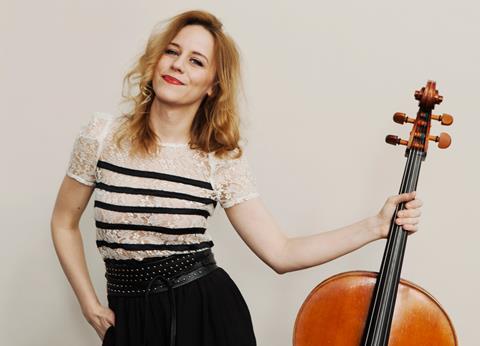
Learning Saint-Saëns’s Cello Concerto no.1 was a formative experience for the Serbian cellist, and the piece has been a mainstay of her repertoire ever since
Discover more Featured Stories like this in The Strad Playing Hub.
Read more premium content for subscribers here
Saint-Saëns’s Cello Concerto no.1 is the piece I’ve performed the most times by far. It’s accompanied me everywhere I’ve been, and it always gets a great reaction. It has everything: a stormy beginning with the cello plunged right into the thick of the action, then a beautiful second movement with its balletic minuetto, followed by a melancholic but very fiery third movement that ends with one of my favourite musical moments: after a very virtuosic passage, it’s as if you’re on top of a mountain and singing with a sense of flight.
It’s funny that audience members come to me afterwards and say that it’s an underrated concerto, because we all learn it when we’re young, but in fact it’s a very demanding piece. Sometimes even conductors will suggest that it’s ‘easy’, but it really isn’t: the soloist’s fingers are moving all the time. It’s also difficult to strike the right balance when it comes to, for instance, finding an elegant vibrato.
I first started learning the concerto when I was around eleven years old. I remember that all the young players in our little orchestra were learning it at the same time, and we were competing against each other to see who’d be the first to nail the double-stops in the first movement! My teacher at the time, Nada Jovanovic, had been a student of French cello teachers, which drew me to the French school of playing and prompted me to attend the Conservatoire de Paris later on. She encouraged me to sing every piece out loud – even when she was driving me to competitions, she’d get me to sing what I was practising at the time. I found it incredibly annoying and embarrassing when I had to sing in front of my parents and classmates, but I’m really grateful for that experience. Not only is it good for memorisation, but it also made me feel as if the piece was a part of me.
I studied with Michel Strauss in Paris, who never asked me for the Saint-Saëns but taught me a lot about rhetorical playing: how to tell a story through the cello, how to be free to use rubato within the structure of the piece, and that there are no limits to one’s imagination. The Saint-Saëns is one of the first concertos that a young cellist encounters that requires this kind of freedom as well as virtuosity in performance, so I think my time with him really helped me understand the piece despite not playing it for him.
In 2023 I performed at a New Year’s Day concert with the Serbian Radio Symphony Orchestra under Bojan Suđić. A few days later, Bojan phoned me to say that they’d been due to record an album with a singer, but that he’d fallen ill, and would I like to record something with them? So of course I suggested the Saint-Saëns, and paired it with Lalo’s Cello Concerto. I practised both like crazy, had one day of rehearsal and then we recorded the album over four sessions.
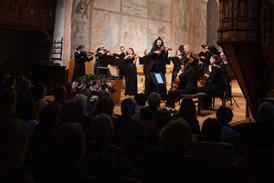
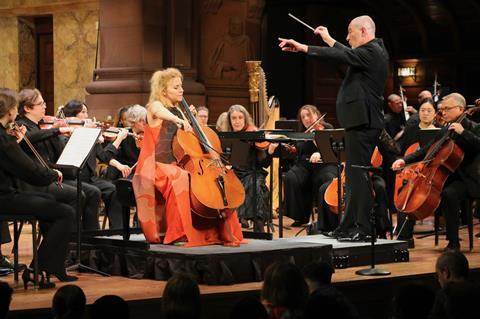
Another very special moment came last year when I rehearsed and played with a youth orchestra at the Stellenbosch International Chamber Music Festival in South Africa. It was made up of kids from all kinds of backgrounds, from townships to richer families. There were over a hundred people on stage in total, all hungry to learn and practising so hard throughout the week under conductor Michael Repper. The atmosphere was electric, almost like being in a football stadium, with everyone so energised – an experience I’ve never had anywhere else.
INTERVIEW BY CHRISTIAN LLOYD










No comments yet