















Andrew Dipper reads through a comprehensive survey of more than 250 US instrument makers from the past 200 years
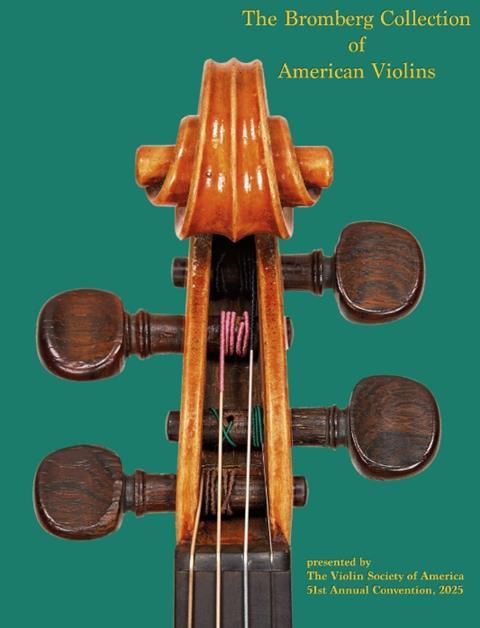
The Bromberg Collection of American Violins
David Bromberg, Bruce Babbitt, Richard Dodson, Brandon Godman
273PP ISBN 9798218824778
VIOLIN SOCIETY OF AMERICA $175
This new hardback book features 260 colour plates of American-made violins by 253 makers, with annotations on each maker based on discussions with the collector David Bromberg. These annotations are based on his lifetime of collecting and on his knowledge of American violins made between 1840 and 1950. The book was formally presented to the public during the 51st annual convention of the Violin Society of America held in Minneapolis in November 2025.
It begins with a detailed index of the illustrated instruments. Colin Maki adds a brief note, while Bromberg writes an engaging foreword that shares his motivation and the process behind collecting. Following this are short introductions that give context about the artistic value and historical significance of the examples.
David Bromberg is a working musician who developed connections in the violin trade during his travels. He was eager to learn about the instruments and their significance through the relationships he made in the places where he performed. The collection mirrors his personality, and viewing the book from his perspective offers valuable insights. It is restricted – owing to reasons outlined in the introduction – to violins made between 1840 and 1950.
The violin illustrations in the book are alphabetically arranged by maker, making it a practical resource for identifying and authenticating instruments, though it resembles a dictionary in style. It also traces influences among makers and shows how European immigrant artisans in various US states, each with their own cultural and musical backgrounds, introduced new ideas into the trade.
The varnishes showcased in the illustrations are especially revealing in this regard, spanning from expert craftsmanship to passionate failure in attempts to master this challenging aspect of violin making. Additionally, the book examines the work of copyists and design-focused craftsmen during the crucial years of American violin making between the two world wars.
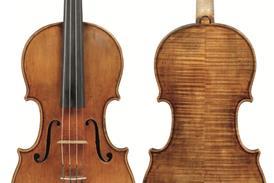
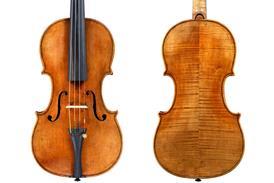
Violin makers who can read, identify and distinguish the details in the many fine full-page colour illustrations of the violins in this collection will find the diverse examples highly engaging, as they often include images of original labels. The notes on the violins resemble memes, typically brief captions under the three-view illustrations of scroll, front and back, but these annotations were made from Bromberg’s memory and are therefore especially valuable.
On page eight, a short reading list is provided to help those interested in, fascinated by, or otherwise involved in exploring the sociology and art of the American violin to deepen their understanding. The illustrations are consistently of high quality, despite being created by at least four different photographers under various lighting conditions – an impressive achievement for the publishers, the VSA and the printer Friesens of Manitoba, Canada.
The Library of Congress was unable to house the Bromberg collection when it was offered to them. In years to come, this will be lamented as a loss to US cultural memory, since this collection was a vital and ephemeral part of America’s social history. In this regard the book’s importance is perhaps best exemplified by its illustration of the printed label on a beautiful 1905 violin by A.W. Kaufmann from San Jose, California, which reads, ‘Made from the body of a daughter of the forest and given voice by the hands of a son of the Mother [the US], whose praises I shall ever sing.’
Although the brevity of the makers’ stories is a limitation, expanding them would have made publication impossible, given the vast scope of the topic. For those interested in the sociology of violin collecting, the book bridges the gap between the violin collector and the collection, highlighting the connection between a musician’s passion for public performance and the tools that enable it.
The book’s neatly curated selection of examples makes it especially valuable to collectors. To non-experts, a collection of this magnitude might be dismissed with the usual off-the-cuff comment ‘seen one violin, seen them all’, but fortunately, this sturdy hardcover volume, with detailed illustrations and a durable folio binding, gives a detailed record of the now-dispersed collection for future generations.
Andrew Dipper
Read: David Bromberg American Violin Collection faces being broken up
Read: US Library of Congress to buy David Bromberg’s collection of over 250 American violins










No comments yet